
Planning on being outdoors a lot this summer? We love time spent outdoors too, and expect to return home from picnics, hikes, and camping tanned and happy, but also healthy. One concern is Lyme disease, which is carried by deer ticks that infest grassy and wooded areas. Here’s what you need to know about Lyme disease, prevention, and treatment.
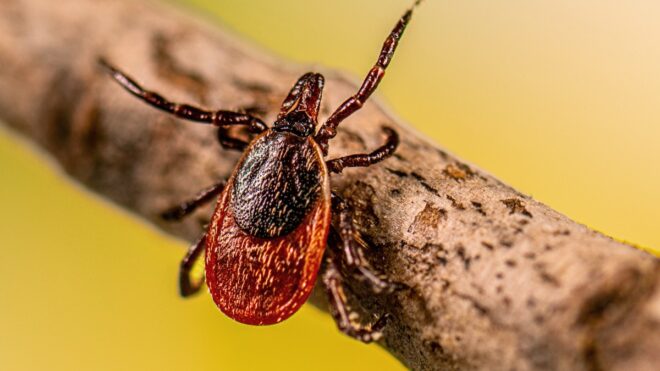
Humans usually get Lyme disease from the bite of a tick carrying the borrelia bacteria. A tick feeds on the host’s blood by attaching itself to their skin, and continues to feed until it’s swollen to many times its normal size. In the process it transmits the bacteria to the host’s bloodstream. Deer ticks may continue feeding on a host’s blood for several days. They exist in every American state, although mostly in upper Midwest and the northeastern and mid-Atlantic states.
Deer ticks are also found in south central and southeastern Canada, and in Europe. They’re common in grassy, brushy, or wooded areas. Don’t believe it when someone tells you there are no ticks in the area where you plan to hike or picnic. Go out in nature, by all means, but take some intelligent precautions, as we outline below.
Seasons don’t matter to deer ticks. They’re active at all times of the year except when temperatures go below freezing. People bundled up for winter weather aren’t as vulnerable to tick bites as in summer, simply because they’re exposing little skin to the hungry tick.
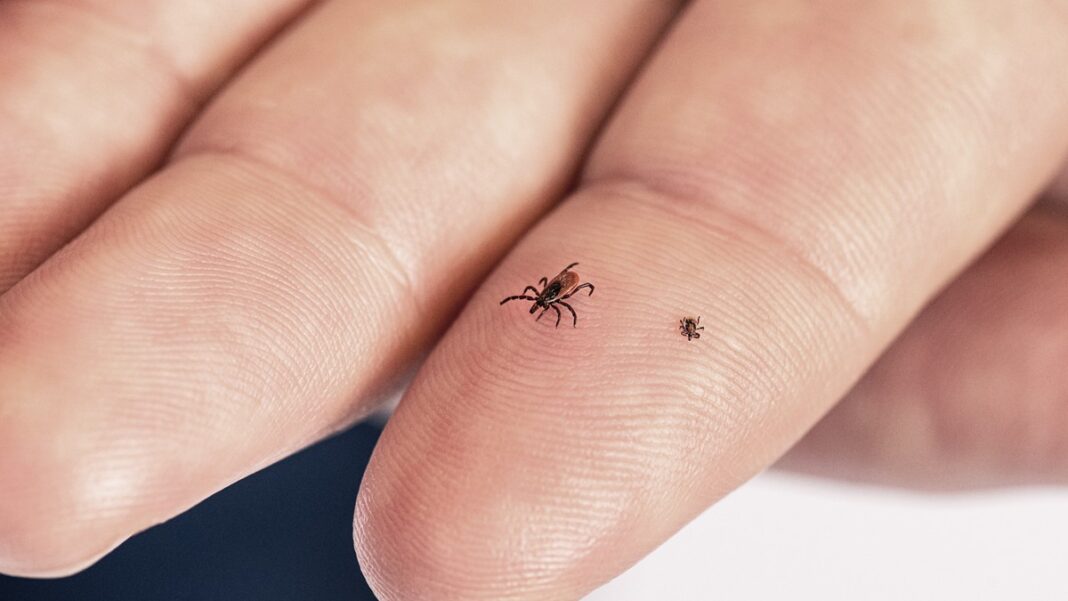
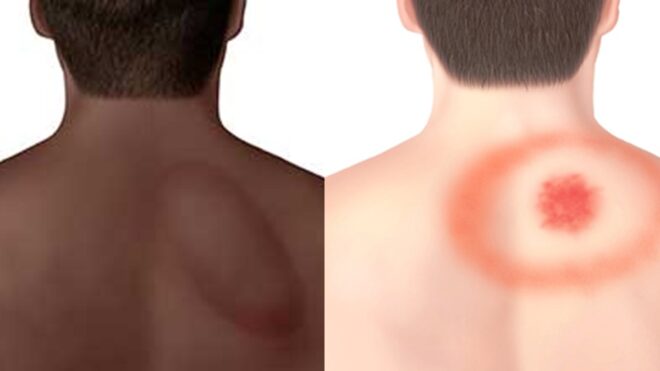
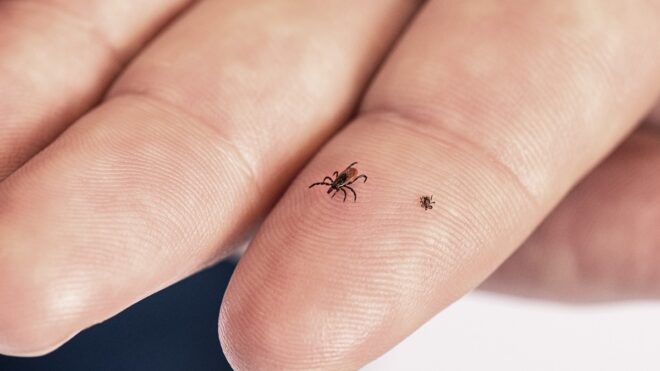
A young tick be as tiny as a poppy seed. Its bite may look as harmless as a mosquito bite. Most people aren’t aware they’ve been bitten for a few days, or until the famous bullseye rash appears, usually between 3-30 days after the bite.The bullseye sign looks like a circle that slowly spreads from the site of the tick bite, clear in the center and looking like a target or bull’s-eye. It may feel warm, but it’s usually not painful or itchy.
On the right, a person with the bullseye rash. On the left, a person with no bullseye but swelling at the site of the tick bite.
A dead give-away is finding the tick on your body. It must be removed as soon as you discover it.
Here is advice from a veteran Canadian outdoorsman who’s dealt with deer ticks for many years:
“First, forget whatever your uncle told you. No matches. No nail polish. No Vaseline. No soap on a cotton ball. All of those do the same terrible thing, they stress the tick out, and a stressed tick empties its gut back into the bite before letting go, which is how Lyme is transmitted.
“Use fine-tipped tweezers. Grip right where the mouthparts enter the skin: not the body – the head. Pull straight up, steady, no twisting, no jerking. It’ll feel like it’s resisting because it is, the tick’s mouth parts are barbed. Just keep the pressure on and it will let go in a few seconds. If a piece breaks off in the skin, leave it alone. Your body pushes splinters out. Digging around with a needle does more damage than the fragment ever would.”
We note: tick removal tools are available for order online and at pharmacies. Here’s a list of the 10 best tick removal tools from Medical News Today. However, the Centers for Disease Control and Prevention (CDC) indicate that fine-tipped tweezers work as well.
“Clean it with alcohol or soap. Wash your hands. Now here’s the part most people skip: don’t flush the tick.
“Tape the tick to an index card with clear packing tape. Write the date and where on your body it was found, and put the card away. If you start feeling symptoms over next 30 days – rash, fever, joint pain, a feeling like flu – show the card with the tick taped to it to the doctor.
“Some labs will test the tick itself, which is faster and often more reliable than waiting for antibodies to show up in your own blood. A dated tick taped to a card is one of the most useful things you can hand a doctor who’s trying to figure out what’s wrong with you.
“If the tick was engorged when you pulled it, and you can’t swear it was off your body within 24 hours, call your doctor that same day. Don’t wait for a rash or other symptoms. Fewer than three out of four Lyme cases even produce the classic bullseye. A single preventive dose of doxycycline within 72 hours of a deer tick bite cuts the Lyme odds way down.
Most doctors in tick country will write that prescription immediately, especially if s/he’s seen the tick taped to a card and a clear timeline.”
Note: never crush a tick in your fingers.
According to the CDC, most cases of Lyme disease can be treated with 10-14 days of antibiotics. People treated with appropriate antibiotics in the early stages of Lyme disease usually recover rapidly and completely.
In all cases of a tick bite, pay attention to the symptoms that foretell stage one of Lyme disease. If you note even one after being bitten, see your healthcare professional as soon as possible.
Fever
Headache
Extreme tiredness
Joint stiffness
Muscle aches and pains
Swollen lymph nodes
Do not accept a doctor’s casual dismissal if you feel symptoms after a tick bite. Insist on testing and a prescription for antibiotics. And here’s how to recover gut health after the antibiotic round.
Stage two may include the above symptoms plus the following:
Many rashes on other parts of the body.
Neck pain or stiffness.
Muscle weakness on one or both sides of the face.
Immune-system activity in heart tissue that causes irregular heartbeats.
Pain that starts from the back and hips and spreads to the legs.
Pain, numbness or weakness in the hands or feet.
Painful swelling in tissues of the eye or eyelid.
Immune-system activity in eye nerves that causes pain or vision loss.
In the third stage, you may have symptoms from the earlier stages and other symptoms.
In the United States, the most common condition of this stage is arthritis in large joints, particularly the knees. Pain, swelling or stiffness may last for a long time. Or the symptoms may come and go. Stage three symptoms usually begin 2 to 12 months after a tick bite.
Lyme disease can get nasty, and it can last for years. Author Amy Tan suffers from Lyme, and you can read about her horrific experience, including being told that her suffering was all in her head, on her website.
How to prevent a tick bite
Before you go out, spray your outdoor clothing, shoes, tent and other camping gear with a repellent that has 0.5% permethrin. Some gear and clothing may be pre-treated with permethrin.
Use an insect repellent registered with the Environmental Protection Agency on any exposed skin, except your face. These include repellents that contain DEET, picaridin, IR3535, oil of lemon eucalyptus (OLE), para-menthane-diol (PMD) or 2-undecanone.
Do not use products with OLE or PMD on children under age 3.
Dress appropriately for a walk in the woods or fields.
Ticks often attach themselves to an unprotected person’s shins and feet, then crawl up to find a place to fasten on for a bite. Don’t give them a chance: wear long-sleeved shirts closed at the cuffs, and tuck the shirt into your pants. Wear closed shoes, long socks, and pants tucked into your socks. Think in terms of dressing downwards: shirt tucked into pants, pants tucked into socks.
Wear light-colored clothes that allow you to easily spot a tick on them.
Stay on clear paths in wooded and grassy areas if you can. Brushing against tree branches, grasses and bushes increases the chances of a tick dropping on you.
On returning home, shower as soon as you can, to wash off any loose ticks. Check yourself all over, using a mirror if needed. Vulnerable areas are underarms, the hairline and scalp; the ears, waist, and inner thigh, behind the knees, and inside the navel.
Before you wash the clothes you wore outdoors, put them in the dryer on hot for at least 10 minutes. This will kill stray ticks.
Check pets that spend time outdoors, every day. Check your kids too.
Have a happy, healthy summer!