

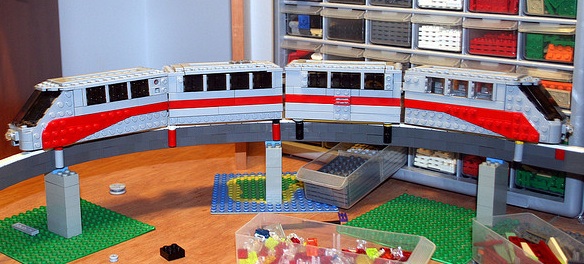
Keeping Public Trains on Track

trains track legoA new research project aims to create an early warning system to save lives of people who take the train.

Trains are one of favourite means of public transportation. See how Europe does it. Trains are fast, affordable and in the right country, they run on time. But as new tracks are laid down, new hazards emerge. A new research project looks to predict future disasters so that trains will continue to rule the public transportation track.

Thousands of people around the world have died in train wrecks caused by natural disasters. In 2004, the tsunami in Southeast Asia derailed a Sri Lankan train, killing 1,700 people. But with modern advances, these tragedies can be avoided — and a Tel Aviv University researcher, working in collaboration with teams from seven countries, is leading the way.

Prof. Lev V. Eppelbaum of Tel Aviv University’s Department of Geophysics & Planetary Sciences and his colleagues are collecting high-tech sensing data from satellites, airplanes, magnetic and soil sensors, and unmanned aircraft to devise a solution that will provide a reliable early-warning system for train operators.

It’s all part of the European Project FP7 research, “Integrated System for Transport Infrastructures Surveillance and Monitoring by Electromagnetic Sensing,” which includes participants from Israel, Italy, France, Sweden, Norway, Switzerland and Romania. The international team of researchers aims to connect emerging technologies so that train accidents caused by avalanches, earthquakes and even terrorists can be avoided.

A system to detect sabotage

“Sinkholes, avalanches, landslides, earthquakes, flash floods — these disasters can cause train wrecks anywhere around the world,” says Prof. Eppelbaum. “We are hoping to develop a platform that can be fitted to any railway, passenger or freight carrier, to better predict natural disasters and possible terror attacks on rail lines.” He says that his part of the study should be completed by next year.

“We are creating a new interpretation system — allowing us to integrate cutting-edge technologies from across Europe,” he says, adding that the biggest challenge, right now, is eliminating background “noise” from the data being collected.

Climatic features and parameters such as soil types and physical geography can be very different from one region to another, which makes the work even more of a challenge. Some of Prof. Eppelbaum’s recent research advances have been reported in the Zeitschrift für Geomorphologie, the Journal of Arid Environments and the Proceedings of the SAGEEP Conference (USA).

On the right Amtrak

The international team also hopes to examine the additional risk of terror attacks on trains. While all the other data collected by the research teams will be made public, this section will remain top secret.

Prof. Eppelbaum expects their methods will be adopted by the world’s railway systems. As the cost of fuel for cars and planes rises, and environmentally-friendly train travel is more heavily promoted, experts predict that more Americans will be riding the rails to work and between cities. In 2008, about 30 million passengers rode on Amtrak trains, and train ridership figures have been steadily increasing.

At present, there is no monitoring system for either natural disasters or terror attacks on rail systems in America or anywhere else. Prof. Eppelbaum says he has his work cut out for him: putting together different geophysical measurements and formats of sensors, he is collecting very different kinds of data and trying to turn it into usable information.

“It’s complicated math and physics,” says Prof. Eppelbaum. “And yes, it includes lots of scribbling and equations on the chalkboard.”

::AFTAU

Above image via pmiaki

Read More

TRENDING

Dan Zaslavsky’s energy tower dream is rising again in Iran and China

The Energy Tower idea never made the leap from drawings and engineering studies to full-scale construction. But nearly two decades after most people stopped talking about it, the concept is quietly evolving in two unexpected places: China and Iran. The concept let dreamers dream and doers do - figuring out more pleasing designs and engineering.

A visit to Amirim, Israel’s first all-vegetarian village in the Galilee

Just 15 kilometers from Tzfat there is a moshav that was founded in the late 50s that was ideologically influenced by organic, vegetarian and vegan principles. My hostess at Ohn-Bar, the tzimmer where I stayed, explained that the people of Amirim were among the pioneers of Israel’s strong vegetarian movement.

Israeli Hydrogen Startup H2Pro Are Trying to Solve Clean Energy’s Hardest Problem

The company has attracted backing from major investors including Breakthrough Energy Ventures, the climate fund founded by Bill Gates, along with industrial partners such as Sumitomo, ArcelorMittal, and Temasek, a multi-billion dollar company that owns Singapore airlines. H2Pro has raised more than $100 million USD and is moving from pilot projects toward commercial-scale deployments.

Desalination experts debunk Aqua Solaire, the floating desalination barge

AI makes it easy to dream, develop, and create images of what could be world-changing ideas, until the reality sets in. A new project making the rounds is Aqua Solaire, an allged French concept for a solar-powered desalination vessel designed to bring drinking water to coastal communities facing drought, storms, and infrastructure failures.

Eco organization offices destroyed by Iran missile

Tel Aviv's eco organization, the Heschel Center, was impacted by an Iranian missile.

Locals From Rishon Fight IKEA

Big Box stores are a pretty new concept in Israel, and thank God that not every Israeli city wants them in their backyard. A word from someone who has see the beautiful farmland around her hometown Newmarket, Ontario stripped and converted into vulgar strip malls of big box shops: they have no place in a healthy and sustainable town or city.

The Jewish National Fund Meets An Inconvenient Truth

According to the JNF, it has transformed thousands of acres of barren land into green forests in Israel. They state that each person emits about 23 tons of carbon per year, estimating that each tree planted can absorb one ton of carbon in its lifetime. That's a whole lot of trees you'd need to be planting. Could so many fit in Israel?

How to quiet noise from construction in your office

Streets need to be resurfaced in New York but the humming and grinding noise is unsettling. Noise is environmental pollution. 

EarthX and a blueprint for sustainable investing

Trammell S. Crow, a Dallas-based businessman and father of four, is focusing his efforts on impact investing, and media that focuses on saving the planet through EarthX.

Mining Afghanistan’s Mineral Discoveries Similar to Avatar

Now that American forces in Afghanistan are commemorating the longest period of any war that America has been involved in, including the 1965-73 Vietnam War, the recent discoveries of large and extremely valuable mineral and metal deposits may finally bring to light a reason to continue the presence of US fighting forces in this war torn and backward country.

From Pilot Plant to Global Stage: How Aduro Clean Technologies’ 2026 Expansion Signals a Turning Point for Chemical Recycling Investors Like Yazan Al Homsi

The company's Next Generation Process (NGP) Pilot Plant in London, Ontario, has officially moved into initial operating campaigns, generating the kind of structured, repeatable data that separates laboratory promise from commercial viability.

Nobul’s Regan McGee on Shareholder Value: “Complacency Is the Silent Killer” 

Why the governance framework designed to protect shareholders so...

Should You Invest in the Private Market?

startustartup Unlike public stock exchanges, which offer daily trading, strict...

Popular Categories