Somehow vegetables with short seasons excite the imagination and appetite more sharply than produce that’s available all year around. Good Middle Eastern cooks have many recipes for delicate fava beans, and this turmeric-fragrant soup is one.
Somehow vegetables with short seasons excite the imagination and appetite more sharply than produce that’s available all year around. Good Middle Eastern cooks have many recipes for delicate fava beans, and this turmeric-fragrant soup is one.
Somehow vegetables with short seasons excite the imagination and appetite more sharply than produce that’s available all year around. Good Middle Eastern cooks have many recipes for delicate fava beans, and this turmeric-fragrant soup is one.
Somehow vegetables with short seasons excite the imagination and appetite more sharply than produce that’s available all year around. Good Middle Eastern cooks have many recipes for delicate fava beans, and this turmeric-fragrant soup is one.
Somehow vegetables with short seasons excite the imagination and appetite more sharply than produce that’s available all year around. Good Middle Eastern cooks have many recipes for delicate fava beans, and this turmeric-fragrant soup is one.
Somehow vegetables with short seasons excite the imagination and appetite more sharply than produce that’s available all year around. Good Middle Eastern cooks have many recipes for delicate fava beans, and this turmeric-fragrant soup is one.
Somehow vegetables with short seasons excite the imagination and appetite more sharply than produce that’s available all year around. Good Middle Eastern cooks have many recipes for delicate fava beans, and this turmeric-fragrant soup is one.
Somehow vegetables with short seasons excite the imagination and appetite more sharply than produce that’s available all year around. Good Middle Eastern cooks have many recipes for delicate fava beans, and this turmeric-fragrant soup is one.
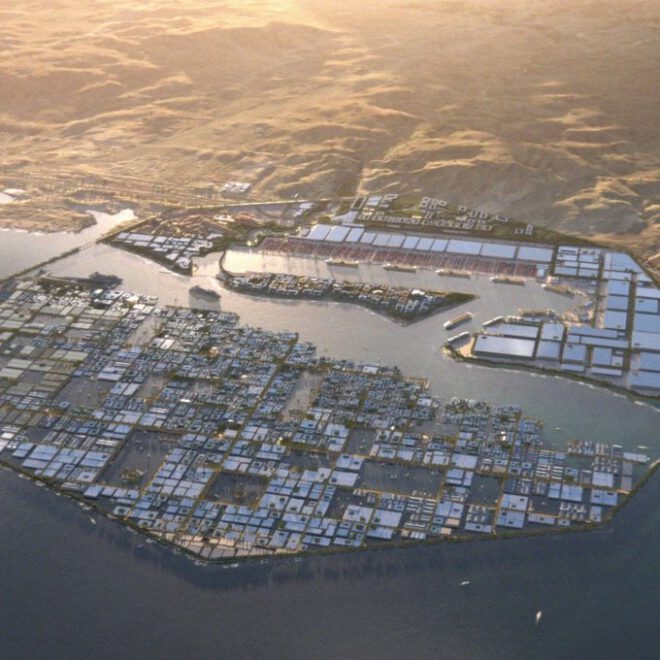
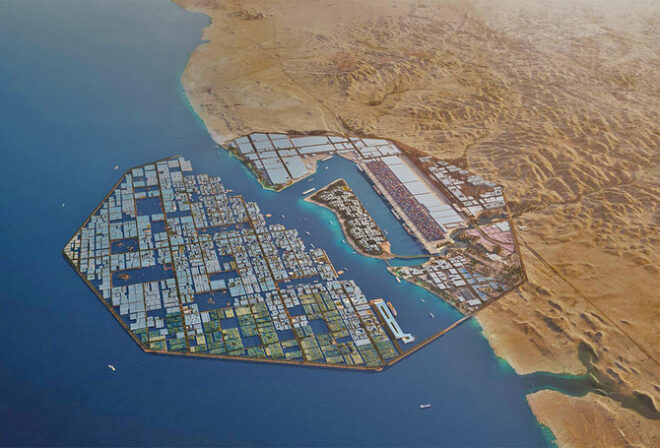
Saudi Arabia is planning on building a floating port called Oxagon, as part of its Neom development. They say it will be the world’s largest floating structure.
The futuristic port set to be built on the Red Sea joins other projects in development by the Saudi Arabian ruler including The Line, Sindala, Trojena and Neom.
The Oxagon port will take advantage of the Suez Canal in Egypt as a major shipping destination hub. The Red Sea is already ecologically very fragile. It will be interesting to see what sort of environmental planning reports and investigations go into this project. Some countries, for instance, test wind factors for the birds when putting up wind turbines. Basic considerations. Based on what we’ve seen at the The Line, the answer will probably be none. This makes me sad especially when you look across the sea to Egypt and see how unspoilt it still is – in Sinai.
The Oxagon port will be the logistics hub for Neom, a large region to be powered with renewable energy as part of Saudi Arabia’s 2030 plan to diversify its economy away from oil, yet using as much oil money as it can right now to build bombastic out-of-touch-to-scale projects.
Oxagon’s idea of hiking in the desert, with AI
Oxagon port will be built in an octagonal shape on land and with part of it floating into the Red Sea. The port and parts of it as a floating city will be arranged around water-filled floating squares connected by small canals. There are plans for a cruise terminal and oceanographic research centre.
Oxyagon floating city on the Red Sea, part of Neom
“Oxagon will be the catalyst for economic growth and diversity in Neom and the Kingdom, further meeting our ambitions under Vision 2030,” said Saudi Crown Prince Mohammed bin Salman.
Cross-section view of a library and warehouse on the floating city. With so much available land, why on water?
“Oxagon will contribute to redefining the world’s approach to industrial development in the future, protecting the environment while creating jobs and growth for Neom. It will contribute to Saudi Arabia’s regional trade and commerce and support creating a new focal point for global trade flows.”
Countries nearby like Israel already have an international marine research center in place in Eilat for decades where they study climate change, ancient tsunamis, and the effects of human traffic at sea on wildlife. Please Saudi Arabia, be in touch with this center and work towards a future we can all be proud of.
Bees are turned off by the electrical changes created by pesticides. A study offers a new perspective on how human-made chemicals disturb the natural environment.
Pollinators are less likely to land on flowers sprayed with fertilisers or pesticides as they can detect electric field changes around the flower, researchers have recently discovered. While science has proven that pesticides are toxic, they know little about how they affect the immediate interaction between plants and pollinators. A new study sheds light on how chemicals immediately alter feeding action of pollinators.
A study, published in PNASNexus, shows that chemical sprays alter the electric field around flowers for up to 25 minutes after exposure. This impact lasts substantially longer than natural fluctuations, such as those caused by wind, and causes a reduction in bee feeding effort in nature. That means, this is a sound argument for the immediate and direct effects of pesticides on pollinators.
Ellard Hunting at the University of Bristol and his team noted that fertilisers did not affect the vision and smell of the bees, and set out to mimic the electrical changes caused by fertilisers and pesticides in the field by electrically manipulating flowers. This showed that bumblebees were able to detect and discriminate against the small and dynamic electric field alterations that are caused by the chemicals.
Hunting said: “We know that chemicals are toxic, but we know little about how they affect the immediate interaction between plants and pollinators. Flowers have a range of cues that attract bees to promote feeding and pollination. For instance, bees use cues like flower odour and colour, but they also use electric fields to identify plants.
“A big issue is thus – agrochemical application can distort floral cues and modify behaviour in pollinators like bees.”
Other airborne materials that affect bees and other pollinators
Various other airborne particles such as nanoparticles, car and factory exhaust, nano-plastics, and viral particles may have similar impacts, affecting a wide array of organisms that use the electric fields that are virtually everywhere in the environment.
Co-author, Bristol’s Sam England, explained: “What makes this study important is that it’s the first known example of anthropogenic ‘noise’ interfering with a terrestrial animal’s electrical sense.
”It’s much like motorboat noise that hinders the ability of fish to detect their predators, or artificial light at night that confuses moths; the fertilisers are a source of noise to bees trying to detect floral electrical cues.
“This widens our understanding of the multifaceted ways in which human activity is negatively impacting the natural world, which can seem quite depressing, but it will hopefully allow is to introduce or invent solutions to prevent the adverse effects that these chemicals may be having on bees.”
Want to do more for the bees and other pollinators? A home garden can help the bees. Read here.
Whether your business is built with wood, or your life savings is in a wooden home, sustainably-built or not, going up in flames is a risk.
Fires in commercial buildings pose a significant risk to human life and may cause severe physical and emotional harm to employees, customers, and the company as a whole. Fires in commercial buildings may be prevented if necessary precautions are taken to prevent them, the damage caused by a fire is kept to a minimum by hiring proper services, and adequate systems, controls, and procedures are in place to allow everyone inside to safely escape and contact rescue services promptly.
Fires in commercial buildings may have long-lasting effects on businesses and their employees. Fires cause more than just property damage; there are numerous other losses as well that make company recovery challenging.
Damage to property
Smoke and soot from a fire may travel around the building and settle on surfaces that were never directly touched by the flames, increasing the extent of the damage. After the fire department puts out the blaze, the smoke and soot continue to have harmful impacts for many hours, weeks, or even months. Because of this, the expense to repair fire damage increases dramatically if it is delayed.
Bear in mind that attempting to clean up the damage caused by the fire all by yourself in an effort to save some of your valuable time is not a smart idea. If you do not have specific safety equipment, entering the impacted buildings might be very hazardous. In addition, if you wipe or clear residues, you can spread them everywhere, which would make the situation much more difficult.
The Downtime and Financial Losses Sustained by Businesses
Any storefront establishment will be forced to close temporarily in the event of a commercial fire. Depending on the extent of the damage, it could take weeks or months to restore the property to its condition before the fire. The longer you have to stop doing business, the harder it will be to make up for the money you lost.
In addition, firms risk losing raw supplies purchased from far-off sources or pricey, irreplaceable equipment. Despite the fact that the world has become more digital, some organizations still feel the sting when vital and one-of-a-kind papers are lost in a fire.
Steps To Take In The Event Of A Fire Accident
It is essential to avoid fires by adhering to all fire safety regulations. Performing risk assessments consistently and making frequent adjustments to the workplace settings and practices might help prevent the worst-case scenario.
A disaster recovery plan detailing how a company will cope with the aftermath of a fire is vital for every enterprise. Business owners and managers may save themselves from having to make hasty choices or waste valuable time by having a plan in place outlining what needs to be done in the event of a fire at their place of business and who should be contacted to help restore the property.
Due to the lack of a comprehensive fire prevention system, commercial properties are often involved in uncontrollable fires that break out. In situations like these, it is a good idea to hire fire watch guards service such as Fast Fire Watch Co. since the fire watch guards employed by this company are equipped with all of the essential equipment and have the necessary expertise to manage a fire emergency.
Fire damage to companies is never good news, but having prompt expert assistance from a fire damage repair firm may often be crucial in avoiding downtime and associated costs. Make sure your firm has one designated in its disaster recovery strategy.
If you believed that you were the self-made genius behind an electric car company, a space launch & telephone company and a hole boring company, wouldn’t you want any debate to take place on your home turf where you set the rules? The strategy behind Elon Musk’s $44 billion purchase of Twitter is up for debate but perhaps this is a good time to give him credit for a long overdue overhaul of social media.
Anyone who has watched social media evolve from Bulletin Board System (BBS) FidoNets to USENET newsgroups through SecondLife and MySpace to Twitter and Facebook will have seen how much social media changed our lives. Twitter played a role in the Arab Spring, Brexit, protests and elections in several nations. At its peak more than 450 million Twitter profiles were active each month. But this number included imposters, alter-egos, doppelgangers, scam artists, trolls, cult-leaders, politicians, oligarchs and bots. This virtual garden of human minds has the same flaw as the original garden of Eden. People have used Twitter as a weapon to destroy lives, spread lies and undermine civilizations.
Twitter’s partial anonymity was a double-edged sword. Until Twitter’s recent purge of journalists, it allowed muckrakers, whistleblowers and vulnerable minorities to speak truth to power without becoming targets for persecution. But anonymity was also like the Ring of Gyges, a shield of invisibility which fed our inner trolls and empowered the dark side of the human heart.
Some countries allow social media corporations to profit from destructive user content while shielding them from liability. Even when moderation didn’t conflict with profits, Twitter’s rapid pace often left moderators behind. But Twitter’s new CEO seems to believe that the company had too much moderation! Autocrats, subversive influencers, racists and Nazis were invited back even as journalists were banned.
Mastadon is like Paris in the 1920s
Advertisers who could not afford to taint their brand began searching for other social media platforms. Vulnerable minorities that had relied on Twitter’s imperfect moderation fled for their own safety. Hundreds of thousands of Twitter users were searching for a new online home.
This influx of new users yearning to be safe reminds us of other places and times when immigrants brought energy and creativity. With its large number of dispossessed artists, musicians and writers, parts of Mastodon resemble Paris in the 1920s.
What is Mastodon?
Mastodon not a company or a single server. It is a decentralized social network application which allows web servers to join an interoperable social network known as the Fediverse. Eugen Rochko of Germany, also known as Gargon, is the Founder, CEO and lead developer of Mastodon. Christine Lemmer-Webbe, co-author of the ActivityPub specification explains that Mastodon is only one one of many possible implementations of this web communication standard. She shared some helpful documentation on her Mastodon profile: High level intro to ideas:
Computer scientist and opensource advocate Simon Phipps has a good introduction to the Fediverse which includes Mastodon instances and an interoperable family of social network applications such as PixelFed photos, Castopod podcasts and Peertube videos. If Flickr, LinkedIn, Mozilla or Bluesky decide to create ActivityPub compatible services, they can also become part of the Fediverse. Mastodon gained the most attention in recent weeks because it allows favoriting, replying and boosting short text messages which resemble Twitter’s tweets.
More than a decade ago I joined another decentralized social media called Diaspora. Unfortunately Facebook and Twitter had already drawn many people into their centralized “walled gardens” where few were aware that they were locking themselves, their friends and families into communicating only through these corporations. This profit-first ethos is why you couldn’t use your Android phone to Facetime family on iPhones even during Covid-19 lockdowns. It’s why you couldn’t view friend’s Facebook photos from your Twitter account or browse an friend’s iPhoto album from a Windows PC. Corporations segregated us behind their paywalls of unnecessary incompatibility. We believed we were their customers but we have always been their product.
Twitter said this quiet part out loud on December 18th, 2022 with an announcement that tweets and accounts will be removed for sharing outgoing links to Facebook, Instagram, Mastodon and other competing social media platforms. The announcement was later replaced with a 404: Page not found error but not before convincing more people that Twitter’s new management doesn’t value the free speech of people who aren’t already wealthy and powerful.
Getting started with Mastadon
What is a Mastodon “instance”?
If you’re not old enough to remember email, ask your parents or grandparents but back in the old days people had to choose an email server. Some used one belonging to their company or internet service provider. Others used yahoo.com, aol.com, mac.com, myInternetCafe.com, myUniversity.edu… It didn’t really matter because with rare exceptions, any email could go to and from any email server because the Simple Mail Transfer Protocol (SMTP) wasn’t owned by a single company, it was an international standard. Mastodon instances are somewhat like email servers or old style bulletin board systems (BBSs.) People in one instance can follow or send messages to people in other instances. Anyone who has set up a BBS, a cloud-based web or MineCraft server is capable of configuring a Mastodon instance. But for most of us the cost of hosting, moderation and security make it more efficient to join and contribute to the running costs of existing one.
How do I choose an instance?
The large number of possible Mastodon “instances” (servers) to choose from presents one of the biggest barriers to joining but it also points to a big advantage. Some instances are focused on a particular region, language or area of interest. Some encourage posting on, maps, animals, art, science, photography or history. Some allow longer posts, some are focused on the needs of writers and journalists, others have a high concentration of tech people. Some prioritize regional content or a particular language. Instances resemble Facebook groups but they are not controlled by a single company. Unlike ad-funded corporate media, Mastodon instances are funded by user donations. Try to find one which uses a donation portal you would trust. If you can’t get into your chosen instance, try another one.
Check local laws
Comedian Groucho Marx quit the Friar’s club with the remark, “I don’t want to belong to any club that would have me as a member!” It’s helpful to choose an instance with a moderation policy that fits your beliefs and the legal requirements of your home. Try to find an instance that is managed by someone who takes moderation and security more seriously than Twitter’s current leadership does. I began with a regional instance which several of my techie friends had already joined. Here is a map of Mastodon instances. And here are some in the Middle East and north Africa: https://mastodon.com.tr https://tooot.im https://mastodon.tn https://sasa.africa
Mastodon is currently strong in Japan and Europe. The European Commission recently decided to help fund it.
Choose an instance based on your interests
The website https://joinmastodon.org* allows you to search instances by region and area of interest. Here are some which may be of interest to GreenProphet readers:
If you can’t get into your chosen instance, try another one. If your chosen instance isn’t working well for you, it is possible to move. Your follows and followers can come with you. Data scientist Danielle Navarro wrote a more detailed look at this and many other aspects of using Mastodon. *When discussing Twitter’s recent ban, a journalist mistakenly wrote that Twitter had banned “John Mastodon, the founder of a competing social network.” That mistake is now trending as a series of jokes and memes within the Fediverse and a fictional founder account: https://mastodon.social/@JohnMastodon How to Say Hello to Mastodon?
Its customary to write an #introduction containing hashtags describing your interests. For me it might be #Environmentalism, #Writing, #History, #Photography, #Science, #Sailing, #A11Y… This post will appear under these hashtags which will help you connect to others with similar interests. But you may wish to “lurk”, listen and watch how people interact before you introduce yourself.
Mastodon currently has a high concentration of gentle and creative people. Women, BIPOC, LGBTQIA, people with disabilities, neurodiverse, artists, musicians, poets, scientists and “Woke” (aka compassionate) people. Mastodon is not a clone of Twitter and many uses hope it will never try to become Twitter. In some ways it’s the opposite of what has become a wretched hive of scum and villainy.
Some people who’ve settled into this kinder place do not want to be reminded of their abusers elsewhere. Mastodon added several million users over the past few weeks. It will certainly face growing pains but kindness is one area where it excels. Users are encouraged to use content warnings (CWs.) They are simple to add and actually increases the chances your post will be “boosted” (retweeted). So you’ll see CWs for politics, book and movie spoilers, images NSFW or displaying direct eye contact. You’ll also see CWs for mentions of Twitter. It’s also customary to add text descriptions to images for people with limited vision. Mastodon makes it easy to do this. There are no profit-driven algorithms which reward hate-driven engagement, instead ordinary people choose to boost posts from others who perform these simple acts of kindness. One blind user explained that he had seen more text descriptions on Mastodon in 24 hours than he had on Twitter over several years.
Who/What should I follow?
Again there is no one-size-fits-all list of people and hashtags to follow, but here are some which may be particularly interesting to GreenProphet readers:
There is never a good way to say goodbye. My personal Twitter account has been battened down and nearly untouched since Musk’s takeover but another has suddenly become a magnet for “followers”, most of which are bots who’ve joined since October 2022.
“The safest way to use computers is still abstinence” – Christine Lemmer-Webber (2018)
While this is excellent advice, she also explains that you should not delete your Twitter account. Someone could take your handle and become an imposter. Deleting your account is also not very useful. Elon Musk already has all of your tweets whether or not you “delete the account.”
Will Mastodon Make Twitter Extinct?
The growth of Mastodon seems to have unsettled Twitter’s leadership. It has already reduced the number of targets for profitable hate. People who parked or deleted Twitter accounts are no longer seeing ads there. But $44 billion won’t disappear overnight An artist in my family explained how Twitter helped connect freelance artists to commissions. The number of Mastodon users grew rapidly in recent weeks but it remains far below the number on Twitter. I wanted to learn how artists are using this new tool so I joined a small instance which focuses on visual art. It has a strong moderation policy and recently closed to new users in order to remain a stable, well-moderated and gently beautiful art gallery. Artists connect with one another and with those who support their work. Its curator “defederated” from some large and under-moderated instances in order to protect the artists. People I had known from open-source communities were becoming early adopters of Mastodon. They had fought Microsoft back when its applications trapped users into a closed and outdated operating system. To go against a near-monopoly felt like jousting at windmills. In the end we didn’t beat them and we didn’t join them, they joined us. Microsoft Windows, Apple OSX, Google Android, cloud computing and the internet of things all rely on the work of open-source visionaries.
Twitter may limp along for years with haphazard management slowly bleeding away $44 billion and struggling to find a path that avoids discussing the Mastodon in the room. But its not going away.
Mastodon user @d4doome explained it this way:
It might be an unpopular thought here but I’d like to see both Twitter and Mastodon thrive. They’re different and there’s room for both.
Twitter is like having an apartment in the big bad city and you go out at night to sample the nightlife. It’s scary and dangerous if you don’t know what you’re doing, it’s a bit sleazy, but it’s exciting and fun.
Mastodon is like having a little cottage in the country and going to the picturesque village pub for a few quiet ales.
You can enjoy both.
Like going to a village pub for a few quiet ales. Critics wondered aloud about the wisdom in purchasing what may become a massive legal liability for a price based on a marijuana meme but if it helped launch global creative communities in Mastodon-themed virtual pubs, it is $44 billion well spent. Here’s to the man who made this possible. Cheers to Elon Musk!
Every design magazine is releasing their Top 10 looks for the last year and they all revolve around a similar theme: neutral mainly, with some linen, warm, cosy, earthy wood, ceramics, handmade pottery, high quality leather, some vintage.
How Do You Choose a Furniture Store in the Local Area?
Are you in the process of shopping for more furniture? If so, you need to think carefully about the different opinions. A high-end furniture store Los Angeles-based could be a great place for you to do your shopping, but you need to select the right one for your needs. There are probably going to be a lot of choices in the area, so how do you choose the right furniture store in the region to help you? Take a look at a few important points to keep in mind, and choose the right furniture store to help you furnish your home.
Your Budget
When you are considering luxury furniture stores, you need to think about your budget. How much money do you have to spend on your furniture? You need to walk into the store with a number in mind. That way, you can quickly narrow down your choices. You can furnish your house on just about any budget, but if you are willing to spend more money, then you open yourself up to more choices. Think about your budget before you start furniture shopping. That way, your eyes do not end up larger than your wallet.
The Selection
You should also consider the furniture store’s selection before you decide to give them their business. You might be looking for a variety of options to help you furnish your home. For example, you might be looking for a coffee table, an end table, some free-standing chairs, and a couch. Ideally, you should select a furniture store that has a wide selection of options available. That way, you have plenty of choices in front of you, and you can even put together a few items at the same time to see how they work in the room together. This will make it easier for you to make the best possible choice for your home.
Mocka also adds that another important factor to consider is the quality and durability of the furniture the store offers. Investing in well-made pieces ensures they will withstand daily use and maintain their appearance over time. Look for a furniture store that provides detailed information about the materials and craftsmanship of their items. Quality furniture may cost a bit more upfront, but it will save you money in the long run by reducing the need for frequent replacements, ultimately adding lasting value to your home.
The Knowledge of the Staff Members
It is entirely possible that you could walk into the store without knowing exactly what you are looking for. In that situation, you are going to rely on the knowledge of the staff members to help you make the right choice. You should consider talking to some of the staff members before you start shopping at the store. See if they have any recommendations that can help you finalize your selections. Maybe they have some knowledge of some deals that might be coming up in the near future. They might even have connections with some of the top furniture providers that can help you save money. Find a furniture store with a knowledgeable staff that can point you in the right direction.
Reviews and Ratings
Finally, you should take a look at some reviews and ratings before you start shopping at a furniture store. You probably take a look at reviews and ratings before you buy something online, and you need to take the same approach when you are looking for a furniture store. What do other people have to say about that store? If a lot of other people have nice things to say about a specific furniture store in the area, there is a good chance that you have found the right store to help you pick out your furniture. You might even want to talk to some of your friends and family members to see if they have any recommendations for you.
Find the Right Furniture Store for Your Needs
Clearly, there are a lot of options available if you are looking for a furniture store in the local area. The right furniture store for one living room is not necessarily going to be the right furniture store for another living room. You should always think about the selection of the furniture store before you decide to purchase something, but you also need to think about the people who work at the furniture store, as they are going to be the ones helping you find the right furniture for your home. Do not hesitate to talk to some of your friends and family members if you are looking for recommendations for stores in the local area.
CT scans help researchers “unwrap” the face of Ramses II without disturbing the mummy in any way. This is his face at 45. He was the man who met Moses.
It’s a mystery waiting to be “unwrapped”: what did Egypt‘s most powerful ruler, Ramses II look like? Removing the mummy cloth would disturb the remains but new technology using CT gives us an accurate look under the cloth. We’ve revealed the selfie of Jesus. Now it’s time for Ramses II.
The images were revealed by the Face Lab from the University of Liverpool, UK in conjunction with Egyptologists. Using scans, the team led by Professor Caroline Wilkinson and the University of Cairo reconstructed how the Pharaoh would have looked at 45 and at the age of his death at 90 using state-of-the-art techniques.
Ramses II was arguably the greatest and most powerful Egyptian king of the during the New Kingdom period and lived from 1303 -1213 BCE. He is interested for major world religions as he was in power during the biblical Book of Exodus, which tells the story of the Israelites escaping from Egypt under the leadership of Moses.
The Face Lab team worked with Sahar Saleem, a Mummy expert and Professor of Radiology to produce two facial depictions using CT data, photographs, and historical data of the pharaoh.
Prof Caroline Wilkinson, Dr Jessica Liu and Mark Roughley spent three months generating both faces with full CGI textures.
Ramses II at 90, the age of his death
Led by Caroline Wilkinson and Sahar Saleem, they were able to interpret the Pharaoh’s skull and restore his lifelike image, reconstructing his featured and skin colouring.
“When we look at a skull for the first time, we are initially looking for the most visible characteristic details,” said Caroline. “For example, on Ramses II there is a very wide nasal bone. It is, between the eyes, very high and very pronounced.”
Through meticulous work, including the use of software used in criminal reconstructions, the Face Lab team pinpointed the position of the pharaoh’s facial muscles.
“The stronger a muscle is where it is anchored, the more its attachments will leave visible marks on the surface of the skull,” explained Professor Wilkinson.
The Face Lab team has recreated a series of faces of important, historical figures including Robert the Bruce and King Richard III. For a more rudimentary experience, meet the face of Pharaoh Thutmoses IV here.
Choose a message and a sticker to match your passion
Stickers are excellent products to leverage in both your professional and personal life, regardless of the purposes you may have in mind. Use them to spread eco-love and messages. Customizations and self-expression are stickers main strength. Custom stickers are an innovative and unconventional way to advertise and market your brand. Not only do stickers “stick around” on surfaces for years (well do be mindful where you put them), but they are the ideal low-cost and high-awareness marketing strategy. You can use them to generate buzz about your business, attract new customers, and promote customer loyalty and satisfaction.
Are you searching for a way to add some extra personality to your business or eco-lifestyle? If so, maybe you should consider eco-friendly custom stickers. Stickers are an affordable and fun way to add interest and color to your branding and can be used in various ways. A new sticker design can create a remarkable impact.
How to Customize Stickers that Suit Your Eco-Conscious Lifestyle
Stickers are long-lasting, durable, and, most importantly, environmentally friendly. To customize a sticker that best represents your lifestyle or brand, you should consider the following points:
Colors: Use colors that represent who you are and incorporate them into your custom sticker design for consistency across your offline and online channels. If you are designing a sticker with no issue, you can use as many colors as possible because most print-on-demand companies use CMYK colors in digital and offset printing. Choose eco colors, without chemicals, when possible.
Typography: If you want to share a brand logo or message, you can use them in your sticker. However, remember that stickers are a smaller surface area, so choose a font that is easy to read. Also, it’s best to pack only a little text in.
The sticker’s shape: At this stage, you should consider where your sticker is placed and what shape best suits the surface to which it is being applied. Custom die-cut stickers are an excellent way to add personality to your eco-conscious lifestyle or brand because their shape is fully customizable. That means you can make them in the shape of your logo or icon. You can have them all if you want an oval, square, rectangular, circle, or die-cut shapes like the Rolling Stones iconic mouth.
Finish: Choose what type of finish you want on your stickers. You can choose a matte finish to give your stickers a more natural, sleek look or a glossy finish to give your custom stickers a more premium look. Regardless of the type of stickers you choose, make sure they accurately represent who you are. Forgo the plastic and choose a paper sticker that might not outlast the rain.
Stickers can match any size of your message. Solar energy anyone?
As a bottom line, custom stickers are ideal for helping you maximize your branding because you can easily plant your custom message and logo anywhere, anytime, and on anything. Not only can they be used as custom product labels, but stickers can also be used as stationery, gifts, decoration, laptops, candle labels, guerrilla marketing, or for showing support for your favorite causes.
And when you want to remove and replace them with new custom stickers, they are usually easy to peel away. They won’t leave any marks or damage the surface. If they leave a bit of glue on the surface, wash it with soap and water or rubbing alcohol, and you are good to go. Customize your own stickers online today and have fun decorating your rooms or promoting something.
Dubai is opening a new cafe in 2023, Donna Cyber Café, featuring “super-model” Diana, who will serve you coffee with a smile between the valleys of her big bosom.
She is a clone of Diana Gabdullina, the wife of Rashid Gabdullin who made the robot. He wife won a beauty contest in 2014 and Rashid wants others to experience his wife’s beauty.
With so much that goes wrong in the Middle East in environmentalism (Burj, Dubai for instance), this kind of cafe sets the woman’s movement back to the 60s. Women and girls we want to socially empower, and not sexualise, should not have their brothers, or fathers served by this demented male fantasy.
The Diana robot, is a Robo-C2, a humanoid robot that is designed to look like a human being, talk like a human, express emotions and interact with people.
The developers of Diana believe she will give their businesses a ‘competitive advantage’ and help attract new clients.
The Donna cafe will be open 24/7 and will include soft-serve ice-cream, a soft drink dispenser and a coffee machine with items being served to customers by Donna’s robotic arms.
We know that hipsters are well, probably no longer hip. And well, what it is a hipster anymore? The site Hipster Jews is down and over with for years. But Hipster Hanukkah? It just sounds good. And Google-able. And to save time sending my friends links to all the Hanukkah recipes I might use this year, I just compiled them all in this one handy link you can all enjoy too.
No need to scroll through endless stories of my first memories of Hanukkah as I had none. I grew up on Christmas and came to love Hannukah in my mid-20s. Now with most of my friends being Jewish, I need to turn to these recipes every year as a necessity. They never grow old.
Essential Hanukkah recipes created by grandmother cook, Green Prophet writer and herbalist Miriam Kresh:
Knitting evolved somewhere in the Middle East. And knitting as both a practical skill and creative craft has survived in certain areas of the Middle East and North Africa until the present day. But ancient cotton from the region was not from Egypt as it is today; but was believed to have come from either the Indus Valley, which is modern day Pakistan, or from Africa. Cotton wasn’t made locally in the Middle East. So what happens when ancient microscopic fibers of cotton turn up on an archeology dig in Israel? A look back into how we once lived.
The oldest sample of cotton known to man in Israel or the Holy Land was found recently, dated to about 7,000 years old, we can interpret that ancient people were skilled in travel, trade and commerce.
The cotton was found by archeologists in the Jordan Vally, home to the River Jordan. The earliest evidence of cotton fibers in the region prior to the present study was dated to several centuries after the Early Bronze age (around 5000-6500 years ago) and comes from the Dhuweila, a site in eastern Jordan.
Although it is impossible to determine whether the cotton at Tel Tsaf, the ancient archeology site in Israel where the cotton was found, was manufactured from domesticated plants, the researchers believe that the early dating of the site means that it is highly probable that the cotton fibers came from the Indus Valley.
Fibers of data on how we once were
It doesn’t look like much, certainly not a piece of cloth. Just some fibers under a microscope, and this kind of item is usually overlooked by archaeologists, the team explained. It’s hard to separate ancient fibers from the new. But when you look to the ancient microscopic elements at a dig, buried below the surface, images of food and trade and culture emerge that can tell the story of how we once lived.
“The interesting thing about this ancient evidence of contact over such a great difference is that it comes from fibers, some of them microscopic fragments of ancient thread,” said Prof. Danny Rosenberg from Haifa University, part of the study along with Stanford. “We assume that these cotton threads, which were found together with wool and plant fibers, arrived at the site as part of fabrics or clothes, in other words as ancient textiles.
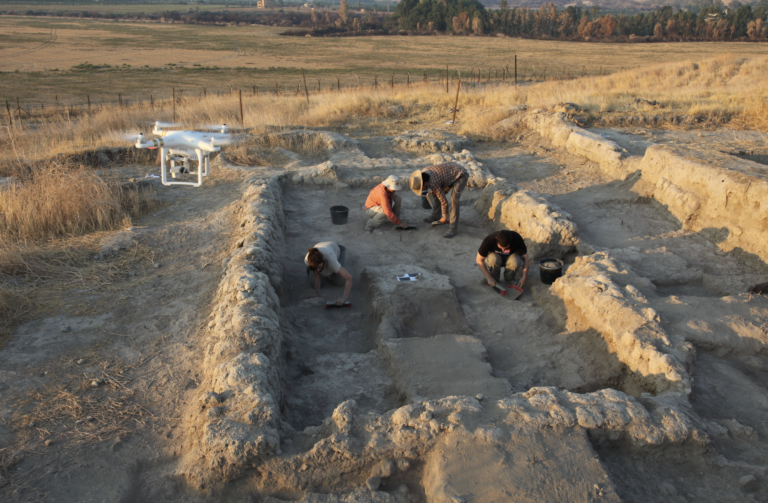
The site Tel Tsaf of the archeology dig in Israel where the ancient cotton fibers were found
Humans were already making textile products tens of thousands of years ago, creating fibers from various plants, such as flax, Rosenberg explained. However, many fabrics and other organic materials tend to disintegrate rapidly if they are not preserved in dry or inorganic environments. As a result, these fibers are usually not found at sites in the Mediterranean climate zone, and most of the evidence comes from later texts and drawings, or from implements that were evidently used to manufacture textile fibers and products.
The location of where the ancient cotton was found is in a very hot area of Israel not far from the Sea of Galilee and close to the town of Afoula. To be more precise the ancient village was close to Kibbutz Sde Elihayu, where I lived for a year, working and studying. The kibbutz helped change the idea of organic agriculture in Israel, thanks to one of its members Mario Levi who I worked with in the fields for a short time.
Working to understand village dynamics
Back then, the village was called Tel Tsaf village and a home for a community of probably hundreds of people who thrived around a spring. The village thrived for some five hundred years, and one of the mysteries surrounding the site is why it ceased to be inhabited, given that there is no evidence of any distress or lack of resources.
This is one of the areas in which the researchers hope to invest a real effort over the coming years. “This was a period when small agrarian villages were beginning to expand and grow, and when the social structure was becoming more complex, creating the foundation for the later development of the important city-states in the region and facilitating the emergence of important technological and culinary innovations.
“We’re still trying to understand why at such an important junction in human history such a prosperous site simply ceased to exist,” the researchers.
To the best of the researchers’ knowledge, modern-day cotton comes from four original sources – two in South and Central America; one in the Indus Valley, in modern-day Pakistan, where there is evidence of the use of cotton dating back some 6,000 years; and lastly in Africa, where the evidence concerning the use of cotton dates back to the first century CE.
Studies of ancient DNA have shown that cotton was domesticated independently and separately in these regions. Although it is impossible to determine whether the cotton at Tel Tsaf was manufactured from domesticated plants, the researchers believe that the early dating of the site means that it is highly probable that the cotton fibers came from the Indus Valley, rather than from a source in Africa second old-world candidate.
Save energy and carbon emissions with a smart thermostat
The adoption of smart thermostats has skyrocketed in recent years. They are also being installed in many older homes. They’re amazing tools that enable you to regulate every facet of your home’s environment. Many of us have undoubtedly seen advertisements for smart thermostats on sites like Amazon or at stores like Home Depot.
A digital thermostat, often known as a programmable thermostat, can be used to regulate the temperature in a home. It’s possible to do this by programming your home’s thermostat to maintain different temperatures at various times of the day. Before you turn in for the night, you may want to lower the temperature by five degrees.
To avoid forgetting to turn on the heat because you’ve been too busy, you can program your smart radiator thermostat to do so automatically every night at midnight. To help you get ready for the day, you can set the thermostat to increase the temperature by five degrees every morning at 6 a.m. during the work week. If you want to wake up to a warmer house on the weekends, you can set the thermostat to do so at 8 a.m.
The Benefits of a Digital Thermostat System
It’s easy to list the benefits of using a digital thermostat, such as:
The temperature in your home can be adjusted to your liking with the help of a programmable thermostat.
Intriguing features and extensive customization make a programmable thermostat hard to ignore.
An analog dial thermostat only gives a rough estimate of the temperature you’ve set it to. You could be misreading the temperature by as much as four degrees, from 19 to 23 degrees Celsius.
Consumer Reports found that switching to a programmable digital thermostat can cut heating and cooling costs by up to $180 annually.
What Can You Expect From a Modern Digital Thermostat?
A digital thermostat includes several different functions, such as:
As we’ve established, you may program different temperatures for the morning, midday, evening, and night. Additionally, the temperature can be locked so that it cannot be altered.
It is possible to divide a program into two halves, one for the winter and fall and another for the summer.
You can set the thermostat to notify you when it’s time to replace the filter in your furnace or central air system.
Some modern digital thermostats feature Wi-Fi connectivity, allowing you to adjust the temperature from anywhere in the world using your smartphone.
The Importance of Resetting Your Digital Thermostat
When dealing with typical issues like poor airflow and variable indoor temperatures, it is not always necessary to fix or replace an HVAC system. Resetting the radiator thermostat may be the only thing needed. With this simple method of troubleshooting, you won’t have to spend any extra time or money to get things back on track. If your thermostat still doesn’t work after being reset, it’s time to call in the experts from your heating, ventilation, and air conditioning system.
A Concise Guide to Resetting Your Digital Thermostat
The uniformity of technological processes is a benefit. While Windows and the Mac are as different as a Tesla and a Toyota, they share many features. Follow these standard procedures to factory reset your device. We think you could get by with only one!
By performing a “factory reset,” all of your changes are wiped out. All of your personal preferences and settings, including alarms and timers, will be erased. However, if your radiator thermostat is faulty, it will be useless regardless of how much you try to fix it.
Turn It Off
If you’re having trouble with a piece of technology, try turning it off and back on again. Just give it a minute or two of your time. In doing so, any settings (or bugs) that were just temporary will be removed from its working memory.
Just Get New Batteries
Your thermostat could be dying since it runs on batteries. It’s possible that only swapping out the old ones for new ones (and wiping away the grime) will do the trick.
To get started, just turn the knob to “on.”
Turning the electricity back on at the breaker box may be necessary before resetting the air conditioner’s thermostat. Stop the air conditioner from running by switching off the breaker that supplies power to it. After waiting at least 30 seconds, power up both the box and the device again.
Put the batteries back in.
It’s unlikely that batteries could perform a complete factory reset. Take them out and put them back counterclockwise. If it did its job, regular operation should be restored.
Conclusion
Is a digital radiator thermostat something you’d like to get for your house? The professionals at tado° can advise you on how to cut costs and consumption. Our trained professionals are equipped with the knowledge and skills necessary to ensure your family’s comfort and safety during the cold winter months. Your electric bill must be affordable as well. We appreciate you taking the time to read our piece about digital thermostats. If you have any further inquiries, please email us at tado°. We’re here to assist you and would be pleased to do so.
A common material called a zeolite might lead to breakthroughs in energy storage
It was 1999 and we were preparing for Y2K, the millennium bug. Winter had already come and we placed a reusable heat pack into a pan of boiling water and let the white lump of sodium acetate melt into its clear liquid form.
As the liquid gradually cooled to room temperature it went into a supercooled state below the temperature where it normally should be solid. All it would take is for something to disturb it, a click of its embedded metal disk, to shock it to “remember” that it was supposed to be solid. It would then solidify and give up the excess stored heat.
You can find people experimenting with supercooled water, beer and other liquids on youtube. There is a legend of a supercooled Russian lake that froze solid, entrapping a herd of horses. Our story is more mundane but less tragic. We threw this heat pack into an emergency box in the attic and forgot about it after moving overseas.
Years later when we were preparing to sell the house we discovered the heat-pack was still in its liquid form. It had been subject to the -2°C to 50°C temperature range in our attic for several years. I clicked the clicker and watched the magic wave of crystallization and felt the warmth that had been stored in that pot of boiling water back in the 1990s.
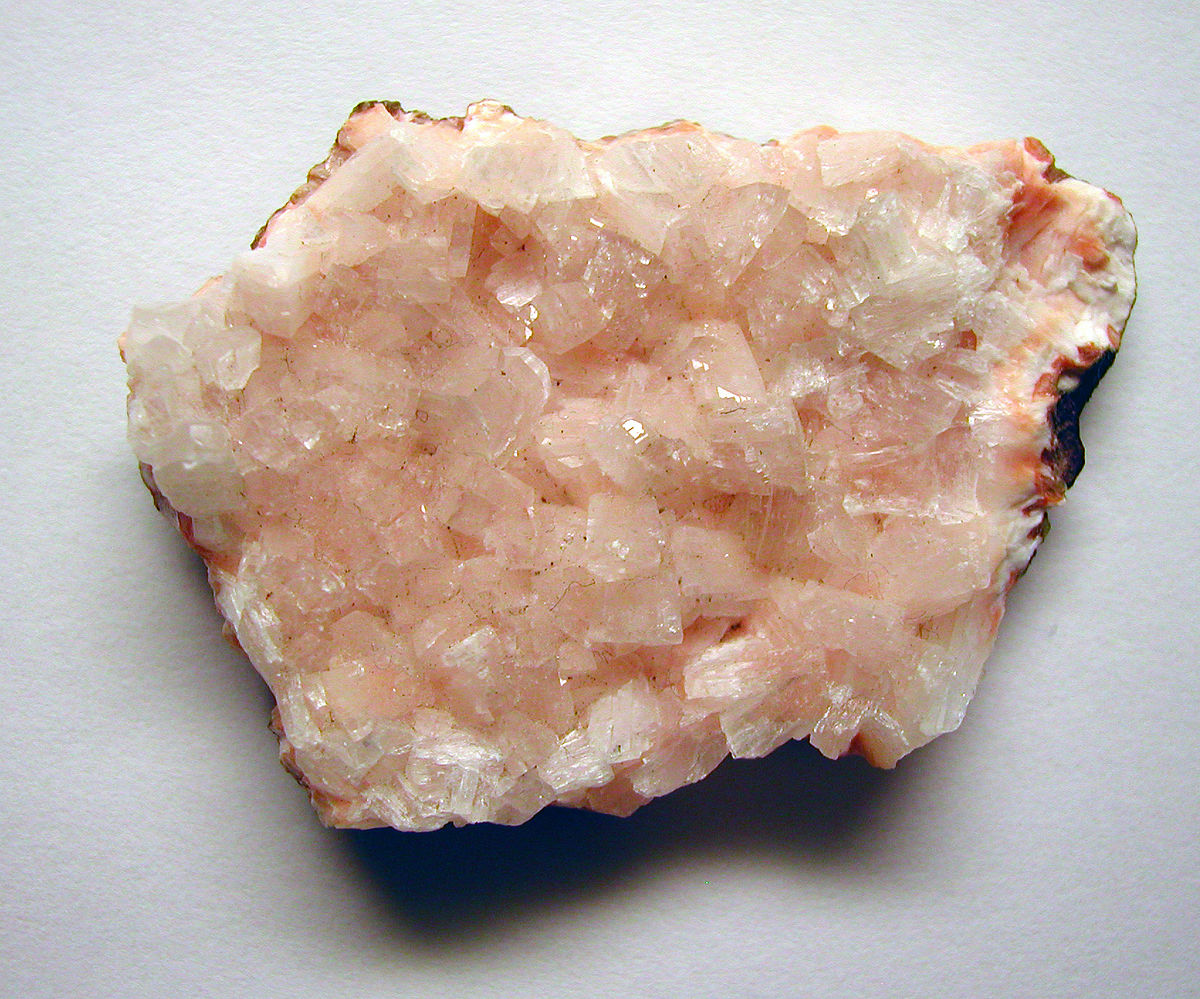
Hothands handwarmers use zeolite energy!
I’d been thinking about Ukrainian people without power and heat during a frigid winter. Iceland has plenty of geothermal energy, North Africa and the Mideast have plenty of solar energy. I woke up in the middle of the night wishing there was a way to transport that heat and thought of those heat packs. But even in those bleary-eyed hours something told me that handwarmers would not store enough energy to make their transport worthwhile. The very next day GreenProphet’s founder and editor Karin Kloosterman told me she had heard that Germans were experimenting with Zeolite to store solar energy.
Swedish mineralogist Axel Fredrik Cronstedt who noticed that on heating, this mineral produced large amounts of steam. So he gave it a name that comes from Zeo the Greek word for boil and lithos, the Greek word for stone. So Zeolite is a boilstone.
Zeolite minerals are known as aluminum silicate, mainly sodium and calcium minerals and water. They are naturally formed from the interaction of ground water with volcanic rocks or clay minerals. Zeolite is made up of a group of natural minerals that are very useful in agricultural, industrial and environmental fields. Modern agriculture is witnessing large and wide uses of zeolite due to chemical and physical properties.
The zeolite ores in the Hashemite Kingdom of Jordan are located in many areas from the north east to the south and discovered on the surface and close to the roads in most geological discoveries.
According to the Memorial Sloan Cancer Society, Zeolites are used in detergents, water and air purifiers. They are also marketed as dietary supplements to treat cancer, diarrhea, autism, herpes and hangover, to balance pH and remove heavy metals in the body.
About 40 natural zeolites have been identified during the past 200 years; the most common are analcime, chabazite, clinoptilolite, erionite, ferrierite, heulandite, laumontite, mordenite, and phillipsite.
Zeolite is beginning to sound like cryptocurrencies, nanotubes and plastics. But wait there is more! Apparently zeolite can also dry dishes, clean oil spills, concentrate oxygen, remove methylene blue from textile wastewater, be used as kitty litter and clean nuclear waste. Zeolite does seem to be the jack of all trades of the material world. Watch this space for more on an amazing material that gives Graphene a run for the money. But can it store heat energy? Yes it can!
There are three main ways a material can be used to store heat energy in Thermal Energy Storage (TES) systems:
Direct thermal mass: Hot water bottles, hot water tanks, stones, irons and oil-filled electric heaters use this method. Heat a large mass with a high heat capacity and it will stay warm for a long time.
Latent Heat Phase transition: Those sodium acetate heat packs use this method. Heat something above its melting or boiling point and store it in that state. When a liquid freezes or a gas condenses, it returns to its lower energy phase and releases this stored heat. A block of ice is a very old and well-tested example of phase transition thermal energy storage even though it is the reverse of what we are looking for in seasonal heat storage systems. Halotechnics’ molten-salt used in Masdar’s solar-thermal power plants is another example.
Thermo-chemical: Most exothermic (heat-producing) chemical reactions are not easily reversible. So while it’s easy to burn wood, coal and oil, the process of turning CO2 back into wood, coal and oil takes a great deal of energy and time, decades or millenia. But a few exothermic chemical reactions can be reversed over a short time scale and a reasonable high efficiency. The reaction where water molocules cozy up into the microporous structure of zeolite is one such reversible exothermic reaction.
According to an article published in Frontiers in Energy Research, the zeolite water reaction can have thermal storage densities of 50–300 kWh/m3. This compares favorably with water thermal mass storage of only 0 to 70 kWh/m3. Currently available zeolites are not yet commercially viable for thermal storage but there is room for improvement. Just as sugar, flour and eggs can be baked into many different, zeolites are class of minerals with thousands of possible variations of the same basic elements. Scientists have been experimenting with these to try to produce higher efficiency.
Heidrun Klostermann manages the ZeoMet project at Germany’s Fraunhofer Institute for Organic Electronics, Electron Beam and Plasma Technology with a goal of producing zeolites with higher heat storage efficiency. In a Fraunhofer press release he explained:
“We coated the zeolite pellets with aluminum – this doubled thermal conductivity after just the first attempt without negatively impacting water adsorption and desorption. We are currently aiming to increase this by five to ten times through adjusting the coatings.”
The solution is unlikely to come in time to help keep people warm during this winter, but they are making progress. The Fraunhofer article also explains that because Zeolites can be used to take and store heat from where it isn’t needed and release it where and when it is needed, it also can be used for cooling and drying. A variation of this is used in a Bosch dishwasher. We look forward to seeing what other spinoffs come from research into this versatile material!
California’s aquifers have dried up while lack of water continues ongoing conflicts in the Middle East. Unless you know what you have, you can’t know how to protect it. America’s NASA, which needs no introduction, and the French Space Agency, Centre National d’Études Spatiales (or CNES) are starting to observe and monitor our planet’s water like never before. Canada’s Space Agency and the UK’s Space Agency has also chipped in.
The project aims to observe nearly all the water on our planet’s surface from low-Earth orbit over a period of three years. The satellite will measure the height of water in freshwater bodies and the ocean on more than 90% of Earth’s surface. This information will provide insights into how the ocean influences climate change; how a warming world affects lakes, rivers, and reservoirs; and how communities can better prepare for disasters, such as floods.
The satellite was launched from a SWOT spacecraft launched atop Elon Musk‘s SpaceX rocket from Space Launch Complex 4E at Vandenberg Space Force Base in California.
The Turpan Depression, nestled at the foot of China’s Bogda Mountains, is a strange mix of salt lakes and sand dunes, and is one of the few places in the world that lies below sea level.
After SWOT separated from the second stage of a SpaceX Falcon 9 rocket, ground controllers successfully acquired the satellite’s signal. Initial telemetry reports showed the spacecraft in good health. SWOT will now undergo a series of checks and calibrations before it starts collecting science data in about six months, the teams report.
“Warming seas, extreme weather, more severe wildfires – these are only some of the consequences humanity is facing due to climate change,” said NASA’s Bill Nelson. “The climate crisis requires an all-hands-on-deck approach, and SWOT is the realization of a long-standing international partnership that will ultimately better equip communities so that they can face these challenges.”
SWOT will cover the entire Earth’s surface between 78 degrees south and 78 degrees north latitude at least once every 21 days, sending back about one terabyte of unprocessed data per day. The scientific heart of the spacecraft is an innovative instrument called the Ka-band radar interferometer (KaRIn), which marks a major technological advance. KaRIn bounces radar pulses off the water’s surface and receives the return signal using two antennas on either side of the spacecraft. This arrangement – one signal, two antennas – will enable engineers to precisely determine the height of the water’s surface across two swaths at a time, each of them 30 miles (50 kilometers) wide.
“We’re eager to see SWOT in action,” said Karen St. Germain, NASA Earth Science Division director. “This satellite embodies how we are improving life on Earth through science and technological innovations. The data that innovation will provide is essential to better understanding how Earth’s air, water, and ecosystems interact – and how people can thrive on our changing planet.”
The clearest picture of Earth’s water, measuring millions of lakes
Among the many benefits the SWOT mission will provide is a significantly clearer picture of Earth’s freshwater bodies. It will provide data on more than 95% of the world’s lakes larger than 15 acres (62,500 square meters) and rivers wider than 330 feet (100 meters) across. Currently, freshwater researchers have reliable measurements for only a few thousand lakes around the world. SWOT will push that number into the millions.
Along the coast, SWOT will provide information on sea level, filling in observational gaps in areas that don’t have tide gauges or other instruments that measure sea surface height. Over time, that data can help researchers better track sea level rise, which will directly impact communities and coastal ecosystems.
Such an ambitious mission is possible because of NASA’s long-standing commitment to working with agencies around the world to study Earth and its climate. NASA and CNES have built upon a decades-long relationship that started in the 1980s to monitor Earth’s oceans. This collaboration pioneered the use of a space-based instrument called an altimeter to study sea level with the launch of the TOPEX/Poseidon satellite in 1992.
Cooperation for the Climate
The Dead Sea is shrinking. Can compelling satellite images help protect our salty seas and lakes and freshwater supplies?
“This mission marks the continuity of 30 years of collaboration between NASA and CNES in altimetry,” said Caroline Laurent, CNES Orbital Systems and Applications director. “It shows how international collaboration can be achieved through a breakthrough mission that will help us better understand climate change and its effects around the world.”
SWOT measurements will also help researchers, policymakers, and resource managers better assess and plan for things, including floods and droughts. By providing information on where the water is – where it’s coming from and where it’s going – researchers can improve flood projections for rivers and monitor drought effects on lakes and reservoirs.
“SWOT will provide vital information, given the urgent challenges posed by climate change and sea level rise,” said Laurie Leshin, NASA’s Jet Propulsion Laboratory (JPL) director. JPL developed the KaRIn instrument and manages the U.S. portion of the mission. “That SWOT will fill gaps in our knowledge and inform future action is the direct result of commitment, innovation, and collaboration going back many years. We’re excited to get SWOT science underway.”
Want a certificate in medical marijuana, endorsed by New York? get in on the first classes
From toking and smoking to moms who sell “Weed” in TV shows, cannabis has come a long way since my college friends had to dig holes in their walls to grow their medical cannabis in Toronto, in secret. As states hand out medical licenses for growing operations and businesses, universities and colleges, too, want to capitalise on cannabis, a $22B USD market in the United States today, and set to be a $130B market in 2030.
The New York University (NYU) School of Professional Studies is now offering a Certificate in the Business of Cannabis, in the Spring 2023 semester. The Certificate, according to the school, will foster an in-depth understanding of the cannabis industry and its professional opportunities.
Become a Masterchef of cannabis
Students will have the opportunity to learn about the unique aspects of the industry, including cannabis cultivation techniques, managing a dispensary, financial regulations, medical cannabis, and cooking with cannabis.
“NYU SPS developed this program in collaboration with industry professionals and thought leaders in the field, many of whom will also teach our courses,” said June Chin, MD, an adjunct professor at the School who helped to create the Certificate program and will teach The Chemistry of Cannabis: Medicine, Wellness, and Product Use in the Spring.
A noted expert in developing medical cannabis protocols for the industry and internationally accepted methods for cannabinoid formulations, research, education, and training programs, she added, “This Certificate provides a distinctive credential for those seeking to develop the skills to transition into this thriving market.”
The Certificate consists of a required introductory course, Overview of the Cannabis Industry, which will include a visit to a local dispensary to learn firsthand what dispensaries do and how they operate. Upon completion of the introductory course, students are required to take four core foundational courses: Managing a Cannabis Dispensary and the Regulation of Operations; Cannabis Sales and Marketing; The Chemistry of Cannabis: Medicine, Wellness, and Product Use; and Cannabis and Social Equity Policy.
If I were in New York right now, I’d sign up. Cannabis has been a thing, where I live in Israel. We have Raphael Mechoulam, the first to isolate THC and CBD in the 60s, and we have Jewish convert Dr. Alan Shackelford who comes and goes, bringing his wealth of clinical experience and how cannabis works in real patients. He was the first doctor to treat Charlotte Figi with epilepsy.
Some electric cars use lithium-ion batters. The Quant is an electric car that stores its energy in salt.
International transportation conferences are now abuzz with talk of the rise of the electric car. In particular, many experts believe that this type of vehicle has the potential to completely transform global transportation as we know it. So, what exactly is an electric car? And how could it shape the future of transportation.
The current state of electric cars – what are they and how do they work
Electric cars have become an increasingly popular trend in recent years, thanks to their eco-friendly attributes and convenience. But what are electric cars and how do they work?
Electric cars operate using electricity stored in high-capacity batteries, which power an electric motor instead of an internal combustion engine like gasoline-fueled vehicles. This can allow for greater acceleration levels and better fuel economy due to the motor’s efficiency.
Moreover, electric cars often emit fewer pollutants than gasoline cars, making them environmentally friendly. Given their multiple advantages, it is not surprising that more and more drivers are choosing electric cars over traditional vehicles.
The rise of the electric car is revolutionizing the transportation industry, and its associated insurance industry is no exception. With more electric cars on the roads, insurance companies must contend with the challenge of forming efficient, yet fair policies. Insurance providers in all countries are reviewing existing policies and attempting to factor in changes to risk factors due to electric vehicles.
Why electric cars are the future of transportation
Ceer is an electric car from Saudi Arabia, using BMW parts
Electric cars represent the future of transportation due to their environmental friendliness, cost savings, and convenience. Starting with environmental friendliness, electric cars are powered by clean energy sources like solar and wind power and don’t produce any pollution or emissions.
This makes them preferable to gasoline-powered vehicles which contribute to air quality issues throughout the world. In addition to being green, electric cars are also very economical to operate since they require far less upkeep than traditional cars and it’s much cheaper to power them than fill a gas tank.
Finally, electric cars offer convenience not found in other vehicles – charging is increasingly simple compared to refueling at the gas station and can usually be done from home. Ultimately, electric cars are the sustainable way forward for transportation that provide enough practical advantages for people of all walks of life to enjoy the many benefits of electric mobility.
The benefits of electric cars – for the environment and for consumers
Tesla Cybertruck: renewable energy, electric or hydrogen?
Electric cars have become increasingly popular among modern consumers, providing a number of benefits for both the environment and the individuals who choose them.
From saving money on gas to fewer emissions, electric cars offer a great way to protect the environment while also decreasing your expenses over time. Not only are they more cost-effective than traditional gas-powered vehicles, but they also produce less sound pollution that can impact the air and water quality in nearby areas.
Furthermore, many electric cars generate no tailpipe emissions at all, meaning your everyday drives will help to reduce air pollution drastically. For those looking for a true green transportation option, switching to an electric car could be the answer.
The challenges of electric cars – infrastructure and cost
Electric cars have been gaining in popularity in the last few years, but they still face significant challenges due to infrastructure and cost. While municipalities and private industry are making rapid strides in improving charging stations for electric car owners, it is still difficult for much of the population to find a place to charge up their vehicles.
This lack of reliable charging stations is a major issue preventing many people from investing in an electric vehicle. In addition, electric cars tend to be considerably more expensive than gasoline-powered alternatives, which adds another issue for potential buyers looking at this type of vehicle.
Given the number of obstacles standing in the way of fully embracing electric vehicles, it is clear there is still much work to be done before these cars become commonplace on public roads.
How to prepare for the rise of electric cars
Hey Elon – can you solve the problem of mining for lithium needed to run Teslas?
The rise of electric cars will be one of the most important environmental milestones of our times. Although the technology is already in place, there are still some steps that citizens and policy makers can take to ensure that this transition to electric cars is as smooth as possible.
Setting up charging stations and incentivizing people to switch over from petrol powered cars are two key strategies for helping speed up adoption of these energy-saving technologies.
Additionally, programs such as dedicated lanes for electric car users, increased tax deductions, and improved education about their sustainability benefits could help create a robust environment where electric vehicles can thrive. With the right approach and dedication from stakeholders, it is possible to make this shift a success!
Electric cars are the future of transportation. They offer many benefits over traditional petrol and diesel cars, including being better for the environment and saving consumers money on fuel costs.
There are some challenges that need to be overcome before electric cars can truly take over from petrol and diesel cars, such as infrastructure development and decreasing battery costs. However, these challenges are surmountable with time and preparation. Are you prepared for the rise of electric cars?