Crab legs overturn fishing industry pest into new export

blue crab

“It eats everything, leaves nothing and reproduces very quickly,” laments Mouradh, a fisherman from the Tunisian islands of Kerkennah. For the country’s fishers, the blue crabs that were being hauled out of the water, tangled up in their broken nets, were a disaster.

An invasive species introduced into the Mediterranean through the Suez Canal, the blue crab threatened the artisanal fishing techniques used along the Tunisian coastline, specifically damaging the gillnets and traps used in the Charfia (a traditional, fixed fishery system that blocks the path of fish and leads them to traps). With their sharp shells and claws, blue crabs ruin these fishing nets and feed on other fish species also caught in the nets or traps.

fishing nets tunisia
Tunisia has developed a complete value chain for blue crab so that fishers and food producers in Tunisia can tap into this income source.

Blue crabs were first found off the Tunisian coast in 1993. By 2014, they began proliferating massively, causing significant damage to the coastal artisanal fishing sector, especially in the Gulf of Gabès in southeast Tunisia, where, during the high season, the blue crab represented more than 70 percent of the catch off this Mediterranean gulf.

These predatory crabs compete with indigenous species for space and food. They feed on all other species of fish, and its only natural predator, the octopus, is not enough to limit its spread. By disturbing the natural ecosystems, the blue crab has also negatively affected the yields of Tunisian women clam collectors, who were supported by FAO to improve their household incomes

At the same time, this blue crab is the fifth most popular crab in the world market. It is especially sought out in the Asian, United States and Australian markets where it is featured on the menus of many restaurants.

Seeing the potential of turning this foe into a friend, FAO and the Tunisian government launched training sessions for the fishers in this region. Through the “Strengthening Governance and Development of Fisheries in Tunisia” project, FAO trained 90 fishers in Djerba, Gabès and Kerkennah.

Fishers received information sessions on the benefits of the blue crab and 1 500 multipurpose traps to allow them to catch the crab more easily. During FAO’s practical, hands-on training sessions, the fishers were able to compare the effectiveness of these large, mesh net traps against the traditional cylindrical crab pots.
fishing-tunisia

In collaboration with Tunisian marine research center, the National Institute of Science and Technology of the Sea, FAO also produced a practical manual in French on  blue crab fishing with multipurpose traps. It specifically addresses small-scale fishers, teaching them best practices in catching blue crabs.

Beyond the advancement of fishing techniques in Tunisia, FAO has assisted the government in developing a complete value chain within this niche market. Good governance of fishing, that allows fishers to catch crabs of good quality while respecting the environment, has facilitated the marketing of the blue crab locally and internationally.

The first blue crab processing and marketing plant for the Asian market, created by the government in 2019 in the Kerkennah islands, triggered a mini economic boom in the area with 50 new jobs for plant technicians.

Valerio Crespi, FAO Fisheries and Aquaculture Officer explains, “This successful plant not only allowed fishers to diversify their sources of income, it also added value to an invasive species.”

The exports of blue crab during the month of May 2021 rose significantly, reaching 2 090.9 tons with a value of USD 7.2 million (about 19.6 million Tunisian dinars), while exports for the same period in 2020 was 796.1 tons with a value of USD 3.1 million (or 8.6 million dinars).

Private sector investments in blue crab processing plants have gone from simple packaging and freezing raw crabs to preparing cooked products in order to expand to markets in Asia, Italy, Spain and the Americas. Some food manufacturing plants in Zarzis are considering including cooked crab as one of their products to enter other markets. In fact, even in Tunisia where crab has never been a traditional dish or ingredient in cooking, this product is starting to appear on local menus due to its new availability in markets.


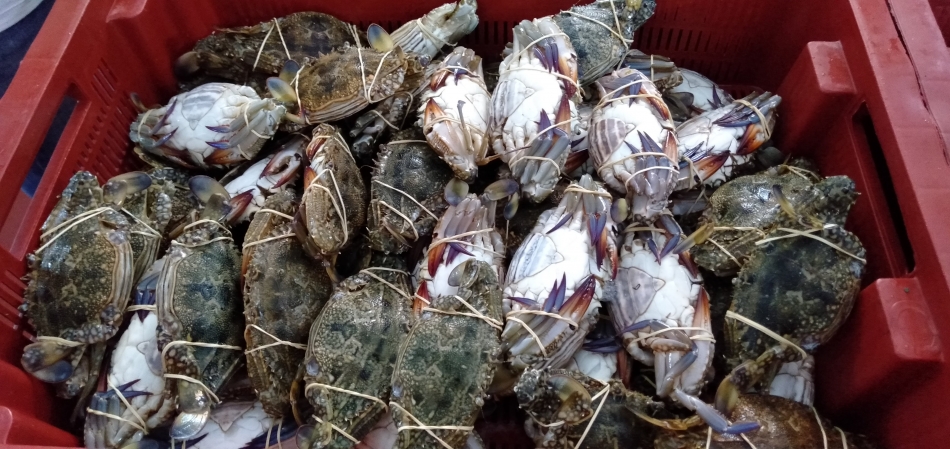
Photos: Left/top: The blue crab was initially a disaster for fishers, ruining nets and traditional fishing techniques. ©FAO/Valerio Crespi Right/bottom: FAO offered training and better traps to Tunisian fishers to take advantage of this new type of catch. Though not well-known locally, blue crab is very popular in other markets. ©FAO/Valerio Crespi
Karin Kloosterman
Karin Kloostermanhttp://www.greenprophet.com
Karin Kloosterman is an award-winning journalist, innovation strategist, and founder of Green Prophet, one of the Middle East’s pioneering sustainability platforms. She has ranked in the Top 10 of Verizon innovation competitions, participated in NASA-linked challenges, and spoken worldwide on climate, food security, and future resilience. With an IoT technology patent, features in Canada’s National Post, and leadership inside teams building next-generation agricultural and planetary systems — including Mars-farming concepts — Karin operates at the intersection of storytelling, science, and systems change. She doesn’t report on the future – she helps design it. Reach out directly to [email protected]

Read More

TRENDING

Fishermen sue tire manufacturers on behalf of the salmon

A federal trial in San Francisco has brought US tire manufacturers, fishing groups, and environmental scientists into court over a chemical most drivers have never heard of — but which scientists say may be silently reshaping aquatic ecosystems.

Yaniv Levy’s Lifelong Quest to Protect Sea Turtles in a Time of War and Greed

This is the story of Dr. Yaniv Levy, founder of Israel’s Sea Turtle Rescue Center—the world’s only government-supported turtle hospital and breeding center unlike any in the world. But to understand why his work matters, you have to go back nearly 30 years, to another coastline altogether: Aldabra Atoll, part of the Seychelles, one of the last untouched Edens left on Earth.

How to help Gaza fishermen

The destruction of Gaza's two main aquaculture farms, along with the hatchery facility, has also left the sector unable to produce alternative aquatic foods through aquaculture. 

Invasive species of the Mediterranean Sea

The Med region is changing as hundreds of new species invade. Can you imagine floating in Cefalu with killer jellyfish?

Yerukim Forms a New Green Economy Where the Money is Really Green

The Yerukim members who pick up the recyclables get to keep the monetary reward, the public earns "green" bills that can be used in shops, and business owners get to be associated with environmentalism.

Choosing Riyadh over Dubai? What Investors Should Know

Saudi Arabia is deploying capital at unmatched scale to catalyze tourism and advanced industry while rewiring its power-and-water backbone. The investable frontier is widening—especially in renewables, grid storage, water efficiency/desal retrofits, and hospitality operating platforms. Prudent investors will insist on phased delivery, enforceable KPIs (energy, water, biodiversity), and RHQ/zone compliance—while pricing political-economy and reputational risks alongside growth upside.

Sell your cooking oil for biodiesel money

Want to make money on old french fry oil? Sell it.

Qatar Alternative Energy Summit Pairs Investors And Innovators

Alternative energy investors and innovators can meet n' greet in Doha, Qatar March 16 and 17.

Here’s How To Implement The Four Pillars Of Employee Engagement

If you throw a party for your work team and they are vegans, don't make it a barbecue. Know the sustainability values of your team to boost moral and retain good people.

Locals From Rishon Fight IKEA

Big Box stores are a pretty new concept in Israel, and thank God that not every Israeli city wants them in their backyard. A word from someone who has see the beautiful farmland around her hometown Newmarket, Ontario stripped and converted into vulgar strip malls of big box shops: they have no place in a healthy and sustainable town or city.

The Jewish National Fund Meets An Inconvenient Truth

According to the JNF, it has transformed thousands of acres of barren land into green forests in Israel. They state that each person emits about 23 tons of carbon per year, estimating that each tree planted can absorb one ton of carbon in its lifetime. That's a whole lot of trees you'd need to be planting. Could so many fit in Israel?

How to quiet noise from construction in your office

Streets need to be resurfaced in New York but the humming and grinding noise is unsettling. Noise is environmental pollution. 

Popular Categories