
Canada’s forest sector contributes roughly 25 billion USD to the country’s economy every year, while the US forest products industry generates an estimated $288 billion USD per year. Together, North America’s timber economy is worth hundreds of billions of dollars.
Yet an astonishing amount of perfectly good wood never becomes part of a building. A friend of mine works in grading wood. Only the straightest, unblemished trees fetch the high prices. The rest? Off to the chipper or back to the forest floor.

Those castaways, the bent trunks, twisted branches, unusual forks and organically shaped knots and sections are chipped, burned, or left as firewood or to rot (the mushrooms are happy!) because they don’t fit the standardized lumber industry.
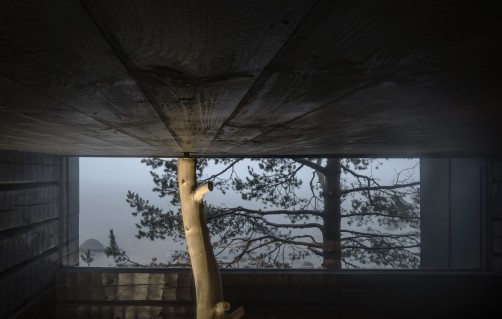
The problem here is economic as much as aesthetic. Timber markets reward straight, uniform logs that can be milled efficiently into dimensional lumber. Those unusual trees with bends, curves, knots that might resemble the face of your uncle, or which are used in weekend cottage projects, are typically downgraded to low-value pulpwood.
Yet for foresters and landowners, these “misfit” trees often sell for only a fraction of the value of premium sawlogs, representing millions of dollars in lost value every year while also shortening the time carbon remains locked away in buildings.
Architect and Aalto University PhD researcher Jaakko Torvinen believes it’s time to rethink the way we see forests. And he’s been working with a Canadian university, Carleton, for proof on how it can be done.
After Green Prophet featured Torvinen’s work in Finland, where he demonstrated how “ugly wood” could become beautiful architecture rather than biomass, he brought the idea to Canada, co-leading a graduate design studio at Carleton University in Ottawa with Dr. Peter Osborne.
The collaboration merged two complementary research directions.
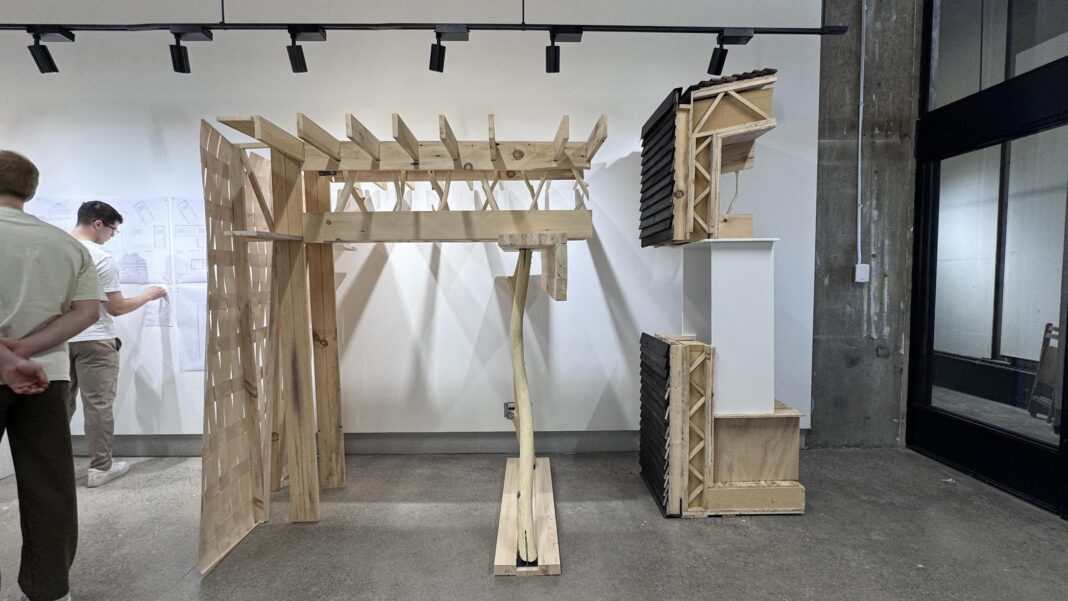
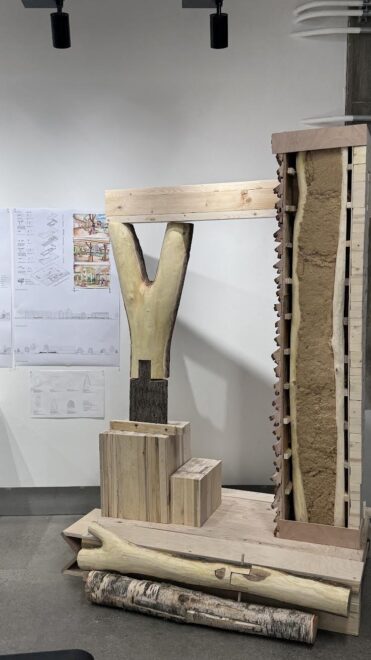
Torvinen tells Green Prophet: “The graduate studio at Carleton University was a combination of my research and Dr. Peter Osborne’s research. He focuses on trait-based wood utilization in timber construction, aiming to expand what wood species we use in building products. I am investigating how we could utilize the organically shaped parts of trees that are not utilized architecturally and structurally.”
Rather than beginning with blueprints, students began in the forest.
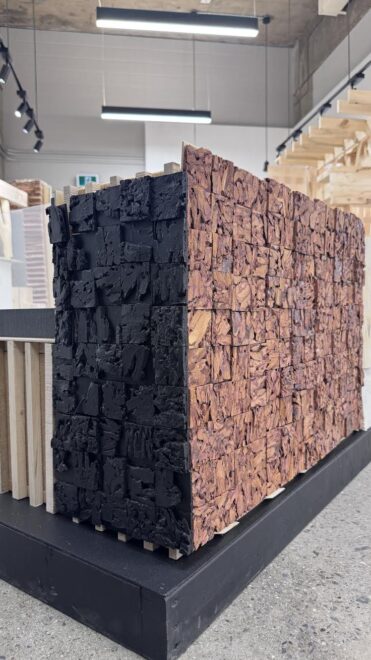
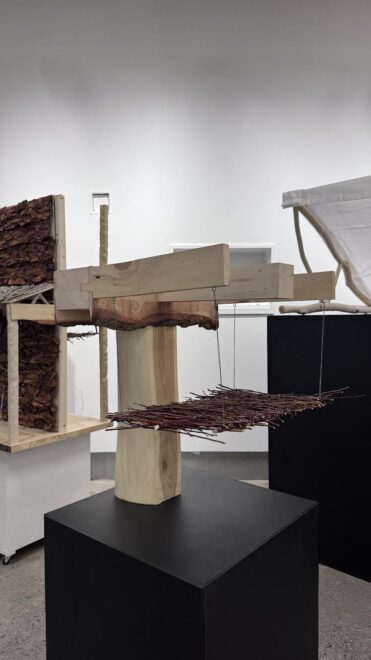
They analyzed the woodlands around Ottawa, Ontario studying which tree species grow locally and how their natural characteristics might become assets instead of defects. The class then sourced material from a local arborist, wood that otherwise would have been fed into a chipper, and transformed it into structural prototypes.
“After building the prototypes, the students designed a fictional public building, the architecture of which was guided by the prototypes they had previously made,” Torvinen explains.
The exercise turned conventional architecture upside down. Instead of forcing trees to conform to industrial standards, the buildings evolved from the shapes the trees had already grown.
For Canada’s forestry sector, the implications reach far beyond an architecture studio. As governments and industry search for ways to reduce waste, increase carbon storage locked into wood, and improve the value of every harvested tree, researchers like Torvinen and Osborne suggest that innovation may lie not only in engineered wood products like cross-laminated timber, but also in embracing the irregular forms the industry has traditionally rejected. Torvinen shows how unusual forms can be sound and solid.
Canada has an opportunity to lead. By creating new markets for crooked trunks the forestry sector could generate greater returns from every harvest while reducing waste and keeping more carbon locked inside long-lasting buildings.
Credit to Carleton students: Alvin Ahn, Dennis Avgerinos, Mostafa Bdeir, Andre Cusson, Haseena Doost, Maria Fares, Alexis Gawlina, Rashida Leslie, Rayan Mazeh, Nadine Mustafa, Shagana Muttiah, Rebecca Sondermeyer, Katrina Tarcia.