
It wasn’t much to look at: a tiny black-and-white photograph, barely an inch by two inches, that had slipped out of an old family album from her husband’s farm in Thedford, Ontario. Four teenage girls in work clothes stared out from it, smiling in front of a tent.
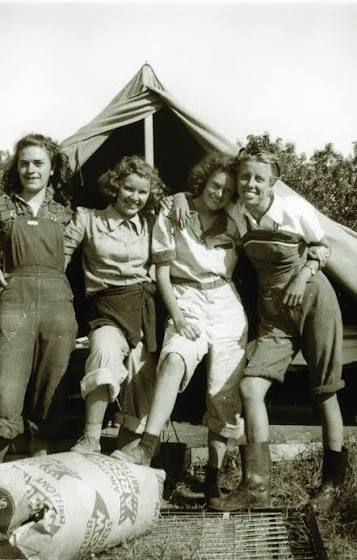
On the back, someone had written a single word: Farmerettes. Nobody in the family could put a name to a single face, but when Bonnie Sitter, a retired travel agent now living in Exeter, asked her husband who they were he said they’d been teen girls who worked on his parent’s farm when he was a boy.
He couldn’t remember their names, says Sitter, as he’d only been a toddler, but he’d known enough not to throw the photograph away. Somehow it survived, tucked among decades of family memories.
Most people would have slipped the picture back into the album but Sitter couldn’t stop wondering who these girls were and what had become of them. As she dug in, she realized her own husband’s family had hired teen girls who’d signed up to miss school for weeks at a time and help out farmers during WWII when young men went to fight in Europe. The girls had helped pick Dutch set onions, harvest celery and stomp on mint grown at the farm, later distilled into oil sold to Wrigley’s for gum made in Toronto.
Related: Women make dresses from war-time flour sacks
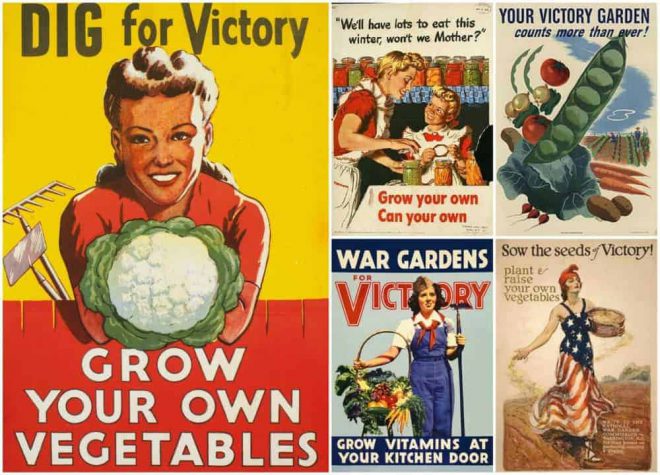
The Farmerettes, as they were colloquially known, were part of Ontario’s Farm Service Force, Ontario’s wartime answer to the labour shortage on farms and Canada’s counterpart to the Victory Garden movement that called on women in America to turn their suburban lawns into gardens.
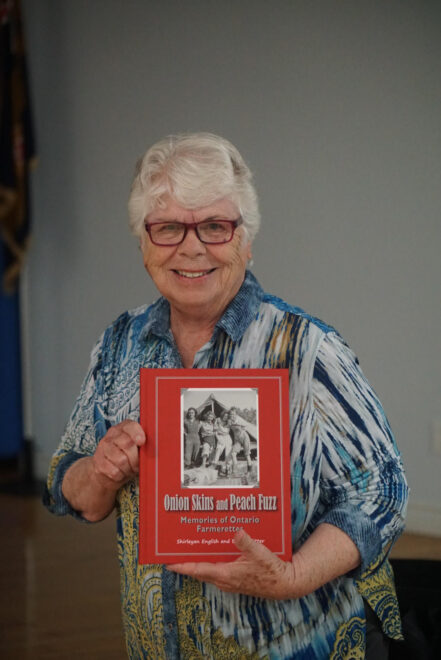
Sitter’s questions grew into a years-long project that produced the self-published book Onion Skins and Peach Fuzz: Memories of Ontario Farmerettes, the documentary We Lend a Hand, a 2024 Canada Post commemorative stamp, and an ongoing effort to build a database of every one of the roughly 40,000 young Canadian women who served as Farmerettes between 1941 and 1952. As far as Sitter has been able to determine, no complete government roster was ever kept.
“I find a rabbit hole… and away I go,” says Sitter who has written a new book on Fred Sloman, a teacher who travelled by train to educate children in remote northern areas.
This Farmerette rabbit hole led Sitter to one of Canada’s most overlooked wartime stories. Most Canadians know about the soldiers who fought overseas, and some remember the women who built aircraft and munitions at home, she says.
“But no one can build guns or bombs without food,” she says. And, she stressed, far fewer know about the teenage girls who kept the country’s farms running.
Her book was published in 2019 but the documentary film made about it will be screened this summer at the Canadian National Expo, the CNE, twice daily, with the cost of an entry ticket to the fair in Toronto.
It is a wake-up call to teen girls on TikTok planning their next Coachella outfit or trip to Sephora: During the Second World War, thousands of young men left family farms to enlist, but the crops still needed planting and harvesting. Ontario’s government answered by recruiting high school girls, from ages 16 to 18, to spend parts of spring, summer and fall to fill in for the labor shortage.
The pitch was blunt: “We can’t fight if we don’t eat.”
Ontario sent teenage girls directly into the fields. The Northern girls were particularly hardy, Sitter says, but there were girls from private schools like Branksome Hall in Toronto, who also pitched in and did just fine after a quick and painful learning curve.
To qualify, a student needed good grades, her parents’ permission, and a willingness to commit to at least 13 weeks of work. The real incentive “or dangling carrot,” says Sitter, was that a girl could skip her final exams and still be promoted to the next grade. In exchange, many were also excused from returning to school right away come September.
Before leaving home, they agreed to sign a pledge to do their best, keep fit, and serve their country (as printed on a paper for them to read and review during downtime) and it included a promise to carry on even on the bad days.
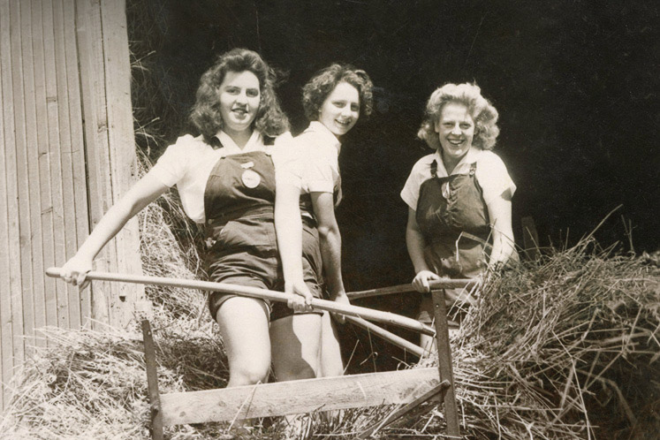
For girls from Toronto, Timmins, Port Arthur, North Bay, South Porcupine and hundreds of other Ontario towns, it sounded almost like summer camp, and a break from everyday life during the post-depression years and in times of food rations — until they met the work.
Some travelled down by train from Timmins to board at Bloor and Jane in Toronto where they were sent on to their destinations, others shipped out from the staging camp, Camp Winonona in South Porcupine, where local Italian women worked alongside them before the Farmerettes were dispatched to their farms.
Wartime gas rationing meant families couldn’t just drive up to visit, so fathers worried about daughters far from home and would arrange for someone to check on them using their gas coupons as cover. In at least one case, the young driver sent to check on a girl ended up becoming her husband.
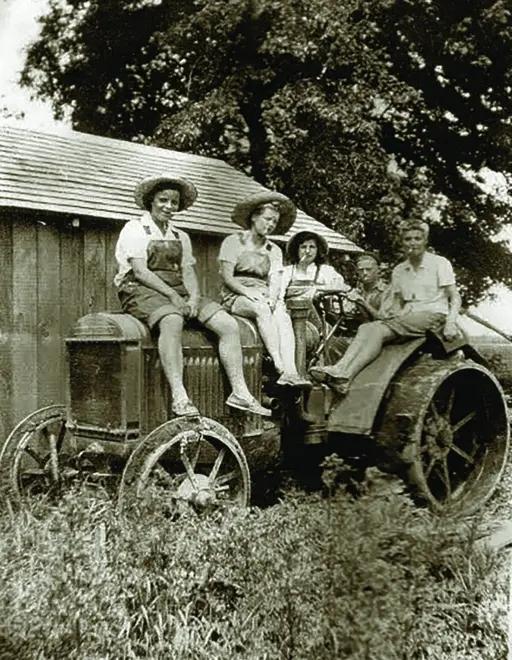
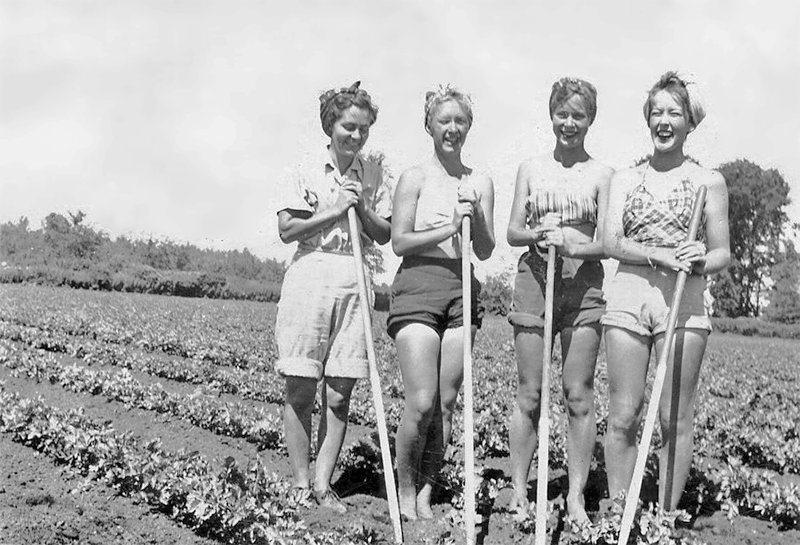
The work itself could be especially brutal for girls who’d never touched a farm implement in their lives. A foreman might simply point at a field and tell a girl she was going to weed it — straddling and clearing three rows at a time. “Some didn’t know the difference between strawberries and weeds,” Sitter says, “One crew picked up a bag thinking it was fertilizer and cemented down the weeds around the strawberry fields.”
An 8-hour day was intense. A morning might start in a peach orchard near Vineland, on a property spanning some 125 acres, carrying heavy wooden ladders from tree to tree and giving each one a cautious bounce before climbing three rungs up, a harness holding the picking basket against their bodies. The fine fuzz from the peaches left itchy rashes on arms and necks, from both thinning the fruit and picking it later.
Initiation into farming meant sunburns and callouses and sore bodies, but yet when Sitter read the correspondence with the Farmerettes, they recall it being the best year of their lives.
She’s poured over hundreds of letters and interviewed almost as many living Farmerettes.
Some of the common farm work might include bending over endless rows of onions for eight straight hours, screening them and sorting until the skins clung to hair and clothing.
Others cut asparagus nearly an inch below the soil, pitched hay, stooked grain, drove teams of horses, or suckered tomato plants. The women were paid 25 cents an hour but sometimes they were paid for piece work: picking strawberries paid four cents a quart; the fastest girl on record could fill 32 quarts in an hour and she earned the title of Farmerette of the Week. One Farmerette was voted best legs, an honour she kept until her last days, says Sitter.
“Look at what they are holding,” she asks the audience of white-haired Probus ladies attending a talk in Newmarket at the Legion. “They are working at the farm but are also looking at their compacts to see how they look.”
They laughed.
Some farms even converted old cars into makeshift “doodlebugs” to serve as extra farm vehicles, since new equipment was scarce during the war. And the Farmerettes would ride in them or drive them around the farm.
There were lessons for life to be learned: One Farmerette wrote about a farmer losing an entire crop of cantaloupe due to an early frost, and she came away from the season having learned that being a farmer was tougher than being a farm laborer.
Sitter shared stories like these recently with the Probus Club where 70 women turned out to hear how one forgotten photograph became a years-long search for Canada’s lost Farmerettes. There are about 250 Probus clubs across the country that bring retired and semi-retired people together for friendship, learning and travel. Sitter was hoping members in the audience might recognize an aunt, cousin or relative in the photos she projected in her presentation.
The work was hard, one could see that, but the Farmerettes built friendships that lasted a lifetime. They slept in bunkhouses and tents with names like Hell’s A-Poppin’, or in converted gristmills — one, Camp Number 6, housed girls upstairs, where the heat was such that nobody remembers lying awake for long. “When their heads hit the pillow, they were out,” says Sitter.
They cooled off in tubs of water after their shifts, danced when they got the chance, hitchhiked back to their hometowns when gas rationing left no other way to get there, and filled each other’s autograph books with notes and small handmade keepsakes, some cut from scraps of leather.
They took photographs of themselves in towels after washing up, well aware of what was happening overseas, and mailed the seductive pictures to boyfriends and soldiers so they would be inspired to keep pressing on. Local girls, Sitter notes, didn’t always love it when a fresh batch of newcomer Farmerettes landed in town. “They’d put the local girls’ noses out of joint.”
There were foreign teens in the mix too: One private school volunteer had been evacuated from England during the Blitz and, after settling in Toronto to attend Branksome Hall, found herself unable to return home because of the war. She signed on as a Farmerette while her father served as Home Secretary in Winston Churchill’s wartime government; her own journey eventually returned her by a rough sea passage from New York to India to meet her dad and learn her brother was killed in the war.
And history has a way of folding back on itself. In the course of her early research, Sitter tracked down Shirley Ann English, a former Farmerette from North Bay, and discovered that Shirley Ann had worked on Bonnie’s husband’s family farm back in 1952, and that the young man she dated there was Bonnie’s own future brother-in-law.
English had put an ad in a local paper and some 300 letters poured in, which would be the foundation for Onion Skins and Peach Fuzz the two would write together. English died in 2025 at 89.
Sitter has also turned up smaller pieces of local trivia along the way, including from one Farmerette from Cochrane who went to high school with a young Tim Horton.
The project has always been a race against time. Many of the women Sitter interviewed were already in their nineties; some had passed their hundredth birthdays. Every delayed phone call risked losing another story.
So far she’s identified about 1,000 former Farmerettes, with nearly 39,000 still unaccounted for since there’s still no complete public record of every girl who answered the call. So Sitter keeps searching, asking people to go through their old family albums before another photograph disappears and another face loses its name.
A dedicated Farmerettes group on Facebook has become one of her main tools for finding them.
Among the keepsakes Sitter has gathered are the small tokens the girls traded at the end of each season — autographs, staged photos with bushels of tomatoes, scraps of leather, handwritten notes and little poems.
One message is on a scrap of leather shaped into the symbol of the Maple Leaf: “Dear Evelyn, when you are old and at your knees, remember us under the peach trees.”
A simple farewell between teenage girls who had no idea, at the time, that they were making history.
We Lend a Hand: The Forgotten Story of Ontario Farmerettes will be screened twice daily at the Canadian National Exhibition (CNE) in Toronto from August 21 to September 7, 2026, with admission included in the price of a CNE ticket. The award-winning documentary tells the remarkable story of the 40,000 teenage girls who volunteered on Ontario farms during and after the Second World War, based on Bonnie Sitter and Shirleyan English’s book Onion Skins and Peach Fuzz.