
Why we might be missing messages from aliens

SETI search, alien signals, extraterrestrial intelligence, technosignatures, radio signals from space, narrowband signals, space weather, stellar plasma turbulence, interstellar communication, SETI Institute research, M-dwarf stars, search for aliens, astrophysics discovery, radio astronomy, signals from alien civilizations
Are we listening?

I am with Elon Musk and his dream to move to Mars. I have always had a feeling that we’re not alone.

For decades, scientists searching for extraterrestrial intelligence have focused on one specific type of radio signal, extremely narrow spikes in frequency. These “narrowband” signals are considered strong candidates for technological transmissions because natural astrophysical processes rarely produce them. However, new research from the alien-hunting organization, the SETI Institute, suggests alien signals might be harder to detect than previously thought, not because they do not exist, but because they may become distorted before leaving their home star systems.

A SpaceX Moon Base rendering by Doge Norway

The study, published in The Astrophysical Journal, explores how stellar “space weather” could blur radio transmissions from distant civilizations. Turbulent plasma near stars, including charged particles carried by stellar winds and eruptions such as coronal mass ejections, can interfere with radio waves as they travel outward from a transmitting planet. Even if a civilization sends a perfectly narrow signal, the plasma surrounding its star could spread the signal’s energy across a wider range of frequencies.
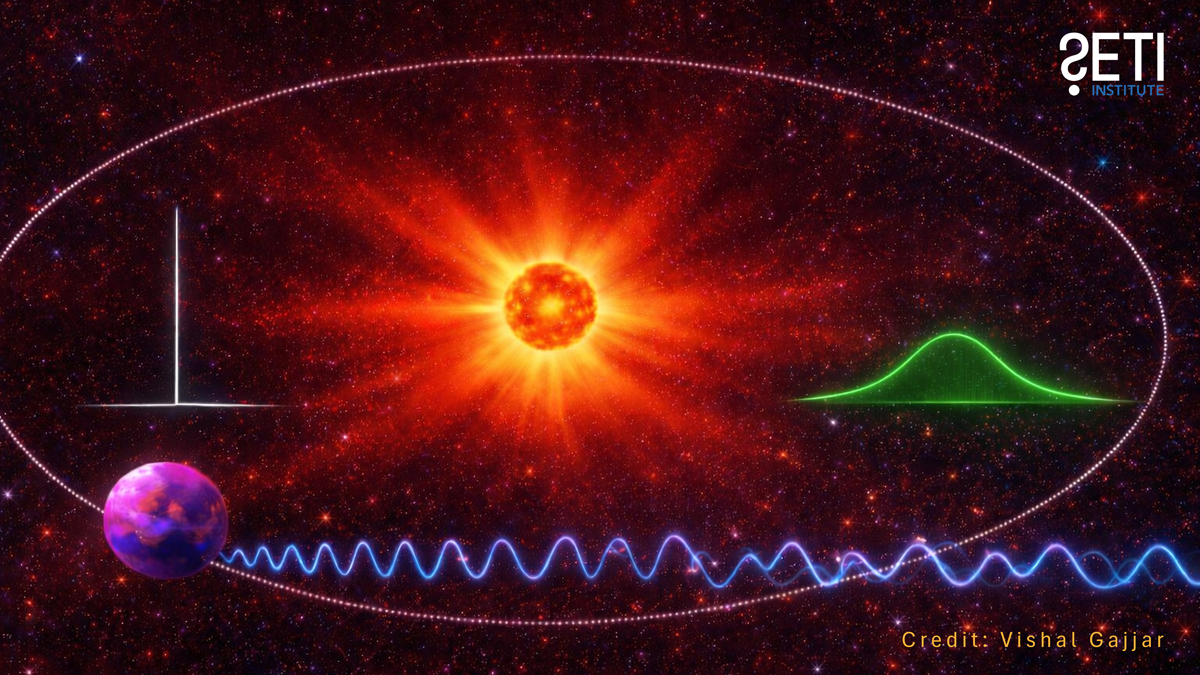
A planet’s radio signal may begin as a sharp tone (left, white) but can be spread out by the star’ssurroundings plasma winds into a wider, fainter signal (right, green). The study suggests we may
be missing signals by mostly looking for the sharp white shape instead of the broader green one

(credit: Vishal Gajjar).
A planet’s radio signal may begin as a sharp tone (left, white) but can be spread out by the star’s
surroundings plasma winds into a wider, fainter signal (right, green). The study suggests we may
be missing signals by mostly looking for the sharp white shape instead of the broader green one
(credit: Vishal Gajjar).

This process weakens the signal’s peak strength and makes it more difficult for traditional SETI detection systems to identify. Many current search pipelines are optimized to detect ultra-sharp signals, meaning broadened transmissions could slip below detection thresholds.

SETI search, alien signals, extraterrestrial intelligence, technosignatures, radio signals from space, narrowband signals, space weather, stellar plasma turbulence, interstellar communication, SETI Institute research, M-dwarf stars, search for aliens, astrophysics discovery, radio astronomy, signals from alien civilizations

“SETI searches are often optimized for extremely narrow signals,” said Dr. Vishal Gajjar, astronomer at the SETI Institute and lead author of the study. “If a signal gets broadened by its own star’s environment, it can slip below our detection thresholds, even if it’s there, potentially helping explain some of the radio silence we’ve seen in technosignature searches.”

A hospitality concept proposed for an eco-resort in a remote natural setting in Qatar. Balsam Madi.
A hospitality concept proposed for an eco-resort in a remote natural setting in Qatar. It might as well be a base station for Martians. Balsam Madi.

To understand how strong this effect might be, researchers studied radio transmissions from spacecraft within our own solar system. By measuring how solar plasma affects these signals, the team developed models that estimate how stellar turbulence might distort transmissions in other planetary systems.

Their findings suggest the effect could be particularly strong around M-dwarf stars, small and active stars that make up roughly 75% of the Milky Way’s stellar population. Because these stars often produce intense stellar activity, signals from planets orbiting them could become significantly broadened before escaping the system.

The research suggests future SETI searches may need to expand their approach, developing detection systems capable of identifying signals that have been smeared or broadened by stellar environments, not just perfectly narrow ones. By accounting for how stellar activity reshapes radio transmissions, scientists hope to design searches that are better matched to what actually arrives at Earth, potentially revealing signals that have so far remained hidden.

Read More

TRENDING

Elon Musk to create Mars base station on the Moon

For those unaware, SpaceX has already shifted focus to building a self-growing city on the Moon, as we can potentially achieve that in less than 10 years, whereas Mars would take 20+ years.

What a martian ice age left behind tells us about our future

We have heard that peak climate change might be...

Perseverance Rover Uncovers Ancient Martian Chemistry — And Raises the Question: Could This Hint at Past Life?

On Earth, similar mineral–organic interactions can be biological or abiotic. In Jezero Crater, the long geological timescales suggest the reduced vivianite and sulfides may have formed without biology — but organic compounds could still have driven the chemistry.

Space travel sunscreen found in new fungus experiment

Moving to Mars? He's a new fungus-based sunscreen to...

Why Is the Martian Night Sky So Bright? New NASA Video Sheds Light on the Red Planet’s Glow

Another factor is sunlight scattering at high altitudes. Even though the Sun sets on Mars just as it does on Earth, light continues to scatter off the high-altitude dust, keeping the sky bright for hours. This is why astronauts may one day be able to navigate or work during the “night” without artificial lighting—at least in the early evening.

Yerukim Forms a New Green Economy Where the Money is Really Green

The Yerukim members who pick up the recyclables get to keep the monetary reward, the public earns "green" bills that can be used in shops, and business owners get to be associated with environmentalism.

Choosing Riyadh over Dubai? What Investors Should Know

Saudi Arabia is deploying capital at unmatched scale to catalyze tourism and advanced industry while rewiring its power-and-water backbone. The investable frontier is widening—especially in renewables, grid storage, water efficiency/desal retrofits, and hospitality operating platforms. Prudent investors will insist on phased delivery, enforceable KPIs (energy, water, biodiversity), and RHQ/zone compliance—while pricing political-economy and reputational risks alongside growth upside.

Sell your cooking oil for biodiesel money

Want to make money on old french fry oil? Sell it.

Qatar Alternative Energy Summit Pairs Investors And Innovators

Alternative energy investors and innovators can meet n' greet in Doha, Qatar March 16 and 17.

Here’s How To Implement The Four Pillars Of Employee Engagement

If you throw a party for your work team and they are vegans, don't make it a barbecue. Know the sustainability values of your team to boost moral and retain good people.

Locals From Rishon Fight IKEA

Big Box stores are a pretty new concept in Israel, and thank God that not every Israeli city wants them in their backyard. A word from someone who has see the beautiful farmland around her hometown Newmarket, Ontario stripped and converted into vulgar strip malls of big box shops: they have no place in a healthy and sustainable town or city.

The Jewish National Fund Meets An Inconvenient Truth

According to the JNF, it has transformed thousands of acres of barren land into green forests in Israel. They state that each person emits about 23 tons of carbon per year, estimating that each tree planted can absorb one ton of carbon in its lifetime. That's a whole lot of trees you'd need to be planting. Could so many fit in Israel?

How to quiet noise from construction in your office

Streets need to be resurfaced in New York but the humming and grinding noise is unsettling. Noise is environmental pollution. 

Popular Categories