
More than 1,000 people are now reported dead after catastrophic flooding tore through Nepal and China’s Tibet region, with thousands more missing. The massive flood which carried cement-like mud through Nepal villages began high in the Himalayas on August 26, when an enormous mass of glacier ice, rock and bedrock collapsed and sent a wall of water, mud and debris down through mountain valleys wiping out anything in its path.
It is tempting to call the Nepal mudslide a natural disaster. But in a rapidly warming Himalaya and Nepal (and world!), the distinction between natural and human-made disasters is getting harder for us to draw.
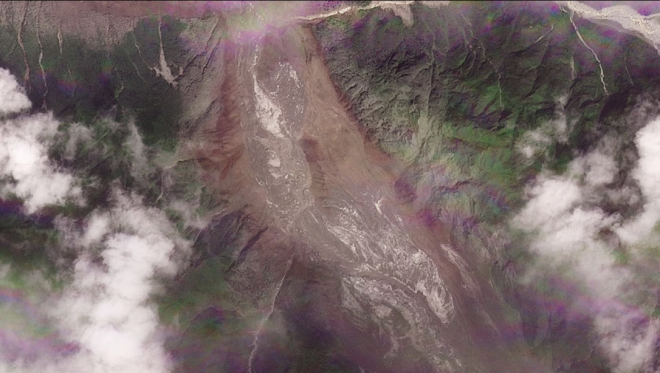
Scientists are still reconstructing exactly what happened. Satellite imagery examined by researchers indicates that bedrock beneath part of a glacier collapsed, carrying an enormous quantity of ice with it. Permafrost is melting and there is nothing we can do about it, it seems. The resulting avalanche crashed into the valley below, where ice, rock and water transformed into a catastrophic downstream flood.
The United Nations reported in 2023 that that Nepal’s mountains have lost close to one-third of their ice 30 years because of global warming. Scientists caution that climate change cannot yet be identified as the singular trigger for this particular collapse. But warmer conditions can melt snow, degrade the permafrost that helps hold steep mountain slopes together and increase the amount of meltwater moving through these already fragile systems.
This happened to me and my property in Canada two winters ago. One day there was 2 feet of snow, and the next after a 68 degree spring thaw, hundreds of acres of snow melted, the ground still frozen, resulting in a massive amount of water that washed out the road.
The Himalayas, like the rest of the world, are becoming unstable. This raises an uncomfortable question about what we are building on the other side of the climate equation.
Did China’s AI boom meets the melting Himalayas
Rumors are circulating that China has built secret server farms in the mountains and under glaciers to avoid cooling costs. It’s a known thing – and Finland has been doing this for decades: building server farms underground where it’s cold. We know that China is investing enormous amounts of money and energy into artificial intelligence, cloud computing, data centers and the electricity infrastructure required to run them. Rumors on x, which we can’t verify, suggest that Chinese server farms heated the glaciers near the Himalayas causing the instability to worsen.
There is currently no evidence establishing that connection. And getting data out from China would be impossible.
But data centers consume electricity, and where that electricity is generated from fossil fuels, they contribute greenhouse gases to the atmosphere. Those emissions join the accumulated global emissions driving climate change. The resulting warming does not respect borders, obviously.
The catastrophe also exposes another uncomfortable relationship between development and the Himalayan environment. Hundreds of workers were reported missing from hydropower projects after the flood, with many feared trapped inside tunnels. Roads, bridges, power installations and communities have been devastated.
The Financial Times has reported that scientists are increasingly concerned about development in a Himalayan landscape already being transformed by warming, glacier retreat, permafrost degradation and seismic instability. Imagine what could happen to melting glaciers when mixed with an earthquake?
Reuters reports that Nepal has been pressing China for better access to upstream glacier and water data. Nepal officials say improved real-time information could provide precious warning when ice, lakes or mountain slopes become unstable. China says it has been sharing meteorological and hydrological information with Nepal and will continue supporting disaster relief and risk reduction.
There is no evidence that Chinese servers melted Nepal’s glacier. But there is a much larger story here. Humanity is constructing an increasingly energy-intensive digital world at precisely the moment when the physical world is demonstrating how consequential additional warming can become. Nepal will be dealing with the consequences long after the television cameras leave.
University of Delaware epidemiologist Jennifer Horney warns that the devastating flooding could create health challenges that persist long after the waters recede.
Horney, an expert in disaster preparedness and public health, points to the long-term physical and mental health consequences of flooding, particularly when damaged or inadequate health infrastructure makes it harder for communities to access care.
Flooding can increase the risk of infectious disease outbreaks, she says. Contaminated water and food can contribute to the spread of illness. Standing water left behind by floods can also create breeding grounds for mosquitoes that transmit diseases such as dengue, malaria, encephalitis and chikungunya. So the effects of devastating events persist long after the event.
The World Health Organization is already warning that damaged water and sanitation systems, displacement and disrupted medical services could increase communicable disease risks in Nepal. Health posts have been destroyed, hospital access has been affected and thousands of households require immediate assistance.
Nepal Floods: Clean Energy, Climate Change and How to Help
National Trust for Nature Conservation (NTNC)— A Nepalese nonprofit working on biodiversity, protected areas, climate change and community-based conservation, including major Himalayan conservation areas.
Clean Energy Nepal (CEN) — Works on climate change, clean energy, clean air, water and building climate resilience in Nepalese communities.
LI-BIRD (Local Initiatives for Biodiversity, Research and Development) —A Nepal-based organization focused on biodiversity, resilient agriculture, natural resources and helping rural communities adapt to climate change.