
For generations, when Jews found doors closed to them, they built new ones—not only for themselves, but for everyone.
It happened in New York when Jewish doctors were excluded from many hospitals and Jewish patients sometimes couldn’t receive care. In 1852, philanthropist Samuel Samson and other benefactors founded The Jews’ Hospital, which would eventually become Mount Sinai Hospital, now one of the world’s leading medical centers serving people of every background.
It also happened in Toronto, where members of the Jewish community founded Mount Sinai Hospital in 1923 after Jewish physicians faced barriers to hospital appointments and privileges. Today it is one of Canada’s premier teaching hospitals, caring for patients of every background.
That history is being invoked today as a new generation of Jewish professionals responds to another challenge, this time within parts of the climate movement.
The Jewish Climate Trust says it has seen increasing numbers of Jewish climate professionals report feeling unwelcome in environmental spaces following the October 7, 2023, terrorism attacks. Members of the LGBTQ+ community have reported similar experiences of exclusion in other settings. Israelis and Jews have also reported being barred from Pride parades and other public spaces.
Even within climate journalism, it is worth remembering that Pulitzer Prize-winning outlet Inside Climate News was founded by Jewish journalists David Sassoon and Stacy Feldman. Originally launched as SolveClimate News, Feldman lived in Tel Aviv during part of the outlet’s early years.
Rather than retreating from climate work, the Jewish Climate Trust has backed a new initiative designed to strengthen both climate action and Jewish community.
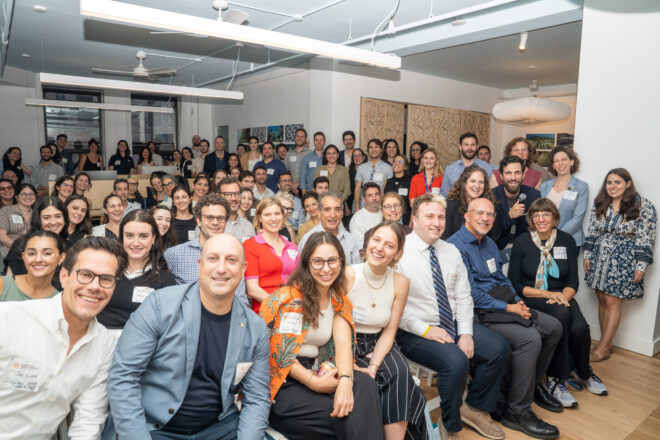
More than a year ago, the Trust funded Adamah to launch the Jewish Green Business Network (JGBN), connecting climate entrepreneurs, investors, scientists and professionals through networking events, mentorship, a job board and an active online community. Its mission is straightforward: accelerate climate solutions while strengthening Jewish peoplehood.
JGBN executive Or Katzman jokingly describes the initiative as “the Green Chabad of LinkedIn,” a place where Jewish professionals can “bring their full selves.”
That sense of belonging has become increasingly important.
As Talya Herring explains: “Representing JGBN at climate conferences, I’ve become aware of the tension many Jewish climate professionals are carrying. Conversations about Israel often happen in polarizing ways, leaving many people feeling isolated. JGBN creates a space where you don’t have to check part of your identity at the door.”
One climate investor quoted by the Trust asked: “Why are we discriminating against a whole people, not allowing them to participate in climate solutions? Why would that help anyone when the world needs these solutions now?”
Building solutions has long been a Jewish response
Jewish history is filled with examples of adversity becoming an opportunity to contribute to society.
Mount Sinai Hospital is only one example. Jewish scientists, including Albert Einstein, helped transform modern physics. Jonas Salk’s work led to one of history’s most important vaccines. Rosalind Franklin’s research transformed genetics. Israel pioneered drip irrigation, helping farmers grow more food with less water, while Israeli Jewish innovators continue developing breakthroughs in desalination, precision agriculture, renewable energy, water recycling and alternative proteins.
Nigel Savage, founder of Hazon and the Jewish Climate Trust, notes that transformative partnerships often begin with shared purpose. The world knows Ben Cohen and Jerry Greenfield, Steve Jobs and Steve Wozniak, and Larry Page and Sergei Brin, he says. Equally influential, he notes, were John Muir and Robert Underwood Johnson, founders of the Sierra Club; Bill Wilson and Bob Smith of Alcoholics Anonymous; Paul Farmer and Ophelia Dahl of Partners in Health; and Bill and Kathy Magee, founders of Operation Smile.
The Trust also highlighted the Jewish Climate Professionals Network, a UK-based initiative founded by Rafi Addlestone and EcoJudaism, as well as Joel Lazar’s Australian Jewish Climate Network.
Rather than allowing exclusion to define them, Jewish communities have often responded by building institutions, investing in education and creating technologies that ultimately benefit everyone. The Jewish Climate Trust hopes JGBN will become another example of that tradition, not as a reaction against others, but as a catalyst for new partnerships.
For the Trust, the lesson is not to dwell on antisemitism but to choose a constructive path forward, which is one rooted in Jewish identity while helping create a healthier and a more sustainable world for all. As environmental challenges become more urgent, the hope is that the best climate solutions will come from every community willing to contribute and that no one will be asked to leave part of their identity at the door.
Do you have a story about a Jewish contribution to the environment or climate change? Send tips to [email protected].