
Eco-anxiety affects nearly 70% of all Americans, new survey

eco anxiety from climate change, man in green light

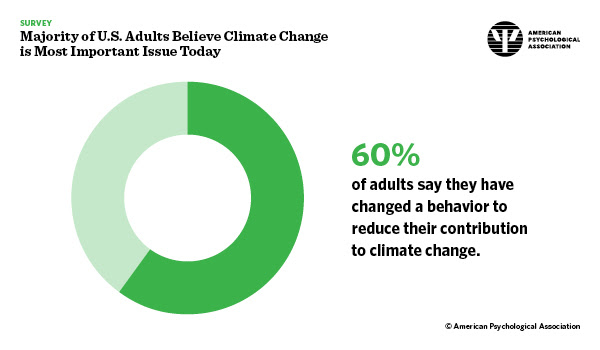
As the effects of climate change become more evident, and more awareness to it is felt, more than half of U.S. adults (56%) say climate change is the most important issue facing society today, yet 4 in 10 have not made any changes in their behavior to reduce their contribution to climate change, according to a new poll by the American Psychological Association. 

This is an important survey to note, because it will implicated how the western east areas of the world, countries like Turkey, Lebanon, Israel, Egypt, Jordan, Syria will follow. There is about a 10 year lag, but we hope the writing is on the wall and enough people will wake up to the real threats that come from fossil fuels and cheap products made in China. 

While 7 in 10 say they wish there were more they could do to combat climate change, 51% of U.S. adults say they don’t know where to start. The survey was conducted online from Dec. 12-16, 2019, by The Harris Poll on behalf of the American Psychological Association. 
APA_Climate_Survey_email-graphics_1.jpg

People are taking some steps to combat climate change, with 6 in 10 saying they have changed a behavior to reduce their contribution to climate change.

Nearly three-quarters (72%) say they are very or somewhat motivated to make changes. 

Among those who have already made behavior changes to reduce their contribution to climate change, when asked why they have not done more, 1 in 4 (26%) cite not having the resources, such as time, money or skills, to make changes. Some people are unwilling to make any changes in their behavior to reduce their contribution to climate change.

When those who have not changed their behavior were asked if anything would motivate them to reduce their contribution to climate change, 29% said nothing would motivate them to do so. 

Climate change fears affects mental health, mainly the younger ones

Concern about climate change may be having an impact on mental health, with more than two-thirds of adults (68%) saying that they have at least a little “eco-anxiety,” defined as any anxiety or worry about climate change and its effects.

These effects may be disproportionately having an impact on the country’s youngest adults; nearly half of those age 18-34 (47%) say the stress they feel about climate change affects their daily lives.

Psychological research shows us that when people learn about and experience local climate impacts, their understanding of the effects of climate change increases.

A quarter of those who have not yet made a behavior change to reduce their contribution to climate change say personally experiencing environmental impacts of climate change (e.g., natural disasters, extreme weather conditions) (25%) or seeing environmental impacts of climate change in their community (24%) would make them want to try to reduce their contribution to climate change. 

Take action to relieve the eco-anxiety

The most common behavior changes people have already made or are willing to make include:

  • reducing waste, including recycling (89%);
  • upgrading insulation in their homes (81%)
  • limiting utility use in their homes (79%)
  • using renewable energy sources, such as solar panels or purchasing electricity from a renewable energy supplier (78%)
  • consuming less in general (77%)
  • or limiting air travel (75%)

Public transport, vegans, bike paths, farmer’s markets wanted 

"beirut lebanon bike path"
Bike path in Beirut, more paths wanted please say Americans. What about us western easterners?

Adults are less likely to say they have changed or are willing to change daily transportation habits (e.g., carpool, drive an electric or hybrid vehicle, use public transportation, walk or bike) (67%) or their diet (e.g., eat less red meat or switch to a vegetarian or vegan diet) (62%). 

A majority (70%) also say that they have already or are willing to take action such as working with their community to reduce emissions, for example by installing bike paths, hosting farmers markets, or using community solar panels.

And nearly 6 in 10 (57%) say that they have already or are willing to write or lobby elected officials about climate change action with a similar proportion (57%) saying they already have or are willing to join an organization or committee working on climate change action. 

The most common motivations for behavior changes among those who have taken action to reduce their contribution to climate change are wanting to preserve the planet for future generations (52%), followed by hearing about climate change and its impacts in the news (43%).

This survey was conducted online within the United States by The Harris Poll on behalf of APA from Dec.12 – 16, 2019, among 2,017 U.S. adults ages 18 and older.


Karin Kloosterman
Karin Kloostermanhttp://www.greenprophet.com
Karin Kloosterman is an award-winning journalist, innovation strategist, and founder of Green Prophet, one of the Middle East’s pioneering sustainability platforms. She has ranked in the Top 10 of Verizon innovation competitions, participated in NASA-linked challenges, and spoken worldwide on climate, food security, and future resilience. With an IoT technology patent, features in Canada’s National Post, and leadership inside teams building next-generation agricultural and planetary systems — including Mars-farming concepts — Karin operates at the intersection of storytelling, science, and systems change. She doesn’t report on the future – she helps design it. Reach out directly to [email protected]

Read More

TRENDING

Weston Higginbotham found dead in a Kyoto forest: is climate anxiety part of the story?

In some ways, Weston has become a symbol of a generation wrestling with environmental and technological anxiety. Friends and family described him as deeply concerned about environmental issues. Reports also noted that he questioned the growing role of artificial intelligence in daily life, even reportedly disagreeing with his mother about her use of AI.

Billie Eilish’s Mom Takes the Stage at Hollywood Climate Summit — But Does Hollywood Still Care About Climate Change?

Hollywood once promised to help save the planet. Leonardo DiCaprio warned of climate catastrophe from awards stages. Celebrities flew to climate conferences. Studios pledged greener productions. Streaming platforms rushed to commission environmental documentaries. But in 2026, with the aftermath of wildfires, heatwaves and floods becoming routine, a question lingers: Does Hollywood still care about climate change?

Can Scientists Predict Coral Bleaching Before It Happens?

Now researchers at the Woods Hole Oceanographic Institution (WHOI) in the US say they have developed a way to predict coral bleaching five to six months before it occurs, potentially giving reef managers enough time to intervene and save vulnerable corals.

10 Amazing Facts About the Sidr Tree

Most people in the West have never heard of the Sidr tree. That's strange when you think about it. This tough, thorny desert tree has fed people, bees, birds, and camels for thousands of years. It appears in Islamic tradition. Its honey sells for astonishing prices.

5 projects to help kickstart your company’s sustainability journey 

True progress happens when environmental ambition meets action. Decarbonizing efficiently is possible for any business in any sector, but actually getting started can sometimes feel daunting.   The trick? It’s to start small and build momentum. Here are five potential projects to help you get started.  

Here’s How To Implement The Four Pillars Of Employee Engagement

If you throw a party for your work team and they are vegans, don't make it a barbecue. Know the sustainability values of your team to boost moral and retain good people.

Locals From Rishon Fight IKEA

Big Box stores are a pretty new concept in Israel, and thank God that not every Israeli city wants them in their backyard. A word from someone who has see the beautiful farmland around her hometown Newmarket, Ontario stripped and converted into vulgar strip malls of big box shops: they have no place in a healthy and sustainable town or city.

The Jewish National Fund Meets An Inconvenient Truth

According to the JNF, it has transformed thousands of acres of barren land into green forests in Israel. They state that each person emits about 23 tons of carbon per year, estimating that each tree planted can absorb one ton of carbon in its lifetime. That's a whole lot of trees you'd need to be planting. Could so many fit in Israel?

How to quiet noise from construction in your office

Streets need to be resurfaced in New York but the humming and grinding noise is unsettling. Noise is environmental pollution. 

EarthX and a blueprint for sustainable investing

Trammell S. Crow, a Dallas-based businessman and father of four, is focusing his efforts on impact investing, and media that focuses on saving the planet through EarthX.

Mining Afghanistan’s Mineral Discoveries Similar to Avatar

Now that American forces in Afghanistan are commemorating the longest period of any war that America has been involved in, including the 1965-73 Vietnam War, the recent discoveries of large and extremely valuable mineral and metal deposits may finally bring to light a reason to continue the presence of US fighting forces in this war torn and backward country.

From Pilot Plant to Global Stage: How Aduro Clean Technologies’ 2026 Expansion Signals a Turning Point for Chemical Recycling Investors Like Yazan Al Homsi

The company's Next Generation Process (NGP) Pilot Plant in London, Ontario, has officially moved into initial operating campaigns, generating the kind of structured, repeatable data that separates laboratory promise from commercial viability.

Nobul’s Regan McGee on Shareholder Value: “Complacency Is the Silent Killer” 

Why the governance framework designed to protect shareholders so...

Popular Categories