


The tide is turning on American cannabis laws. More and more states are opting for medicinal and recreational use of marijuana and whether you are for or against it, there is an interesting effect: technologies being applied for growing cannabis will help make our planet make better food.
Take the Israeli startup EdenShield. The company has taken a special desert plant growing in Israel, Sinai and Jordan, and produces from it natural compounds that repels insects. The plant has evolved special natural chemicals to protect it from being eaten in the harsh desert climate. Think nose plugs for bugs.
While traditional farmers may be slow to adopt EdenShield’s natural extracts, grown and extracted in Israel and then used on netting in the field or applied in the greenhouse, large grow operations for medical cannabis have been taking note.
EdenShield applying its product in the field:
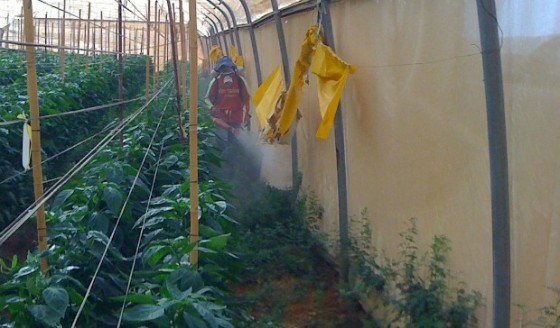
EdenShield is currently looking for financing, but is doing so with a buzz of interest from the medical marijuana community in Canada and the US. Here’s what EdenShield’s CEO, Yaniv Kitron and Guy Malchi, VP of strategy had to say to Green Prophet.
“Around six months ago I got a call from a large Venture Capital firm in Colorado. They wanted to know if our product was suitable for the cannabis plant,” Malchi tells Green Prophet. “We checked the literature and realized that cannabis suffers from ‘the three musketeers’ – thrips, white flies, and slider mites.
“These are the same bugs that we have a lot of experience with and have already demonstrated how our product is effective against them in the field,” he says.
EdenShield’s products which can also be applied onto a crop in the case of roses, is particularly important for the medical marijuana business where customers and regulations are demanding the decreased use of pesticides – who wants to smoke or ingest chemicals that can’t be washed off?
But on the other hand, Malchi points out, because cannabis was a banned substance there is no regulation on what can be used to protect it against pests.
Kitron says; “We hope this market has opened up for us. We’ve started to work with two licensed growers in Israel to demonstrate the efficacy of our product.”
While it certainly wasn’t a business direction they thought about at first, EdenShield is running towards opportunities in medical cannabis production which they think will create business in the more traditional sectors they aim for like food production in commercial farms, or in smaller organic food farms.
Malchi has been to a business networking meeting in Toronto a few months ago, “I can tell you that I approached the licensed holders and I got such great feedback and a huge interest. Now we are in the process of deal making.”
Coming from the world of medical and business innovation, and with Kitron a religious Jew, neither have a problem with pot per se, as long as it’s legal and medical: “The fact that it’s medical means that there is a high level of technical production. We are supplying something that is for medicine which has a good connotation. Maybe more than a technology for growing a bell pepper or tomato,” says Malchi.
EdenShield thinks its product could be especially great for Canadian grow operations where almost all large licensed facilities it seems are indoors: “Indoors our product is much more durable. For us the medical cannabis direction is a good fit,” says Kitron, pictured below.

EdenShield’s compounds are resistance-free, the company says, meaning that bugs never learn how to adapt and tolerate them.
Based on initial surveys the EdenShield technology which does not kill, but which confuses pests to where its food source is, is effective in deterring white flies (by 90 percent) and thrips by 80%.

The team is currently trying their product in Israel and in Africa and are farming the natural substance (plant name is secret) in the northeast Negev Desert. In a kibbutz. They have recently expanded their production from 3 to 30 dunams and are anticipating $1 million USD in sales next year.
And talking about business for cannabis is “sexy” says Malchi. “It certainly introduces our novel approach in a much more bold manner compared to other more conventional crops.
“But the concept is the same. People want to see less pollutants in their plants, and in their food. Ours is a botanical extract which is not only vegan friendly, it’s insect friendly and great for the kosher food market.”
Beyond pot, they’ve also seen an interest in their product for the flower industry in Africa. Europeans with a bad conscience, it turns out, will pay more so that African workers won’t be exposed to pesticides in their flower fields. The flower industry is a dirty one which needs cleaned up.
EdenShield is one of many companies I am seeing that are taking their tech from agtech to “pot”. It’s just a matter of time before the food producers of the world take notice.
Seed breeding, hydroponics and agriculture nutrient companies are also gaining a foothold in new markets from the medical cannabis boon. Technologies derived from the cannabis business, I am sure, will push food production forward the same way space technology aids imaging and medical devices, and defence technologies improve communications. I hope investor types that support platforms like AgFunder are taking note.
Above image of cannabis tech from Shutterstock. Thanks to Trendlines for the tip.




Good stuff, really helpful for beginners like me who are new in the field of medical cannabis. Thanks!
Quality articles is the main to interest the users to pay a visit the site, that’s what this site is providing.
[…] Read the full article on Green Prophet. […]