In California’s self-proclaimed State of Jefferson, a small agricultural technology company is challenging the dominant laser-weeding business model.
Based in the as-yet aspirational State of Jefferson, Laudando & Associates approaches laser-weeding differently than the big dogs. Laser-weeding is a relatively new technology, having entered the market when chatbots started burrowing into public consciousness.
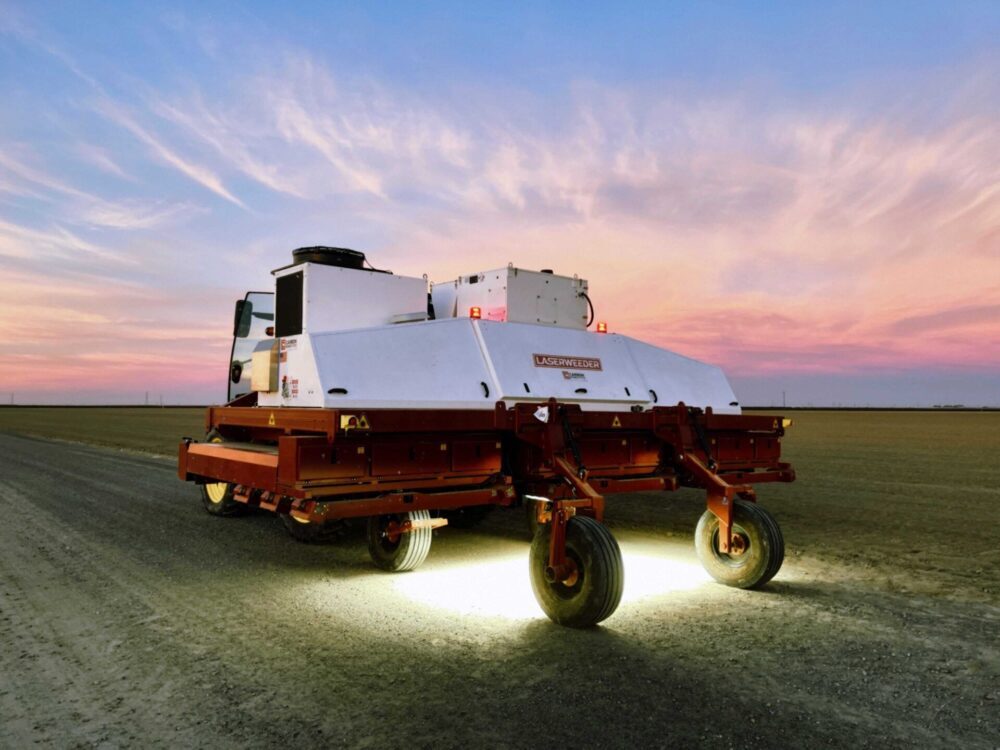
While many companies operate on a subscription model, L&A aims to give farmers more ownership over their tools. Though RaaS (Robotics as a Service) and SaaS (Software) are standard business models in laser-weeding and robotic electric weeding generally, that default setting runs counter to the independence that right-to-repair activism calls for. Between these divergent approaches is not just the question of independence, but the practicality of wide-scale robotics use.
Before getting into the philosophy of how best to serve ag-robotics (these robots build solar panels in farm fields), it helps to understand that the State of Jefferson is an idea that stems from counties in California and Oregon that since the 1940s have intermittently called for leaving those neighboring states in order to unite together and form a new state in the USA’s Pacific Northwest.
While some of these counties overlap with another new state movement’s footprint, that of the Greater Idaho movement, the State of Jefferson grows from feelings of isolation from the urban centers and governments of California and Oregon who some see as lacking the perspective to serve the needs of rural counties.
Thus L&A’s location within the aspirational state of Jefferson is implicitly a statement about the motivations of founder Chris Laudando to give farmers tools that keep working even when the company that made them either is too far away to practically help in reasonable time frame, too expensive, or simply unavailable.
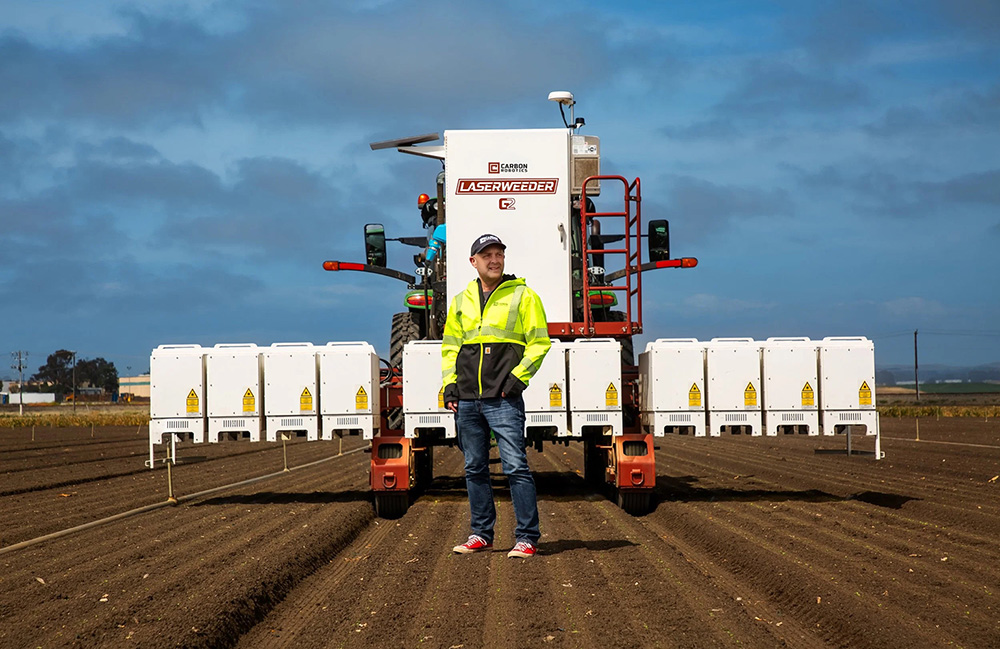
L&A is a wildcard in other ways too, taking on the reigning giant in the laser-weeding field, the NVIDIA-backed Carbon Robotics. And that courtroom drama has had L&A exiled to sell abroad to Australia and other markets while Carbon Robotics confidently states its dominance of the field while other companies like Verdant Robotics carve out their own niches.
L&A, whether based in Chico, CA or Chico, State of Jefferson, sells laser-weeding modules and AI models of each crop. They also provide access to AWS (Amazon’s cloud computing services), allowing farmers to develop and update their own crop models. Physically each model consists of a blue laser driven by the AI edge computing power of an NVIDIA Jetson Orin with USB, Bluetooth, WiFi, and a M12 multiuse port that allows for interfaces such as RS-485, RS-232, and CAN (the same communications system used in cars and other vehicles called the Controller Area Network protocol) in order to allow each module to interface with whatever robotics systems and tools the farmer is using.
RELATED: Agritech stories on Green Prophet
This means farmers get a tool open to their needs and resources, ready to be integrated into whatever systems they have or prefer.
It’s possible that in the struggle between L&A and Carbon Robotics, that L&A may be in the right on technical merits if not legal outcome, much like the hopeful residents of the State of Jefferson. While Carbon Robotics sued L&A for patent infringement, court filings indicate that Carbon Robotics focused on the 300 to 100 nanometer wavelength range of lasers while the specifications of L&A’s L&Aser module are in the higher 400nm wavelength.
L&A had counter-sued, though the last filings indicate a default judgment in favor of Carbon Robotics. L&A is down, but not out except in the American market, while Carbon Robotics’ other competitors are also growing stubbornly and won’t be uprooted quite yet. If anything, laser-weeding is spreading through the electric weed control industry faster than bindweed.