

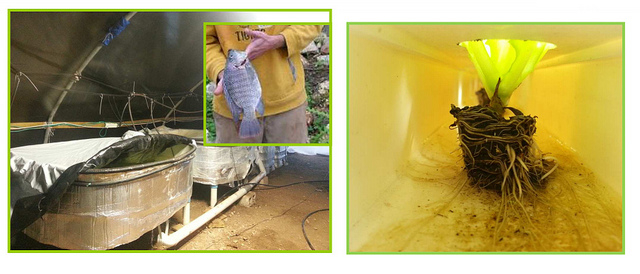
Chinese proverb: Give a man a fish, and you feed him for the day. Give him a fishing rod and feed him for life. New Israeli proverb: Give a man a fishing rod and a hydroponics farm, and you give him food and sustainable income for life.
The new Israeli proverb could be summed up in a word as aquaponics.
Moti Cohen is pioneering a new spin on an old method, in Israel. His approach is a combination of aquaculture (fish farming) and hydroponics (growing plants on water).
He’s building aquaponics farms and is consulting for agencies, such as the United Nations, on how to make aquafarms successful.
The idea is to create a circular farm that provides people with fish and plants to eat in a closed loop. The crops feed off the waste created by the fish, while the fish thrive on the oxygen made by the crops. Both become an important source of nutrients for the people –– with no waste, fertilizer or much water needed.
The “brilliant” idea is an age-old one, Cohen says. It is just starting to see a modern revival.
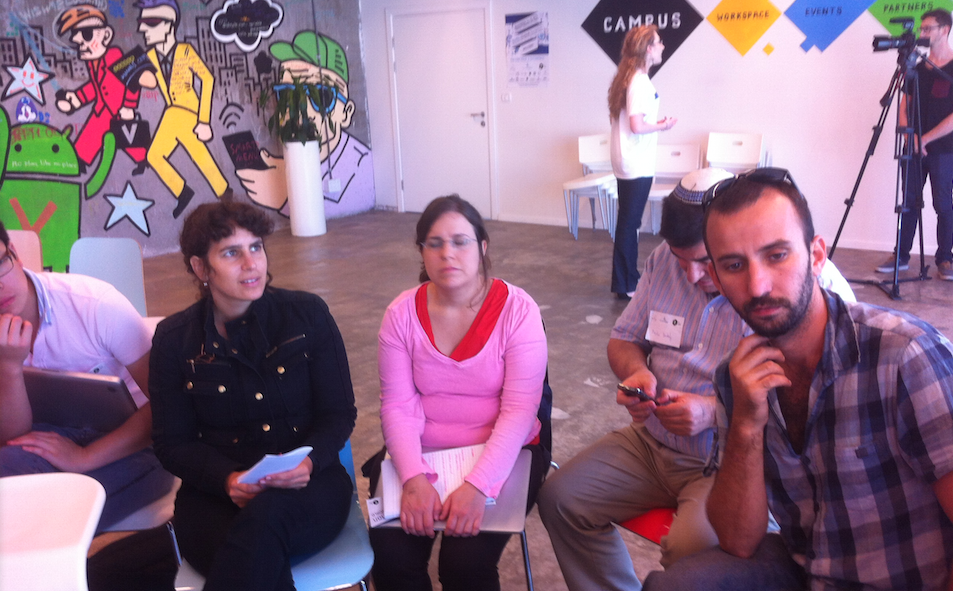 Moti Cohen (right) at a Google Hackathon in Tel Aviv.
In ancient Asia, for instance, rice growers discovered they got better yield when fish were in the rice paddies following floods. The Aztecs, too, developed aquaponics, and there are still people around the word growing using this method, Cohen says.
“It is an ancient method that we can bring up to speed now that we have electricity and fish ponds and great technologies to make aquaponics better than it ever has been,” he says.
The new movement is still young. “We are talking about dozens of years. We are still missing a lot of experts and refining the growing methods. People are inventing new things every day, and the promise is huge.”
Cohen’s private company based in Hofit, Israel, is called LivinGreen Urban Ecosystems. They have built nearly 1,000 aquaponics systems, mostly based on individual needs.
Some are do-it-yourself kits, while in other instances Cohen will operate as a special consultant to NGOs or aid agencies to help them get their self-sustaining farms off the ground and sometimes off the grid.
Systems built with customers in mind
“Our approach is to the customer,” he says. “This is our main advantage. We are not just doing aquaponics.
“For instance, there is a hotel in Zanzibar and we have started talking about doing projects there. They have to buy all their fish and plants to eat from the mainland. But we can support the hotel in an integrated system right on the island.
“We can also connect with Israeli companies like Eco Gas, using hydroponics and biogas, so it really varies.”
The beauty of it all is that the “farms” can be built on rooftops or vertically, wherever space or land might be a challenge. Cohen has consulted for the United Nation’s Food and Agriculture Organization (FAO) with UK partner Christopher Somerville. Together they wrote the aquaponics manual for the FAO.
Cohen has given technical support even to urban farmers in Gaza, the West Bank and Jordan. With Somerville, he is working to advise a group in Ethiopia on building “smart fish” greenhouses. There is another non-profit in Cambodia.
Aquaponics provides fish and crops in a closed-loop system.
LivinGreen employs four people and was founded in 2010. Cohen, 32, studied at the School of Marine Sciences in Michmoret, not far from Hofit on the Mediterranean shore.
Today, led by Cohen, the unique company provides complete systems with consulting, special consultancy and supplies, as well as fish.
Researchers fine-tuning fish farms
Ben-Gurion University researcher Dina Zilberg heads a lab working to improve fish health on fish farms.
She says that while the scientific evidence is not yet there, she is sure that aquaponics –– rearing fish in ponds with plants in water that consume fish waste –– is much healthier for the fish than if they were without the plants.
Fish farming can be a pretty stressful environment for the fish, she says. She sees it in their fatty livers, probably from poor feed, or overfeeding, and what happens when one “rotten apple” of a fish can contaminate and kill others in the closed-loop system.
The main difficulty she sees with the widespread use of aquaponics is that it requires a certain amount of expertise in both fish health and plants. “In all these integrated systems, you need to be an expert while producing both plants and fish intensively. From what I know, many of the plants don’t do such a good job in removing all the nutrients and a biological filter is still required,” she says.
She thinks aquaponics might make the most sense for family farmers who might be operating smaller units for their own consumption.
Cohen agrees that aquaponics is not suitable for every place and time, and is not a silver-bullet answer for developing nations.
LivinGreen systems cost about $1,000 and up. Customers can expect about 80 pounds of fish a year from the most basic and small systems –– with lettuce and veggies aplenty.



Hi i am dipankar from india and i am a fish farmar i like to any help for you
[…] Aquaponics is farming with a fishing rod in Israel […]
yr doing great work but hows about finding a source for coldwater fish for the jerusalem area
yr doing great work but what about finding a source for cold water fish for the jerusalem area?????
cheers shalom
yr doing great work but hows about finding a source for eatable coldwater fish for the jerusalem areacheers shalom ?????
Hello ,
i have piece of land about 10 Acre and sufficient water near Houston tx .I am interested in Fish farming . please send me detail design and list of equipment and how much cost .
thanking you ,
Speaking of fishing; I wish some one would sneak to the Kinneret lake (Sea of Galilee) one night and release a few thousand bass fingerlings , like the species people buy in stores here. Give them a couple of years to mature and reproduce; and there will be some great sport fishing in that lake.
Why not? The Kinneret’s value as a commercial fishing source is just about finished; and sport fishing there would help the tourism industry a lot.
Because releasing fish into a new habitat is a)against the law, and b) will disrupt the ecosystem of the lake. Bad idea.