
Eat Less Meat and Save The Planet

eat less meat Cut your meat consumption by half to combat global warming, urges UN Environment Program.

All over the US, Europe and even in the Tel Aviv University, people are adopting Paul McCartney and Yoko Ono’s Meat-Free Mondays. But one meatless day a week isn’t enough to undo the environmental damage that  industrial farming methods cause. The UN Environmental Program (Unep) is asking us to cut our meat consumption in half.

UK consumers are buying less meat since the horse meat scandal came to light through contaminated Burger King Whoppers. Now its believed that the fraud stretches across the European Union, with horse meat even appearing in school lunches. It’s like a finger pointed at the meat-eating consumer, shaking us into awareness.

While appreciating the useful, although nauseating lesson in transparency and awareness, there’s an issue just as serious at stake. That is, at steak.

If the first world doesn’t curb its runaway appetite for meat, the fragile balance of the natural world will tip over.

As reported by the Unep, the huge expansion of industrial beef-farming methods in the Europe and the US causes “a web of water and air pollution.” The fertilizers, pesticides and chemical weed-killers so freely used in growing grain to feed cattle don’t only pass into the bodies of beasts (and eventually man). The very seas are dying from toxic runoff. The bees that pollinate our fresh food are dying out. And methane emissions produced by our gigantic beef cattle industries are proved to cause global warming on a scale that not even all the transportation in the world combined does.

And while people in poor countries actually need more animal protein, Westerners are consuming much more meat than they need to maintain health.

Professor Mark Sutton,  author of the Unep study, says,

“Eat meat, but less often – make it special. Portion size is key. Many portions are too big, more than you want to eat.”

The enormous Burger King Whoppers come to mind.

The UN scientists paint an optimistic picture in which the undernourished in the world are allotted more meat, while developed countries conscientiously  reduce meat in their diet. But it seems unlikely to happen on some ideal internationally regulated scale. The best ordinary people can do is start planning more meatless meals every week. One less cow slaughtered, one less cow raised.

At least, people can turn to poultry and pork. Chicken in particular is the most environmentally friendly meat, according to Professor Sutton.

” Chicken is one of the most efficient meats, as it grows very quickly and you can collect the manure,” he says.

The Unep study forewarns of dark scenario for the planet.

“Unless action is taken, increases in pollution and per capita consumption of energy and animal products will exacerbate nutrient losses, pollution levels and land degradation, further threatening the quality of our water, air and soils, affecting climate and biodiversity.”

So, what’s for dinner tonight?

Try one of our savory vegewarian main-dish recipes:

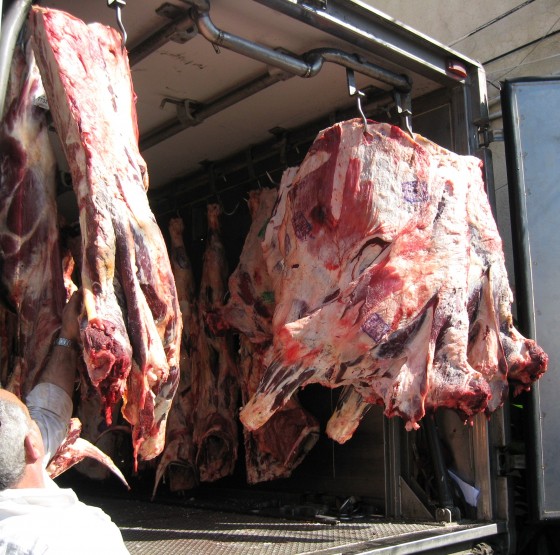
Photo of beef truck in Shuk HaCarmel, Israel, by Miriam Kresh.



Miriam Kresh
Miriam Kreshhttps://www.greenprophet.com/
Miriam Kresh is an American ex-pat living in Israel. Her love of Middle Eastern food evolved from close friendships with enthusiastic Moroccan, Tunisian and Turkish home cooks. She owns too many cookbooks and is always planning the next meal. Miriam can be reached at miriam (at) greenprophet (dot) com.

Read More

2 COMMENTS
  1. You say that: “The very seas are dying from toxic runoff..” but it isn’t merely from raising meat that this is happening, but the use of fertilizer and chemicals – especially companies such as Monsanto – for increasing crop produce – as well as the accumulation of plastic and garbage in our waterways and oceans.
    ..and what about the scariest of all – disposal of radio active wastes into the oceans; see locations of ocean toxic waste dumps: http://businesslifestyle.site88.net/ocean-disposal-of-radioactive-waste/
    Note nuclear reactors on Earth are just ticking time bombs, which was a wake up call for Russia who no longer builds them:
    http://nuclearinfo.net/twiki/pub/Nuclearpower/CurrentReactors/world_map.png

TRENDING

Health Canada approves lab grown milk

Canada's approval of animal-free dairy proteins marks a milestone for precision fermentation and the growing alternative-protein industry. Will consumers embrace milk made without cows?

5 Reasons Why You Should Save Seeds (and plant them)

Saving seeds from tomatoes, peppers, herbs and flowers helps preserve biodiversity, strengthen food security, and keep heirloom varieties alive. Even a small balcony garden can make a difference.

Billie Eilish’s Mom Takes the Stage at Hollywood Climate Summit — But Does Hollywood Still Care About Climate Change?

Hollywood once promised to help save the planet. Leonardo DiCaprio warned of climate catastrophe from awards stages. Celebrities flew to climate conferences. Studios pledged greener productions. Streaming platforms rushed to commission environmental documentaries. But in 2026, with the aftermath of wildfires, heatwaves and floods becoming routine, a question lingers: Does Hollywood still care about climate change?

Can Scientists Predict Coral Bleaching Before It Happens?

Now researchers at the Woods Hole Oceanographic Institution (WHOI) in the US say they have developed a way to predict coral bleaching five to six months before it occurs, potentially giving reef managers enough time to intervene and save vulnerable corals.

Make Guarapo De Piña (it’s fermented pineapple juice)

In Cuba, guarapo is simply freshly-pressed sugar cane juice, and is drunk on the spot, without waiting for it to ferment. But in Colombia, Venezuela, Peru and Mexico, they homebrew guarapo from pineapples or oranges, and the fragrant fluid sits on the kitchen counter top to ferment until it's bubbly.

Yerukim Forms a New Green Economy Where the Money is Really Green

The Yerukim members who pick up the recyclables get to keep the monetary reward, the public earns "green" bills that can be used in shops, and business owners get to be associated with environmentalism.

Choosing Riyadh over Dubai? What Investors Should Know

Saudi Arabia is deploying capital at unmatched scale to catalyze tourism and advanced industry while rewiring its power-and-water backbone. The investable frontier is widening—especially in renewables, grid storage, water efficiency/desal retrofits, and hospitality operating platforms. Prudent investors will insist on phased delivery, enforceable KPIs (energy, water, biodiversity), and RHQ/zone compliance—while pricing political-economy and reputational risks alongside growth upside.

Sell your cooking oil for biodiesel money

Want to make money on old french fry oil? Sell it.

Qatar Alternative Energy Summit Pairs Investors And Innovators

Alternative energy investors and innovators can meet n' greet in Doha, Qatar March 16 and 17.

Here’s How To Implement The Four Pillars Of Employee Engagement

If you throw a party for your work team and they are vegans, don't make it a barbecue. Know the sustainability values of your team to boost moral and retain good people.

Locals From Rishon Fight IKEA

Big Box stores are a pretty new concept in Israel, and thank God that not every Israeli city wants them in their backyard. A word from someone who has see the beautiful farmland around her hometown Newmarket, Ontario stripped and converted into vulgar strip malls of big box shops: they have no place in a healthy and sustainable town or city.

The Jewish National Fund Meets An Inconvenient Truth

According to the JNF, it has transformed thousands of acres of barren land into green forests in Israel. They state that each person emits about 23 tons of carbon per year, estimating that each tree planted can absorb one ton of carbon in its lifetime. That's a whole lot of trees you'd need to be planting. Could so many fit in Israel?

How to quiet noise from construction in your office

Streets need to be resurfaced in New York but the humming and grinding noise is unsettling. Noise is environmental pollution. 

Popular Categories