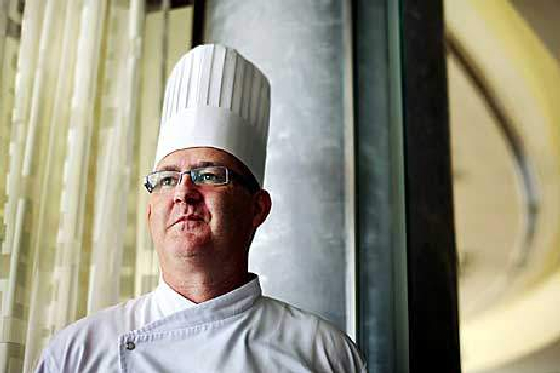
A member of the Forum for Environmental Justice looks at environmental hazards in the Galilee region.
They meet once a month to venture into the field together, discuss environmental problems and devise ways to cooperate to solve them. Most recently, earlier this month, Israeli Jewish and Arab politicians, community leaders, the public and media toured the Sha’our Stream in the Beit Hakerem Valley, in Israel’s Galilee region. Considered a hazardous zone, “it stank like crazy from overflowing drainage,” says Shelly Sharron, English media coordinator for the Abraham Fund Initiatives.
A Jerusalem-based NGO that works to promote equality and social inclusion for all of Israel’s citizens, the Abraham Fund is hosting the Forum for Environmental Justice in an effort to improve the smell of that stream and combat other environmental hazards. A relatively new project that sprouted from seeds planted five years ago, each month the forum brings together municipal leaders from the Jewish and Arab communities in the mixed Galilee region of northern Israel and beyond, encouraging them to find solutions to their shared problems of environmental waste and hazards.
The environment is a great equalizer, since generally all sides are aware of what’s at stake, regardless of national or geographic affiliation. Ever since the Abraham Fund first proposed Mirkam, a social initiative that runs projects to benefit Arabs and Jews in the north, both groups have been aware of the importance of working together. The initiative, developed 10 years ago in response to deteriorating relationships in the wake of the second intifada, encompasses a number of projects.
Disposing of garbage safely, together
The population of the region is split almost evenly between Jews and Israeli Arabs and cultural and fiscal differences can sometimes get in the way of sound environmental policy in the region. By bringing together municipal leaders from both communities the new forum, an outgrowth of Mirkam, hopes to effect change and provide local and national government units with information and resources to inspire a sound cooperative spirit to tackle shared challenges.
One of those mutual problems is determining how to protect the region’s streams and rivers (we already know how the precious Jordan River is almost dead). This issue starts in one community and quite literally trickles down to many others. Sewage from an Arab village that lacks the proper treatment facilitates, for example, enters rivers and eventually reaches the Mediterranean Sea, passing through Jewish towns and naturally invoking the citizens’ ire on its way, Abraham Fund co-director Amnon Be’eri-Sulitzeanu cites an example for ISRAEL21c.
The members of the forum are creating detailed surveys and maps indicating the locations of the hazardous areas, to determine what needs to be done as the first step toward execution. The results of the ensuing cooperation should be felt in the local communities and ultimately in the national legal system, Be’eri-Sulitzeanu believes.
The forum’s current flagship project is the rejuvenation and development of the Sakhnin Valley, conducted in partnership with the Misgav Regional Council, the city of Sakhnin, and the Union of Cities for Environmental Quality, Agan Beit Netufa. The project comprises cooperation with Arab leaders from the local councils of Dir Al-Asad, Majad Al-Krum, Be’ene and Nahef, and Jewish leaders from Carmiel municipality, the northern district of the Ministry of Education, and Delta Galil Industries.
For the time being the forum is thinking and acting locally, dealing with shared environmental hazards in the north. Sharron reports from the July meeting, characterized by the stench of sewage emanating from the beautiful stream: “Everyone – Jews and Arabs – both have rubbish to throw out. It’s very important that the local governments provide a safe way to get rid of the garbage.”
Environment as incentive for coexistence
Explaining why the forum is intervening in what appears to be a government responsibility, Sharron says that “Most of the time the Arab villages… barely have enough funds to pay their employees. If they don’t have that money, it’s difficult to provide infrastructure to deal with the rubbish.”
Numerous problems are obvious and out in the open. Sharron says she’s seen piles of rubbish dumped haphazardly at the edges of olive groves, and bones, meat carcasses and other leftovers chucked into the streets by butchers. “This is dangerous to the health of the environment,” she declares.
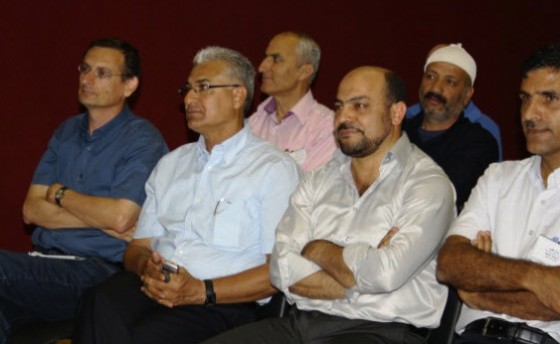 Members of Parliament at a recent meeting.
In the framework of the forum, Jewish and Arab local council heads will be able to work together to tackle the health and environmental issues affecting both their constituencies.
The July meeting included seminars enabling policy makers to engage locally. Presentations were made by various bodies including the Western Galilee Township Association for Environmental Protection, and participants heard an update about the sub-committee formed by the Ministry of Environmental Protection to treat environmental hazards.
Be’eri-Sulitzeanu couldn’t be happier with the model of using environmental problems as a basis for encouraging coexistence, which is his passion: “The environment is a fantastic platform for cross-border or cross-municipality cooperation,” he says. “We took a shot and it was the right one. Right away Jews and Arabs were willing to cooperate on these environment issues because everyone realized that environment hazards don’t recognize borders,” he asserts, adding “We do projects to demonstrate that Jewish and Arab cooperation is worthwhile.”
(This story first appeared on ISRAEL21c – www.israel21c.org)