

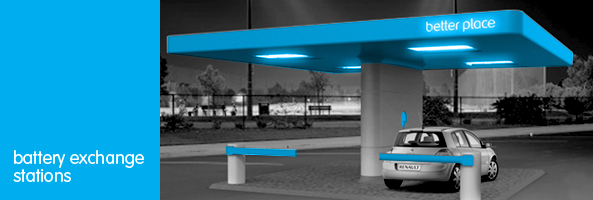
 Automotive companies in Michigan are looking to Israeli battery and electric car innovators, like Better Place, to help revive their ailing car industry.
Michigan meet Israel, Israel meet Michigan: In actual fact, the state of Michigan and the State of Israel don’t need an introduction. In some ways the automotive heart of America has been working steadily with Israel for decades.
While it’s no big secret that the Big Three automotive companies in Michigan have tanked, government incentives are now looking to transform America’s battered auto industry into something new. And Israel could play a part.
Ron Perry, executive director of the Michigan Israel Business Bridge, says that Israel’s history as a supplier to the Big Three – General Motors, Chrysler and Ford – is well developed. With a new focus on electric and hybrid cars, Michigan, he surmises, could benefit from collaboration with Israeli battery researchers.
Before the Michigan Israel Business Bridge was created about three years ago, a number of Israeli firms were supplying parts and solutions to the US auto industry. “The history of Michigan and Israel in the automotive industry has been one in which several kibbutz companies in Israel that produce automotive supplies, and lower level companies, sold to the Big Three and new companies, such as automotive tech companies,” Perry tells ISRAEL21c, remarking that General Motors has an R&D facility in Israel.
As they restructure and build more focused and leaner brands, the Big Three in Michigan are looking to build smaller cars, as well as plug-in hybrids and electric cars.
“Going forward, Michigan will always be an automotive state – people are looking at hybrid vehicles and electrical vehicles and have put a stake in the ground worth a billion dollars of federal funding,” says Perry.
Connecting via batteries
Some $1.3 billion in federal stimulus monies has been channeled into batteries to make Michigan the battery manufacturing capital of the world. Dow Chemical is getting into batteries, Perry relates, asserting that it’s batteries that will bring Michigan and Israel together.
In batteries, there is an opportunity for Israeli companies, says Perry, who is a consultant on water technologies, biotech, clean tech and security. “We’ve made a call out to Israel – to many Israeli companies and researchers in universities developing advanced battery technology for vehicles, energy storage and energy conversion.
“These are all things the State of Michigan and its universities are seeking. There are Israeli companies that are developing the infrastructure for electric vehicles, such as Better Place and ETV, that are developing new engines for the electric vehicle world,” says Perry.
For example, Israel’s ETV Motors recently raised $12 million to fuel its engine, described by USA Today as “a jet engine for a Toyota Prius.”
So far, the Michigan-Israel group has connected with Prof. Doron Aurbach from Bar Ilan University’s Department of Chemistry, a leader in the battery storage field, who also collaborates with key players at other Israeli universities, including Tel Aviv University (which developed the battery storage company Enstorage) and the Technion – Israel Institute of Technology.
“Couples” form after speed dating exercise
The Michigan Israel Bridge has developed two forums over the last couple of years that have led to some concrete business exchanges.
One exchange led to a partnership with a Michigan organization called Automation Alley, which connected Michigan businesses – OEM and Tier 1, 2 and 3 suppliers – to Israeli companies.
It was accomplished “speed dating style,” says Perry, who is not at liberty to divulge the partnerships forged until the companies themselves announce details. “Customers sales were made, as were new customer acquisitions and a couple of strategic alliances between Michigan and Israeli companies,” he says. “We are helping them to further develop their business.
“Even though they have been selling to Detroit, historically [Israeli companies] have a hard time getting their foot in the door. Many of these companies have for years been trying to get to the right business development people even if they have local reps. We’ve helped open doors for some companies who weren’t able to open them before.”
A jumpstart from military and telecom tech
Some of Israel’s automotive technology comes from the military and telecom industries and includes Raval, a company based in the Negev Desert near Sde Boker. Raval supplies fuel tank systems for cars to prevent fuel reflux.
Another Israeli company working with America is Mivrag from the Galilee region, which supplies cold-formed metal parts to Tier 1 and Tier 2 companies including GM, VW, Delphi and Opel. There is also Tadir-Gan that provides precision-molded aluminum parts.
Then there was Microheat’s HotShot technology that went up in flames. The company developed a windshield wiper technology that was to prevent wiper fluid from freezing. A technical problem in GM cars caused a fire and a led to a lawsuit, forcing the company to file for bankruptcy in 2008. The lawsuit was known as the GM ignition switch lawsuit, which was the final straw for GM after years of poor performances.
While he concedes that, “It’s no secret that Michigan has its problems, too,” Perry adds that, “A very large percentage of Israeli companies make a lot of hoopla and then fizzle out when they reach the US market. With that said, I am happy to discuss the good and the bad, and the future.”
And that’s because, according to Perry, “Michigan is not going down easily in this changing world. It is trying to chart a new course.” So with a little innovation, and perhaps a little help from Israel, America’s automotive state may begin to show marked signs of improving.
(This story was first printed on ISRAEL21c – www.israel21c.org)


[…] to the public. American firms in the auto industry are now in contact with Israeli companies like Better Place l/ to assist them in developing electric cars and batteries. Judging from these projects, it is very […]
[…] Renewable Energy Michigan Looks to Israel to Rev Up Automotive Battery Business […]
On the collaboration of Israeli electric car battery manufacturers and Detroit: http://bit.ly/61ifnX
Michigan Looks to Israel to Rev Up Automotive Battery Business … http://bit.ly/5kioHB
Michigan Looks to Israel to Rev Up Automotive Battery Business – Green Prophet (blog) http://ow.ly/16cAjF
RT @greenprophet: News:: Michigan Looks to Israel to Rev Up Automotive Battery Business http://bit.ly/8bvOl5
RT @greenprophet: News:: Michigan Looks to Israel to Rev Up Automotive Battery Business http://bit.ly/8bvOl5
News:: Michigan Looks to Israel to Rev Up Automotive Battery Business http://bit.ly/8bvOl5