

 Billions could be saved if Mediterranean countries combined conservation efforts, finds new Israeli-Australian study. Picture via Hebrew University.
We already know that rodents suffer from human-made boundaries between Israel and Jordan: Coordination of conservation efforts across national boundaries could achieve significantly higher results and at less cost than conservation actions planned within individual states, researchers at the Hebrew University of Jerusalem and in Australia have found. This could be the kind of news that spurs more cooperation among countries in the MENA-Middle East region. This is the kind of news that Green Prophet loves most!
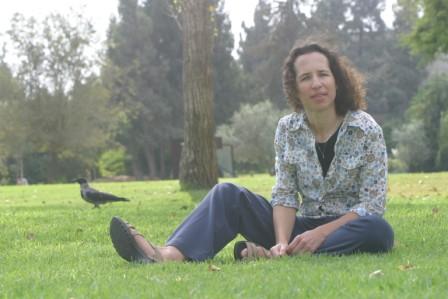 Dr. Salit Kark (pictured left) of the Alexander Silberman Institute of Life Science and Dr. Noam Levin of the Department of Geography at the Hebrew University of Jerusalem, together with Dr Hedley Grantham and Professor Hugh Possingham from the University of Queensland in Australia, wanted to determine how much more efficient it might be if countries within the Mediterranean basin collaborated their conservation decisions and efforts.
“We wanted to investigate the costs and benefits of international collaboration on biodiversity conservation. We chose the terrestrial Mediterranean basin due to its complexity. On the one hand it is an important global biodiversity hotspot with many endemic and rare species. On the other hand, it holds over 25 countries with 250 million people, and large threats are posed to its unique biodiversity. Currently, conservation efforts are largely uncoordinated across the whole region,” said Dr Kark, head of the Hebrew University Biodiversity Research Group.
The study — featured on the cover of a recent edition of the Proceedings of the National Academy of Sciences of the USA — found that there could be a $67-billion savings in costs if conservation efforts of endemic vertebrates were coordinated across all the highly threatened Mediterranean ecosystem, compared with an uncoordinated plan. The amount saved is estimated as 45% of the total cost.
A coordinated plan with just the European Union (EU) countries would also lead to substantial savings compared with no coordination across the Mediterranean Basin’s countries. The authors also discuss the limitations of coordinating efforts.
“Because countries belonging to the European Union cover nearly half of the area of the Mediterranean Basin, we estimated the costs and benefits of conservation when efforts are coordinated across the whole Mediterranean and compared this to an EU partly coordinated plan and with the current situation where each country does its own thing,” Dr Levin, a Geographic Information Systems and remote sensing expert, said.
“While many conservation studies consider biodiversity, in the real world one needs to consider the cost of conservation and the threats to biodiversity. This study shows that when conservation costs and threats are taken into account, conservation is much more efficient,” said Prof. Possingham.
It would be ideal if conservation dollars could be directed to areas with the highest return on investment, however, this requires the ability to transfer money across national boundaries, something that is rarely considered, said Dr Grantham.
“The initiative declared in the recent Paris Summit for the Mediterranean, which nearly all heads of state from the Mediterranean Basin, including those from Europe, the Eastern Mediterranean Basin and North Africa attended, provides a political basis for coordination. Conservation would be an excellent avenue for countries across the region to work together,” said Dr Kark.


RT @Pescalune: Cross-border Conservation Efforts Could Save Billions in the Mediterranean Region http://bit.ly/6Mbg5Q
RT @Pescalune: Cross-border Conservation Efforts Could Save Billions in the Mediterranean Region http://bit.ly/6Mbg5Q
Cross-border Conservation Efforts Could Save Billions in the Mediterranean Region http://bit.ly/6Mbg5Q
RT @risovic: Cross-border Conservation Efforts Could Save Billions in the Mediterranean Region, http://bit.ly/8b5O4o #Israel #Australia
@greenprophet Cross-border Conservation Efforts Could Save Billions in Mediterranean Region, New Study Finds #HebrewU http://bit.ly/7y41Dl
Cross-border Conservation Efforts Could Save Billions in the … http://bit.ly/8Jx3wt
Cross-border Conservation Efforts Could Save Billions in the …: Billions could be saved if Mediterranean countrie… http://bit.ly/5wr21a
Cross-border Conservation Efforts Could Save Billions in the …: Billions could be saved if Mediterranean countrie… http://bit.ly/5wr21a
Save billions – Cooperate on biodiversity research: http://www.greenprophet.com/2009/12/27/15133/biodiversity-middle-east-conservation/
News:: Cross-border Conservation Efforts Could Save Billions in the Mediterranean Region, New Study Finds http://bit.ly/4nD5Jg