Explore the complete private terminal experience in business aviation. Learn how FBOs provide VIP service, privacy, luxury lounges, expedited boarding, enhanced security, and seamless travel for private jet passengers.
Most people know Mars for M&M's and Snickers. Few realize the company has spent four decades researching cocoa flavanols and sustainable cocoa science. After six days testing CocoaVia with pioneers of Toronto's raw food movement, Green Prophet explores the surprising story behind one of the world's most researched cocoa supplements.
Hydraulic systems are at the heart of heavy manufacturing, but poor maintenance can lead to fluid leaks, downtime, and unnecessary waste. By focusing on preventive maintenance, fluid monitoring, filtration, and early leak detection, industrial facilities can improve efficiency, reduce environmental impact, and strengthen sustainable manufacturing without major capital investments.
Jewish herbalism is experiencing a revival as educators like Naomi Spector uncover centuries of plant knowledge preserved through the diaspora. Blending the wisdom of Maimonides, Ashkenazi and Sephardi traditions, and remedies passed from generation to generation, this forgotten ecological heritage reveals how Jewish communities adapted to new landscapes while keeping their cultural identity rooted in the natural world.
The Neptun of Marstal is more than a restored Danish sailing ship. Operated as a non-profit sail-training organization, it invites people of all ages to swap screens for sails, learn traditional seamanship and discover how caring for the sea begins by experiencing it firsthand. Along the way, strangers become crewmates, old maritime skills are kept alive, and the voyage offers a powerful lesson in environmental stewardship, cooperation and the enduring value of learning by doing.
Explore the complete private terminal experience in business aviation. Learn how FBOs provide VIP service, privacy, luxury lounges, expedited boarding, enhanced security, and seamless travel for private jet passengers.
Most people know Mars for M&M's and Snickers. Few realize the company has spent four decades researching cocoa flavanols and sustainable cocoa science. After six days testing CocoaVia with pioneers of Toronto's raw food movement, Green Prophet explores the surprising story behind one of the world's most researched cocoa supplements.
Hydraulic systems are at the heart of heavy manufacturing, but poor maintenance can lead to fluid leaks, downtime, and unnecessary waste. By focusing on preventive maintenance, fluid monitoring, filtration, and early leak detection, industrial facilities can improve efficiency, reduce environmental impact, and strengthen sustainable manufacturing without major capital investments.
Jewish herbalism is experiencing a revival as educators like Naomi Spector uncover centuries of plant knowledge preserved through the diaspora. Blending the wisdom of Maimonides, Ashkenazi and Sephardi traditions, and remedies passed from generation to generation, this forgotten ecological heritage reveals how Jewish communities adapted to new landscapes while keeping their cultural identity rooted in the natural world.
The Neptun of Marstal is more than a restored Danish sailing ship. Operated as a non-profit sail-training organization, it invites people of all ages to swap screens for sails, learn traditional seamanship and discover how caring for the sea begins by experiencing it firsthand. Along the way, strangers become crewmates, old maritime skills are kept alive, and the voyage offers a powerful lesson in environmental stewardship, cooperation and the enduring value of learning by doing.
Explore the complete private terminal experience in business aviation. Learn how FBOs provide VIP service, privacy, luxury lounges, expedited boarding, enhanced security, and seamless travel for private jet passengers.
Most people know Mars for M&M's and Snickers. Few realize the company has spent four decades researching cocoa flavanols and sustainable cocoa science. After six days testing CocoaVia with pioneers of Toronto's raw food movement, Green Prophet explores the surprising story behind one of the world's most researched cocoa supplements.
Hydraulic systems are at the heart of heavy manufacturing, but poor maintenance can lead to fluid leaks, downtime, and unnecessary waste. By focusing on preventive maintenance, fluid monitoring, filtration, and early leak detection, industrial facilities can improve efficiency, reduce environmental impact, and strengthen sustainable manufacturing without major capital investments.
Jewish herbalism is experiencing a revival as educators like Naomi Spector uncover centuries of plant knowledge preserved through the diaspora. Blending the wisdom of Maimonides, Ashkenazi and Sephardi traditions, and remedies passed from generation to generation, this forgotten ecological heritage reveals how Jewish communities adapted to new landscapes while keeping their cultural identity rooted in the natural world.
The Neptun of Marstal is more than a restored Danish sailing ship. Operated as a non-profit sail-training organization, it invites people of all ages to swap screens for sails, learn traditional seamanship and discover how caring for the sea begins by experiencing it firsthand. Along the way, strangers become crewmates, old maritime skills are kept alive, and the voyage offers a powerful lesson in environmental stewardship, cooperation and the enduring value of learning by doing.
Explore the complete private terminal experience in business aviation. Learn how FBOs provide VIP service, privacy, luxury lounges, expedited boarding, enhanced security, and seamless travel for private jet passengers.
Most people know Mars for M&M's and Snickers. Few realize the company has spent four decades researching cocoa flavanols and sustainable cocoa science. After six days testing CocoaVia with pioneers of Toronto's raw food movement, Green Prophet explores the surprising story behind one of the world's most researched cocoa supplements.
Hydraulic systems are at the heart of heavy manufacturing, but poor maintenance can lead to fluid leaks, downtime, and unnecessary waste. By focusing on preventive maintenance, fluid monitoring, filtration, and early leak detection, industrial facilities can improve efficiency, reduce environmental impact, and strengthen sustainable manufacturing without major capital investments.
Jewish herbalism is experiencing a revival as educators like Naomi Spector uncover centuries of plant knowledge preserved through the diaspora. Blending the wisdom of Maimonides, Ashkenazi and Sephardi traditions, and remedies passed from generation to generation, this forgotten ecological heritage reveals how Jewish communities adapted to new landscapes while keeping their cultural identity rooted in the natural world.
The Neptun of Marstal is more than a restored Danish sailing ship. Operated as a non-profit sail-training organization, it invites people of all ages to swap screens for sails, learn traditional seamanship and discover how caring for the sea begins by experiencing it firsthand. Along the way, strangers become crewmates, old maritime skills are kept alive, and the voyage offers a powerful lesson in environmental stewardship, cooperation and the enduring value of learning by doing.
Explore the complete private terminal experience in business aviation. Learn how FBOs provide VIP service, privacy, luxury lounges, expedited boarding, enhanced security, and seamless travel for private jet passengers.
Most people know Mars for M&M's and Snickers. Few realize the company has spent four decades researching cocoa flavanols and sustainable cocoa science. After six days testing CocoaVia with pioneers of Toronto's raw food movement, Green Prophet explores the surprising story behind one of the world's most researched cocoa supplements.
Hydraulic systems are at the heart of heavy manufacturing, but poor maintenance can lead to fluid leaks, downtime, and unnecessary waste. By focusing on preventive maintenance, fluid monitoring, filtration, and early leak detection, industrial facilities can improve efficiency, reduce environmental impact, and strengthen sustainable manufacturing without major capital investments.
Jewish herbalism is experiencing a revival as educators like Naomi Spector uncover centuries of plant knowledge preserved through the diaspora. Blending the wisdom of Maimonides, Ashkenazi and Sephardi traditions, and remedies passed from generation to generation, this forgotten ecological heritage reveals how Jewish communities adapted to new landscapes while keeping their cultural identity rooted in the natural world.
The Neptun of Marstal is more than a restored Danish sailing ship. Operated as a non-profit sail-training organization, it invites people of all ages to swap screens for sails, learn traditional seamanship and discover how caring for the sea begins by experiencing it firsthand. Along the way, strangers become crewmates, old maritime skills are kept alive, and the voyage offers a powerful lesson in environmental stewardship, cooperation and the enduring value of learning by doing.
Explore the complete private terminal experience in business aviation. Learn how FBOs provide VIP service, privacy, luxury lounges, expedited boarding, enhanced security, and seamless travel for private jet passengers.
Most people know Mars for M&M's and Snickers. Few realize the company has spent four decades researching cocoa flavanols and sustainable cocoa science. After six days testing CocoaVia with pioneers of Toronto's raw food movement, Green Prophet explores the surprising story behind one of the world's most researched cocoa supplements.
Hydraulic systems are at the heart of heavy manufacturing, but poor maintenance can lead to fluid leaks, downtime, and unnecessary waste. By focusing on preventive maintenance, fluid monitoring, filtration, and early leak detection, industrial facilities can improve efficiency, reduce environmental impact, and strengthen sustainable manufacturing without major capital investments.
Jewish herbalism is experiencing a revival as educators like Naomi Spector uncover centuries of plant knowledge preserved through the diaspora. Blending the wisdom of Maimonides, Ashkenazi and Sephardi traditions, and remedies passed from generation to generation, this forgotten ecological heritage reveals how Jewish communities adapted to new landscapes while keeping their cultural identity rooted in the natural world.
The Neptun of Marstal is more than a restored Danish sailing ship. Operated as a non-profit sail-training organization, it invites people of all ages to swap screens for sails, learn traditional seamanship and discover how caring for the sea begins by experiencing it firsthand. Along the way, strangers become crewmates, old maritime skills are kept alive, and the voyage offers a powerful lesson in environmental stewardship, cooperation and the enduring value of learning by doing.
Explore the complete private terminal experience in business aviation. Learn how FBOs provide VIP service, privacy, luxury lounges, expedited boarding, enhanced security, and seamless travel for private jet passengers.
Most people know Mars for M&M's and Snickers. Few realize the company has spent four decades researching cocoa flavanols and sustainable cocoa science. After six days testing CocoaVia with pioneers of Toronto's raw food movement, Green Prophet explores the surprising story behind one of the world's most researched cocoa supplements.
Hydraulic systems are at the heart of heavy manufacturing, but poor maintenance can lead to fluid leaks, downtime, and unnecessary waste. By focusing on preventive maintenance, fluid monitoring, filtration, and early leak detection, industrial facilities can improve efficiency, reduce environmental impact, and strengthen sustainable manufacturing without major capital investments.
Jewish herbalism is experiencing a revival as educators like Naomi Spector uncover centuries of plant knowledge preserved through the diaspora. Blending the wisdom of Maimonides, Ashkenazi and Sephardi traditions, and remedies passed from generation to generation, this forgotten ecological heritage reveals how Jewish communities adapted to new landscapes while keeping their cultural identity rooted in the natural world.
The Neptun of Marstal is more than a restored Danish sailing ship. Operated as a non-profit sail-training organization, it invites people of all ages to swap screens for sails, learn traditional seamanship and discover how caring for the sea begins by experiencing it firsthand. Along the way, strangers become crewmates, old maritime skills are kept alive, and the voyage offers a powerful lesson in environmental stewardship, cooperation and the enduring value of learning by doing.
Explore the complete private terminal experience in business aviation. Learn how FBOs provide VIP service, privacy, luxury lounges, expedited boarding, enhanced security, and seamless travel for private jet passengers.
Most people know Mars for M&M's and Snickers. Few realize the company has spent four decades researching cocoa flavanols and sustainable cocoa science. After six days testing CocoaVia with pioneers of Toronto's raw food movement, Green Prophet explores the surprising story behind one of the world's most researched cocoa supplements.
Hydraulic systems are at the heart of heavy manufacturing, but poor maintenance can lead to fluid leaks, downtime, and unnecessary waste. By focusing on preventive maintenance, fluid monitoring, filtration, and early leak detection, industrial facilities can improve efficiency, reduce environmental impact, and strengthen sustainable manufacturing without major capital investments.
Jewish herbalism is experiencing a revival as educators like Naomi Spector uncover centuries of plant knowledge preserved through the diaspora. Blending the wisdom of Maimonides, Ashkenazi and Sephardi traditions, and remedies passed from generation to generation, this forgotten ecological heritage reveals how Jewish communities adapted to new landscapes while keeping their cultural identity rooted in the natural world.
The Neptun of Marstal is more than a restored Danish sailing ship. Operated as a non-profit sail-training organization, it invites people of all ages to swap screens for sails, learn traditional seamanship and discover how caring for the sea begins by experiencing it firsthand. Along the way, strangers become crewmates, old maritime skills are kept alive, and the voyage offers a powerful lesson in environmental stewardship, cooperation and the enduring value of learning by doing.
Open X or TikTok and you’ll find plenty of angry commenters asking the same question: how is it legal to place Hindu idols in Canada’s lakes and rivers?
Traditionally, Ganesha idols were handcrafted from natural clay and painted with plant-based pigments. Over time they would gradually dissolve back into the water and soil. Today, many commercially available idols are manufactured from plaster of Paris, synthetic paints, glues and decorative materials. Some can be purchased on Temu for less than $30, raising questions about what exactly is entering Canada’s freshwater ecosystems when they are immersed.
For Hindu communities around the world, the immersion of a Ganesha idol during Ganesh Chaturthi represents a sacred return of the deity to nature. For environmental regulators, however, placing any foreign object into a lake, river or coastal environment can trigger concerns about pollution, habitat disruption and water quality.
The controversy is not unique to Canada. Idol immersions have faced growing scrutiny in India itself, where courts and environmental authorities have increasingly restricted ceremonies in natural water bodies due to concerns over pollution and ecosystem damage. Some immersions are now directed to designated tanks and controlled locations rather than rivers and lakes.
Still, it is important not to be selective in our outrage. The Great Lakes are already polluted, largely from plastics, industrial chemicals, agricultural runoff and wastewater. Hindu idols are not responsible for those problems. At the same time, Canada has long struggled to balance cultural traditions with environmental stewardship. As immigration grows, newcomers and longtime residents alike must learn the often strict rules governing Canada’s protected landscapes and waterways.
The more interesting question may be how traditions can evolve without losing their meaning.
Could religious idols be made exclusively from natural materials? Could communities create designated immersion areas that protect sensitive habitats? Could idols become artificial reefs or underwater art installations rather than shoreline debris? Companies such as EconCrete are already designing structures that encourage marine biodiversity and habitat restoration.
Even when an idol is made from natural clay, or paper mache, as those produced by Eco Ganesh in India, introducing sediment into a lake is not necessarily harmless. Many fish species rely on clean gravel beds for spawning. Excess fine sediment can smother eggs, reduce oxygen flow and alter aquatic habitat. Environmental regulators routinely restrict shoreline alterations and construction projects for precisely these reasons.
The debate over Ganesha idols in Canadian lakes is ultimately not about Hinduism. It is about water. It is about whether ancient traditions can adapt to modern environmental realities, and whether the natural places we consider sacred deserve protection from all forms of pollution, regardless of who introduces them.
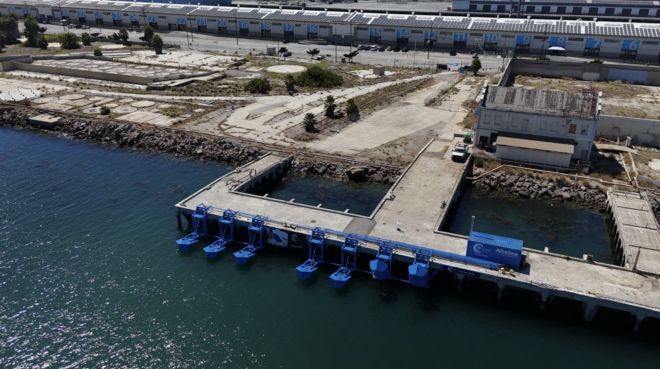
An Eco Wave Energy pilot in Los Angeles, California
Artificial intelligence is changing the world faster than most people imagined. It helps us diagnose disease, help cancer researchers develop new cures, and through a concept called digital twins, helps companies that deal with real world pumps and pipes, use AI to test theories to make processes more efficient.
With digital twins you need a lot of energy, and the leading AI company Nvidia has just featured Eco Wave Power (NASDAQ:WAVE) in a case study in its ability to deliver clean energy from the power of tidal energy.
As part of London Climate Week 2026, NVIDIA is publishing a corporate feature highlighting Eco Wave Power and the company’s use of NVIDIA accelerated computing, AI technologies, and Omniverse-powered digital twins to optimize wave energy generation and infrastructure planning.
“The NVIDIA feature explores how wave energy, AI-powered optimization, predictive analytics, and digital twins can work together to support future energy infrastructure and help address the growing power requirements of AI factories,” says Eco Wave in a press briefing they sent to Green Prophet.
We’ve written about Eco Wave Power over the years, and have visited their pilot site in Jaffa, reminding us that the future of AI may depend less on software and more on energy.
AI factories consume enormous amounts of electricity, even more than servers do for blockchain and Bitcoin mining. As demand for clean, and carbon-free energy rises, governments and tech companies are searching for clean and reliable sources of power. Until we solve fusion, getting an abundance of clean energy from water, we need to reply on a number of solutions from wind, solar, geothermal, and even wave power.
Wave energy is sometimes called wave power. Unlike solar power, which only works during daylight hours, ocean waves move continuously as the sea shifts along with the moon and the tide. This makes wave energy a potentially valuable addition to renewable electricity systems.
Companies such as Eco Wave Power are developing technologies that convert the natural movement of waves into electricity. Their systems are attached to existing coastal infrastructure rather than requiring massive offshore installations. In some ways the systems even offer a protective layer as waves batter the port, as they do in the coastal Mediterranean Sea city of Jaffa.
The company already operates a grid-connected wave energy power station at the Port of Jaffa, Israel, developed in collaboration with EDF Power Solutions and the Israeli Ministry of Energy. I jog by there several times a week.
“The Jaffa installation is indeed a proof-of-concept project,” a company rep tells Green Prophet, “but it is also a grid-connected power station that generates electricity. It is designed to produce power when wave conditions are suitable, generally when wave heights exceed approximately 0.7 meters.”
The company has completed another US-based wave energy pilot project at the Port of Los Angeles, California, developed in collaboration with AltaSea and Shell Marine Renewable Energy.
Researchers have explored different marine technologies over the years, including oscillating water column systems. An oscillating water column uses the rise and fall of seawater to compress air and drive a turbine. It remains one of the most studied approaches in marine renewable energy. And we’ve also covered those systems on Green Prophet.
Wave energy is also closely related to tidal hydropower, another ocean-based renewable technology. While tides are driven by gravitational forces and waves are driven by wind, both offer opportunities to generate clean electricity from the sea.
Artificial intelligence may help accelerate this transition. Digital twins, predictive analytics and advanced simulations allow engineers to model wave conditions, forecast maintenance needs and improve system performance before equipment is deployed in the field. By combining AI with ocean power technology, developers hope to improve efficiency and reduce costs.
Canoeing on Lake Huron, on the Canadian side of this Great Lake
Great Lakes reveal a plastic pollution problem hiding in plain sight
When Canadians think about pollution, they often picture smokestacks, oil spills or distant oceans choked with floating garbage, flipflops and microplastics. Even in the 80s during the days of Acid Rain, Canada blamed pollution in America for its dead lakes. But a new report suggests one of North America’s greatest natural treasures is quietly collecting a steady stream of plastic waste, much of it from our Canada’s own daily habits.
The Great Lakes Plastic Cleanup, a joint effort by Pollution Probe and the Council of the Great Lakes Region Foundation, has released its findings from the 2025 cleanup season. What emerges is a surprisingly detailed picture of how plastic moves through the largest freshwater system on Earth.
The project has now documented more than 277,000 pieces of plastic and debris collected through over 2,800 data submissions across the region. During the 2025 season alone, researchers sorted nearly 32,500 pieces of plastic and other waste weighing more than 42 kilograms.
The BeBot beach-cleaning robot combs a Great Lakes shoreline, removing plastic debris and cigarette butts before they can break down into microplastics and enter the freshwater ecosystem.
What makes this year’s findings especially interesting is that researchers expanded beyond traditional cleanup methods. New technologies, including Canada’s first BeBot beach-cleaning robot, helped remove plastic not only from shorelines but also from waterways and stormwater systems.
The result is a clearer understanding of where pollution originates and how it changes as it travels.
The Great Lakes themselves are full of tiny plastic fragments. Shorelines and storm drains, meanwhile, reveal larger and more recognizable debris. Researchers says this is because larger pieces break down into smaller fragments as they move downstream toward the lakes.
A cottage on Lake Huron, one of Canada’s Great Lakes
One of the most disturbing discoveries is that cigarette butts remain among the most common forms of litter found throughout the region. Smoking-related waste represented nearly 13% of all debris collected. Researchers also noted a growing number of discarded nicotine pouches, a relatively new category of pollution that appears to be increasing alongside the popularity of these products.
Food packaging was another major culprit. Wrappers, cups, containers and plastic bags accounted for more than 8% of all debris found. Food wrappers alone represented almost 5% of the waste collected.
Perhaps most troubling is the persistence of tiny hard plastic fragments. These particles were found everywhere: in the water, on beaches and in stormwater systems. Unlike a bottle or a bag, these fragments are difficult to trace back to their source and nearly impossible to remove once they enter the environment. They become microplastics which will probably linger for hundreds of years.
The findings suggest that cleanup efforts alone will never solve the problem. By the time plastic reaches the lakes, much of it has already broken down into microscopic pieces that can enter food chains, aquatic habitats and drinking water supplies.
The Great Lakes are not dying. But this research reminds us that pollution is no longer just about visible trash. It is about understanding how everyday consumer products gradually fragment into millions of pieces that become part of the ecosystem itself.
Purple has has its time and place. Like any colored hair, it can be health if you treat it right.
You’ve probably searched for a hair care product online, scrolled through the reviews, and still walked away unsure. Five stars from one person, two stars from another, and a dozen comments that all sound suspiciously similar. It’s hard to know who to believe. Who is paid and who is real? And when you’re dealing with something as frustrating as hair fall or thinning, picking the wrong product doesn’t just waste money — it wastes time you didn’t have to spare.
So what actually makes a hair care review worth trusting?
Not All Reviews Are Created Equal
The first thing to understand is that most online reviews exist on a spectrum. On one end, you have genuine experiences from real people who tried something and reported back honestly. On the other end, you have incentivized reviews, filtered testimonials, and content that was written to persuade, not inform. Maybe you are looking for natural haircare, non-permanent dyes, treatments like vitamins that treat your hair from the inside first.
The tricky part is that both can look exactly the same at first glance. A well-written fake review and a genuine detailed one can use similar language. The difference usually lives in the specifics — what the person noticed, when they noticed it, and whether they acknowledged anything that didn’t work.
What a Genuine Review Actually Contains
Real reviews tend to share a few common qualities. They’re not uniformly positive. They mention timelines — how long it took to see any change. They talk about the process, not just the result.
Look for reviews that mention:
What the person’s hair concern actually was before they started
How long they consistently used the product
Whether they changed anything else alongside (diet, stress, other products)
What they noticed first — and whether it matched their expectations
Any side effects or disappointments, even minor ones
When a review reads like a perfect story with no friction, that’s worth questioning. Real hair journeys are messy and slow. Anyone who claims dramatic results in two weeks with zero effort probably isn’t telling the full story.
Why Hair Care Reviews Are Especially Complicated
Curly hair needs a special natural kind of treatment
Hair is not like skincare. A moisturizer might show results in days. Hair growth, on the other hand, operates on a biological cycle that spans months, sometimes several years and can change if you have been pregnant or given birth. The anagen (growth) phase, catagen (transition) phase, and telogen (resting and shedding) phase together mean that visible improvement in hair density can take three to six months — sometimes longer.
This creates a real problem with reviews. Someone who uses a product for three weeks and says it didn’t work may have quit before the biology had any chance to respond. Someone who says it transformed their hair in a month may be noticing reduced shedding, which is a real early sign — but they may be attributing it to the wrong cause.
Context matters enormously. Hair fall caused by iron deficiency won’t respond the same way as hair fall caused by scalp inflammation or hormonal shifts. A product review that doesn’t mention root cause is only telling you half the story.
What To Look for in a Brand’s Own Review Section
It’s reasonable to check reviews on a brand’s website, but you should read them differently than you’d read third-party sources. Brand-hosted reviews are almost always moderated, which means the most critical feedback may not be visible.
That said, even curated reviews can reveal something useful. Look for consistency in what people are complaining about, not just what they’re praising. If multiple reviews mention the same concern — slow delivery, a particular product not suiting oily scalps, results varying with water quality — those patterns are worth paying attention to.
When reading a traya review or any similar treatment-focused brand, pay attention to whether reviewers mention their diagnosis or root cause, not just the product they used. Approaches that personalise treatment based on the individual tend to generate more credible reviews simply because outcomes are tied to specific conditions — making it easier to assess whether the solution actually fit the problem.
Third-Party Sources and What They Miss
Do you shampoo or do no poo? Some countries have soft water, others hard. How can you keep your eco “poo” regimen while you travel?
Dermatologist blogs, independent health publications, and community forums like Reddit can offer less filtered perspectives. But they come with their own limitations. Reddit threads age quickly. A forum post from 2019 about a product whose formulation has since changed is not particularly useful.
Look for sources that are dated, specific, and written by someone who appears to understand hair physiology — not just someone who bought something and had feelings about it.
Final Thoughts
Trusting a hair care review comes down to one question: does this tell me something real, or does it just tell me what someone wants me to hear? Real reviews acknowledge complexity. They admit timelines. They don’t promise the same result for everyone.
Hair is deeply individual. The best reviews reflect that — not by being perfectly positive, but by being genuinely honest about a process that takes patience, consistency, and usually a clearer understanding of why the problem started in the first place.
Elon Musk announcing that SpaceX is building a Moon Base Alpha on the moon.
Even on paper, a trillionaire might be the most powerful force in the world today. Rising on an upward trajectory out of efforts with a basis in the 1980s’ Strategic Defense Initiative and a radical rethinking of the 1990s’ ambitious Clipper program, SpaceX (NASDAQ:SPCX) has begun to realize American ambitions in the highest physical domain. The incredibly ambitious Golden Dome project, the most-anticipated IPO in decades, and the wealthiest man in the world are only the context for the cascade of knock-on effects that this launch will catalyze.
By now it should go without saying that SpaceX has been vital to America’s civilian and military space programs. Both NASA and the United States Space Force depend on SpaceX, as do many companies in the New Space industry of more recent companies of which there are many already and more every day.
In addition, thousands of current and former SpaceX employees are becoming millionaires as a result of this IPO according to the New York Times. One big winner is a New Space company that might rescue the International Space Station: Gavin Petit’s space robotics company, Katalyst Space Technologies. This IPO will bring investment not just in SpaceX and companies with SpaceX ties like Katalyst, it might just create a gold rush for every space company; if it does, the world we live in will be radically transformed from orbit on down, and some terrestrial interests may suffer just as some benefit. This New Space revolution presents predictable challenges to environmentalists and astronomers, yet may pose serious challenges to the generative AI industry beyond the February xAI and SpaceX merger that enabled the SpaceX IPO, a merger which was valued at $1.25 Trillion at the time.
Katalyst home page mission
Linking xAI, which is an AI company that the US military has begun working more closely in light of conflicts the administration has with Anthropic, to SpaceX and its massive IPO may trigger a tokenomics crisis that has already been brewing. The IPO creates the conditions for a brutal price war over enterprise token budgets going on a summer diet even as Anthropic and OpenAI cut token pricing.
Reporting from Forbes argues that this might seriously dent the Anthropic and OpenAI IPOs even as companies using AI turn to solutions that are a better fit for their budgets. Further stacking the deck, xAI has acquired Cursor to begin integrating the generative AI market’s full selection of tools while thumbing its nose at rivals. This acquisition is crucial since generative AI is to using AI what an engine is to driving a car; traditional coding creates the tools that allow for AI to actually be somewhat useful instead of a slop-fueled timesuck and massive waste of money, raising the question of how vital generative AI really is to the future of software when traditional coding is what still provides the real value in generative AI use.
ROI is as yet MIA in most generative AI companies and investors have a strong incentive to buy into the New Space industry paired with practical AI that has more real-world utility. Likewise AI hardware providers, with questions about data centers’ viability becoming frequent. Beleaguered Meta may actually be well-positioned to avoid much impact from this event, having already failed to make science fiction author Neal Stephenson’s Metaverse happen (stop trying to make the metaverse happen, please) while hemorrhaging nearly as bad as the federal workforce post-DOGE.
Attracting savvy investors looking for an edge is not the only way this IPO benefits New Space. While tokenomics is forcing generative AI companies to cut prices and lose their margins, the SpaceX IPO enables SpaceX the choice of lowering its own prices for launch services, which would essentially subsidize launch services and lower the costs of entry into orbit.
Lower launch costs also mean that companies will be able to spend more of their budgets on engineering, manufacturing, and testing their products; in some case this may lower the time to market while increasing viability in the harsh environment of space.
More launch capacity, a higher launch cadence, and lower launch costs benefit New Space companies and their customers while creating terrestrial and atmospheric pollution that has faced varying amounts of oversight in the past yet now is reaching regulatory capture. The existential threat to astronomy as the objects in orbit interfere with terrestrial observation, a threat that grows with each launch as does the likelihood of Kessler syndrome (also known as collisional cascading or ablation cascade) or effect in which orbital debris creates cascade of debris collisions in LEO (Low Earth Orbit, where the majority of satellite constellations orbit before gravity pulls them into the atmosphere where they burn up releasing chemicals into the atmosphere and what doesn’t burn up falls to Earth) which can damage or even destroy anything orbiting at the same altitude.
At present there are more companies monitoring objects, more processing data, and more working on debris clean-up though the potential of the problem outpaces present solutions to it. The combined threats to both science and the environment has motivated activism even as cuts to NASA’s science program and weakening of environmental protections amplify existing problems.
Of continuing concern about AI is the environmental impact which space-based data moat and AI centers aim to address with technology that exists conceptually, yet has not been proven nor stated; what may benefit the environment more is simply reduced demand, similar to how reduced demand for meat and dairy is the only thing that would result in CAFOs (otherwise known as factory farms) no longer being operated.
One unexpected beneficiary of a New Space boom are the opportunities for Afro-Asian space companies as more accessible launch accelerates government projects in Africa’s nascent space programs while creating business for companies from Western Asia like IAI’s projects working with Morocco to Eastern Asia like Hong Kong Aerospace’s spaceport project in Djibouti, as well as proposed spaceports in Kenya and even Somalia.
While there remains speculation that Israel is planning to build an IDF base in neighboring Somaliland (which borders Somalia, Djibouti, and Ethiopian), a spaceport would have more regional benefits especially if it was linked to marine shipping lanes through Berbera and terrestrial transport systems especially if further investment was made in the Aysha to Berbera rail line. The African Space Agency based in New Cairo‘s Egypt Space City would flourish through advocacy for these regional connections to build the capacity enabling the SWANA space boom.
One IPO, many impacts across and above the world, opportunities and challenges for several industries, and potential risks that need to be addressed in order to move forward and upward together.
The Stockholm Exergi carbon capture-and-storage facility in the Swedish capital. Photo: Stockholm Exergi
Artificial intelligence is often blamed for accelerating climate change because data centers cropping up like mushrooms, consume enormous amounts of electricity. AI models require staggering computing power and every new chatbot, image generator and digital assistant comes with a growing carbon footprint. Now some of the companies driving that demand are making one of the largest climate bets in history.
According to The Wall Street Journal, a coalition led by Frontier, backed by Stripe, Google, Salesforce and newly joined AI company Anthropic, has committed an additional $915 million to remove carbon dioxide from the atmosphere. The pledge adds to a previous $1 billion commitment and brings Frontier’s total buying power to nearly $2 billion.
The money isn’t going toward solar panels or wind farms. Instead, it is being used to create a market for technologies designed to pull carbon directly out of the sky and lock it away permanently. We learned in the early days that planting trees isn’t enough: Coldplay collected money to sequester carbon, then the trees died. And hey if Dubai can buy 20% of Zimbabwe for carbon projects, certainly Silicon Valley can play their part.
“The question today in carbon removal is whether demand will keep pace with that technology development,” Frontier head Hannah Bebbington Valori told the Wall Street Journal. “That’s why we’ve raised this growth advanced market commitment.”
The technologies sound like science fiction.
Some companies use giant fans to suck carbon dioxide from the atmosphere. Others spread crushed basalt rock on farmland where natural chemical reactions absorb carbon. Some are experimenting with changing ocean chemistry to increase carbon storage. Others capture emissions from bioenergy plants and store the carbon underground. They promise golden bullets but no carbon sequester technology is there yet.
For decades environmentalists argued that reducing emissions should be enough. Today many scientists acknowledge that even aggressive reductions may not be sufficient. Humanity has already emitted so much carbon that removing some of it may become essential.
The carbon-removal market has exploded from a niche experiment into a multi-billion-dollar industry. According to carbon-removal database CDR.fyi, companies have now purchased roughly 49 million carbon-removal credits worth around $12 billion.
Much of the market depends on a surprisingly small group of buyers. Microsoft alone accounts for roughly three-quarters of all engineered carbon-removal purchases and don’t be surprised if they earn tax breaks or perks on that.
If major tech companies stop buying, the industry could struggle.
That makes Frontier’s new commitment more significant than the dollar amount itself. The group is attempting to prove there will be long-term demand for carbon removal, giving startups confidence to build infrastructure that otherwise might never leave the laboratory.
In Sweden, carbon-removal developer Stockholm Exergi told the Journal that Frontier’s commitments helped unlock government support for its projects. Public money and private money are beginning to work together to build an entirely new climate industry.
The most interesting part of the story is not the technology itself. It is that some of the world’s largest AI and software companies are effectively creating a market from scratch.
Oklahoma father Tyler Brodsky became the center of a national debate after accompanying his young daughters into a women’s restroom during a road trip. For many parents, the story is less about politics and more about a simple question: how do you help your children feel safe when public bathrooms often fail families?
An Oklahoma dad Tyler Brodsky never expected a routine bathroom stop during a road trip to become international news. Yet after bringing his two young daughters into an empty women’s restroom at a QuikTrip gas station in Alabama, he found himself at the center of a viral debate that says far more about our society than it does about him. Police were called, videos were posted. Millions watched as he was either shamed or celebrated. In the end, officers reportedly told Brodsky he had done nothing wrong.
As a mother, and as someone who spent much of her childhood camping across Canada with her father, I understood his decision immediately. When I was a little girl, there were no family washrooms invented. No gender-neutral facilities; there were no carefully designed parenting rooms with changing stations, breast feeding chairs and tiny toilets like you find at ToysRUs. There were simply men’s rooms and women’s rooms.
I never wanted to go into a public bathroom alone when I was under the age of 8. Like many children, I found them intimidating and frightening if they weren’t busy at all. Who could be inside? My father faced the same dilemma that Tyler Brodsky faced decades later. Do you send your young daughter alone into a public restroom, hoping everything will be fine? Or do you accompany her into a space where she feels safe? My dad never wanted me to go to the men’s room because he knows how men think.
The women’s bathrooms were usually cleaner. They had enclosed stalls, and they offered privacy. The men’s bathrooms, at least the ones I remember from campgrounds and trailer parks, were often another world entirely. Smelly urinals lined the walls, doors on stalls were usually broken or missing. The smell alone could be enough to make a child want to leave immediately. And what if I were to see a naked man urinating? I did.
When people criticize Brodsky for bringing his daughters into a women’s restroom, I wonder whether they have ever actually escorted a frightened five-year-old into a busy men’s room. Brodsky’s explanation was straightforward. He said he would rather use an empty women’s restroom than bring two little girls into a men’s bathroom filled with grown men and dirty stalls. Millions of parents appeared to understand exactly what he meant.
After the ordeal, Brodsky posted the video to TikTok writing, “Y’all make this man famous.”We stopped at a QuikTrip on our road trip from Florida back to Oklahoma so my daughters could use the restroom,” he continued in the post. “The women’s restroom was empty, so I took them in. I’d rather do that than bring two little girls into a men’s bathroom full of grown men and dirty stalls. This guy comes barging in yelling, scares my daughters, and somehow thinks THEY should’ve been in the men’s room instead. Am I wrong here?”
This story is not really about politics, it is not about transgender rights. It is not about culture wars. It is not about scoring points on social media. It is about a father trying to protect his daughters and help them use a bathroom.
Good luck even trying to find a hole in the ground in some countries I’ve travelled to, never mind the luxury of mens and womens.
The strange thing is that the outrage often ignores the practical reality. A responsible father, who is a single father, is accompanying two young girls into an empty women’s restroom is doing exactly what society expects parents to do: supervise their children and keep them safe.
The alternative would have been sending them in alone or exposing them to a men’s restroom environment that many parents would prefer to avoid. Some little kids need their bums wiped and dad needs to help with that.
Parents have been dealing with this problem for decades. Similar debates have surfaced repeatedly because public infrastructure has not caught up with family life. Family bathrooms remain surprisingly rare in many places despite being one of the simplest solutions available. The bigger issue may be that we simply do not have enough public bathrooms, and if we had more, he wouldn’t have had to have used a commercial facility.
Visit almost any city and finding a clean restroom becomes an exercise in negotiation. You buy a coffee or a burger to gain access to a key. You ask a restaurant for mercy, you cross your fingers. Despite Starbucks being in the news later for a class action suit over soy and oat milk in lattes, they are pretty good about keeping bathrooms open to the public. A recent trip to a Starbucks in Berlin near the Brandenburg Gate was open to the public, men or womens. We used mens because there was no line. Luckily I didn’t get caught on TikTok.
Japan has shown what public sanitation can look like when governments take it seriously. Clean, accessible public toilets are treated as basic civic infrastructure rather than an afterthought. They are maintained, respected, and available. I loved that about Japan. Plus the toilets clean themselves.
Instead of arguing endlessly about who stood in which doorway for three minutes, perhaps we should be asking why modern cities still make it so difficult for parents, children, seniors, tourists, and people with disabilities or identity issues to find a clean, safe restroom.
Tyler Brodsky’s story struck a nerve because many parents recognized themselves in it.I did. As the kid I once was and the mother I am now. I didn’t let my boy use the men’s until was about 11 or with his dad. It’s not safe. When common sense collides with bureaucracy, common sense should usually win.
Arab squat toilet in Egypt
But you might not like my opinion because I hold unpopular ones about squat toilets. I actually prefer them as they are generally cleaner.
A latte with oat milk shouldn’t cost more than a latte with dairy milk. A lawsuit in Canada is challenging years of non-dairy surcharges at major coffee chains.
For years, ordering a latte with a non-dairy milk meant paying an extra 50 cents, 80 cents, sometimes more. It always felt odd when I saw that on a menu. Now Quebec is launching a class action suit against Starbucks, Tim Hortons and Second Cup for levying a fee on alternative milk, sometimes 6 times more what the supplement is worth.
The lawsuit was launched by Liel Ohayon, a vegan and regular ay Starbucks and Tim Horton’s. She says she pas an extra $0.80 for plant-based milk in a matcha latte, increasing the price from $6 to $6.80 if she asks for soy or oat milk.
Starbucks noted the supplement costs $0.12 more than regular milk.
Ohayon wrote, “By its own admission, Starbucks therefore charges consumers more than six times the cost it incurs when it replaces cow’s milk with plant-based or lactose-free milk in its beverages. Indeed, it does not appear frivolous or manifestly unfounded to argue that it is disproportionate to charge the consumer more than six times what it costs the merchant to substitute cow’s milk with plant-based milk in their tea or coffee, and that this disproportion is sufficiently significant to cause serious harm to the consumer.”
We are told that plant-based alternatives are part of a more sustainable future, yet somehow the customer choosing them is the one paying the penalty.
I say this as someone who isn’t even a vegan. I like dairy. I drink coffee with dairy. It’s one of my weaknesses and I’ve made peace with it. I don’t particularly enjoy oat milk. I can’t stand soy milk. Almond milk often tastes watery to me. The one exception I’ve found is Remilk, the precision-fermented milk protein developed in a lab. For people keeping kosher or looking for an alternative to conventional dairy, it comes surprisingly close to the real thing. A faint coconut note lingers in the background, yet the texture and taste profile are far better than most alternatives I’ve tried.
Remilk is now hitting the shelves
Still, even if alternative milks aren’t my first choice, the economics never made sense.
A couple months ago, I stopped at a Starbucks in Amman, Jordan. Expecting the familiar coffee cream offered in North America, I asked for it and was met with confusion. They didn’t have it. Instead, the barista improvised, blending whipping cream with whole milk to create something approximating the rich half-and-half I was used to. It wasn’t quite right, but there was something charming about the effort. It was a reminder that coffee culture needs to adapt to local realities. I was not made to pay extra on the already expensive coffee.
What is less charming is discovering that some of the largest coffee chains in North America have apparently been charging customers far more than the actual cost of swapping dairy for plant milk. A class-action lawsuit authorized in Quebec is now targeting Starbucks, Tim Hortons and Second Cup over allegations that consumers were charged excessive surcharges for oat, soy, almond and other non-dairy alternatives. According to court filings, Starbucks acknowledged that a plant-milk substitution cost the company about 12 cents while customers were charged 80 cents, more than six times the company’s admitted cost.
The lawsuit argues that these fees were disproportionate and potentially abusive under Quebec consumer protection laws. Quebec also has funny language laws, and the Yiddish word Nosh used to advertise a local eatery has been smacked down by the language police. But whatever crazy happens in Canada you can be sure will move over to LA, and then to NY, and spread widely around the US and with the world.
Starbucks eventually dropped the surcharge in company-owned stores in Canada and the United States in late 2024, while Tim Hortons and Second Cup followed with similar changes. If you see a surcharge on alternative milk, speak up.
Private label, alternative milks available at Starbucks: Chobani Oatmilk, almond milk, coconut milk, soymilk vanilla flavor. None of these are actually milks.
The irony is hard to ignore: According to research from the University of Oxford, producing plant-based milks generally generates significantly lower greenhouse gas emissions and uses less land than conventional dairy milk. Oat milk, soy milk and almond milk each have environmental tradeoffs, but as a category they tend to have a much smaller climate footprint than cow’s milk.
So why were consumers trying to make a lower-impact choice paying extra for the privilege? Independent cafés have a reasonable argument. They operate on thinner margins and often pay more for specialty ingredients. A neighborhood coffee shop may genuinely need to charge more for alternative milks because it lacks the purchasing power of a multinational chain.
Large corporations, however, are a different story. When the surcharge bears little resemblance to the actual cost difference, it is opportunity.
Consumers notice when sustainability becomes a premium product. They notice when doing the “right thing” costs more. And they certainly notice when companies wrap themselves in environmental messaging while quietly charging extra for the greener option. If businesses genuinely want customers to make more sustainable choices, they should stop treating those choices as luxury upgrades. Reward people for using plant-based milk instead.
My awful ex, who I’ve also mentioned before, insisted on having a TV for videogames, anime, or to watch YouTube videos about videogames and/or anime. And if it wasn’t on the TV it was on her phone, sometimes while the TV was also on. That made any kind of parallel existence impossible by both boring me and disrupting my focus. I spent so much time on my computer trying to escape mentally that what little life I had ground even further to a halt. Social media became my community and isolation ensured that I forgot what little I understood about how to exist in community in real like; like so many people experienced, COVID only intensified this. Every connection I had from that point on started becoming parasocial, I became reactive, my ex emotionally abusing me fueled my paranoia, and without my own vehicle I found myself online even when I had a break from my ex.
As much as I come to hate her constant TV use, I found myself trapped in my computer. Futilely I’d play League of Legends on my computer to have something in common with her and to feel a false sense of accomplishment, but the social toxicity only fed into my growing reactivity. Across the internet, social media’s toxicity had started growing from niche abuse of socially-marginalized people to a constant barrage not just of hatred, but also a devolution into constant pointless arguments anchored no deeper than misunderstandings, disinformation, and a topical cycle of news and drama that never ended while never failing to generate further vitriol.
After breaking up with my ex, moving home, breaking up with my other ex, failing to reconnect with friends or meet anyone new, my phone became my sole source of consistent connection. Eventually I found myself watching Instagram Reels, YouTube, and even TikTok despite having sworn that I never would. Some nice conversations were had, I certainly learned so much, and I developed a massive crush on someone who has taught me more about myself and Judaism than anyone, yet I fell victim to the same addiction of endless videos that had so tormented me when my ex had insisted on doing the same.
So I started deleting my social media. I swore off phones and started writing a book about it. I fell off that path, then got back on it. I started rewriting the book from scratch, then fell off that path again, then started all over again. Despite that, hoping to see a glimpse of my far-off crush, I ended up spending whole weeks in bed scrolling on my phone after seeing what she said and then running out of data watching YouTube on the lowest resolution possible. I started losing sleep even after having learned to regulate myself through holistic practices that had helped me find peace and balance. Before long I began to get sucked back into that same pervasive toxicity and cycle of reactivity, I stopped growing and healing only to start reverting. Worst of all, I let myself become distracted from how meaningful and important a person my crush was, how much her wisdom had informed and motivated my own spiritual growth and healing, even as my desire for her began to sour into an unhealthy obsession and my hope curdled into yearning.
Then as if to upend me into an therapeutic ice bath and wake me up to the real world, my crush gently warned me before blocking me on TikTok like God covering Moshe in the cleft of a rock so his fragile human mind didn’t explode from seeing too much of the divine. Oh how I painfully began to realize how I’d lost I’d become after several days of utter shock. Shame set in. Then the reality check came from my aunt, that I’d been way “too much”, which for once was something I needed to hear. Since the depressed feeling of isolation had already set in, my aunt’s callout which helped me realize why I’d gotten so sick of people on YouTube even before this. For whatever it’s worth, a one-side connection with people on a screen might feel better than nothing yet it still contributes to isolation.
So I unfollowed everyone. Sitting with my own thoughts both in silence and poured into the written word, is solitary-yet-whole compared to giving my attention to a screen all day. I still have an epic crush on that spiritual gangsta of a Torah speaker and teacher, now I remember there’s more respect in giving her space and more reason for her to think well of me if I create more screenless time to keep growing and healing.
I’ve started to fill my time with the work of writing again and it’s refreshing to reconnect with something so real. Stories that go where I write them to and not the app equivalent of vapidly endlessly channel-surfing. The infinite scroll is a treadmill to infinite exhaustion for our minds. As much as the premise of something such as a new Green Lantern TV show entices, as much as documentaries old and new fascinate me, as much as the processes for endless projects I might start without finishing beckon to me, I have a very real (and really long) list of tasks and countless articles to write for this very site. So I’m committing to using the screens for what they are: tools.
Otherwise I fear that my commodified attention only becomes an obstacle to my own freedom, a barrier to independence, and an enemy of the love and companionship I so desire. To step into the real world, I may not have killed my TV literally, yet I have chosen to take steps away from the screen and back towards engaging in analog life outside the infinitely turning digital bubble.
Microplastics are a thing that genuinely worry me. I went for a swim yesterday in the Mediterranean Sea and turned back after a few steps in. Waves and waves of microplastics, visible to my eyes, were washing all over me. Instead of a refreshing swim and positive ions from the sea, I felt like I was walking in a toxic soup. We’ve covered microplastics in water, from glass bottles, in the air, and in our bodies. Microplastics are everywhere.
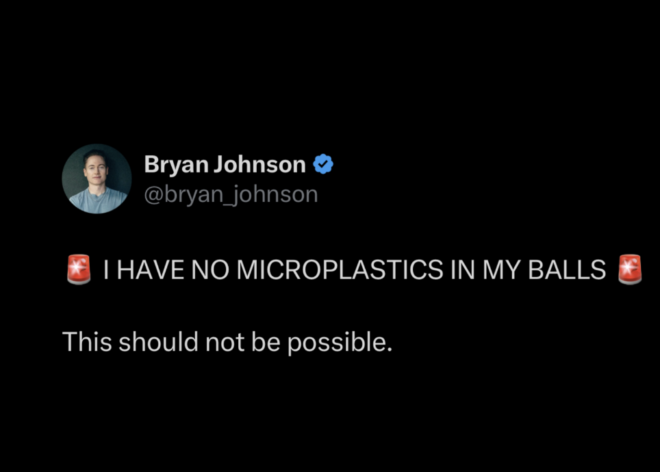
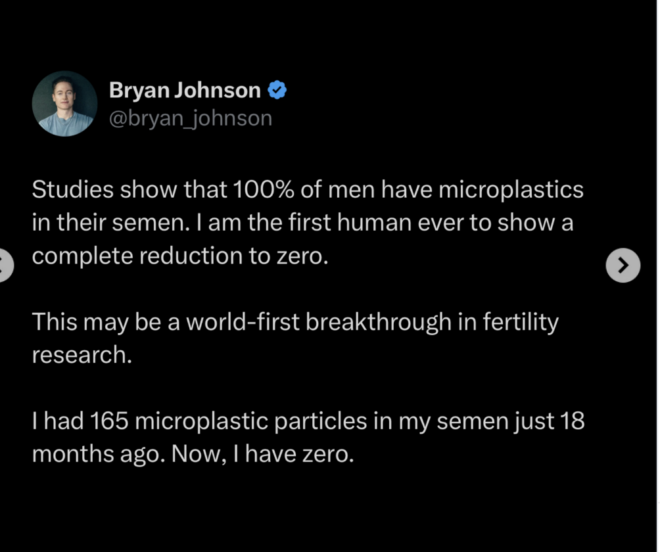
But biohacker Bryan Johnson, who plans on living forever, believes he has found a way to remove bioplastics from his sperm. Using regular sauna therapies and measurements of bioplastics in his sperm he has declared his sperm to be microplastics free.
Bryan Johnson wants to live forever and has found a way to remove microplastics from his body, or at least his sperm
Johnson is a tech entrepreneur ow putting data and actions behind “living forever” in the the Blueprint longevity project. And now he is measuring everything he possibly can, in blood tests, sleep scores, organ scans, and even semen analysis have all become part of his quest to slow aging. He recently said that by removing microplastics from his body he now has the sperm of an 18-year-old.
One of the more unusual things he’s talked about recently is using saunas as a way to help his body get rid of environmental toxins, including microplastics. Johnson’s approach is pretty straightforward: sweat a lot. He uses regular sauna sessions as part of a broader detoxification strategy based on the theory that some unwanted compounds can leave the body through sweat, although researchers are still debating exactly how effective saunas are at removing microplastics specifically.
A barrel sauna with a panoramic window in Canada on Lake Huron.
What is clear is that sauna use has been linked in studies to benefits such as improved cardiovascular health, reduced stress, and better recovery after exercise. I visited Helsinki 15 years ago and can attest that saunas used there regularly do make people at least “look” young and vibrant.
How to get your balls checked for microplastics
Do you have microplastics in your balls? Bryan Johnson reports a successful detox for his semen
When Johnson talks about microplastics in sperm, he’s tapping into a growing area of scientific interest called biohacking. Researchers can detect microplastic particles in human semen samples, raising questions about fertility and reproductive health in the long-term. With egg-freezing and IVF becoming more popular and necessary, sperm health and microplastics will be an issue.
Stedsan’s in the woods, in Sweden. They had a lovely floating sauna before the business went bankrupt.
Whether it’s air filtration, careful food choices, or long sessions in a hot sauna, Johnson’s philosophy is to stack small advantages over time.
When men think about sperm health, the figure that usually comes to mind is the count. Yet motility, the proportion of sperm that actually move, is arguably just as important, and it has become a focus of recent research. A 2024 study of donor candidates, indexed on PubMed, found that motile sperm concentration fell by around 16% and total motile sperm count by around 22% between 2019 and 2022, even though overall sperm concentration in the same group did not change significantly. Findings like these have helped push motility from a technical footnote into a parameter that men increasingly want to understand for themselves.
Bryan Johnson claims to have the sperm health of an 18-year-old (Photo: Dustin Giallanza/Blueprint Project)
That interest has met a growing market of at-home tests that promise to measure not just whether sperm are present, but how well they swim. Biohacker, and longevity expert Bryan Johnson has made his lifestyle around sperm health. This article explains what sperm motility is, what the reference numbers actually mean, how home motility tests work, and where they sit alongside a clinical semen analysis.
What sperm motility actually is
Motility is the share of sperm in a sample that are moving. Clinically, as patient guidance from the British Association of Urological Surgeons puts it, it describes the “swimming ability” of sperm, and it is measured as part of a standard semen analysis alongside count and shape.
Sperm motility explained
The measurement is usually split into two types. Total motility counts any sperm that move at all. Progressive motility counts only the sperm that swim forward in a broadly straight line or in large circles, the kind of purposeful movement associated with travelling towards an egg. Because progressive movement is more relevant to natural conception than mere twitching on the spot, many tests and clinicians pay particular attention to it.
The reference values, and why they vary
One source of confusion for anyone reading their own result is that the “normal” thresholds quoted by different sources do not always agree. This is not an error so much as a reflection of how reference ranges have been defined and revised over time.
BAUS patient guidance describes a typical threshold of more than 30% of sperm moving. UK consumer guidance from Clearblue, drawing on WHO-based figures, describes normal total motility as roughly 40% to 81% and cites progressive motility of 32% or more as within the normal range. These different cut-offs exist because the underlying reference ranges have been revised across editions, and public-facing sources sometimes quote different vintages. The practical takeaway is that a single percentage means little without the context of which reference set it is being compared against.
It also helps to see motility as one number among several. A full semen analysis, as the NHS describes it, looks at how many sperm there are, how well they move, and their shape. Motility on its own is informative, but it is read in combination with concentration and the other parameters, not in isolation.
Why motility, not just count, has drawn attention
Climate change, pollution all have an effect on sperm health. Don’t be ashamed. You can check sperm health at home.
The renewed focus on movement rather than sheer numbers is partly a research story. The 2024 donor-candidate study mentioned above is striking precisely because the motility-based measures fell while raw concentration held steady, suggesting that movement may capture changes that a simple count misses.
The wider picture is genuinely contested, which is worth stating plainly. Some widely cited analyses, including a 2022 review in Nature, have reported long-run declines in sperm count of well over half across several decades in men from Western countries. Other researchers disagree: a 2024 University of Manchester summary concluded that the widely held view that sperm counts are falling globally “may be wrong.” Against that unsettled backdrop, motility has become an appealing thing to measure because it is responsive, informative, and, as it happens, more practical to assess outside a laboratory than some other parameters.
How at-home sperm motility tests work
Home motility tests generally take one of a couple of approaches, and the difference matters for what you get back.
Threshold and cartridge tests
Some kits use a disposable cartridge or device that estimates the proportion of moving sperm against a fixed benchmark, returning a colour-coded or above/below reading. One widely sold UK product, for example, measures progressive motile sperm cells and reports a result through a colour change, with the sample left to process across two short waiting periods. Manufacturers of these tests often publish performance figures: the same product cites sensitivity of 96% and specificity of 91% against its threshold.
Smartphone and optical analysis
The more advanced approach uses a small optical module or smartphone camera to capture the sample and software to estimate the proportion of moving and progressively moving sperm. These systems can report several parameters at once, often including volume, concentration, motility, and total motile sperm count, and many store results in an app so that change can be tracked across samples. They cost more than a single threshold test, but they answer more questions and support repeat measurement.
Why timing and handling matter
Whichever type you choose, the conditions of the sample shape the result. Most protocols recommend an abstinence period of around two to seven days before testing, analysing a fresh sample promptly, and keeping the collection method consistent between tests. Get those wrong and even an accurate device will produce a noisy reading, which is a common reason home results and clinic results diverge.
How accurate are home motility tests compared with a lab?
The honest answer is that home motility tests are screening tools, not diagnostic ones. The NHS describes laboratory semen analysis as checking count, movement, and shape under controlled conditions, which is broader than what most consumer kits do. A home test can give a useful indication of whether motility is broadly typical or potentially low, but it does not replace a clinical analysis.
Published accuracy figures vary by device and describe agreement with a specific reference under specific conditions. The threshold cartridge test cited above reports sensitivity of 96% and specificity of 91%; some app-based systems quote agreement above 95% when compared with laboratory equipment. Encouraging as those numbers are, they are not a promise about an individual’s fertility. A result outside the normal range is best treated as a reason to seek a clinical opinion, not as a diagnosis.
What to look for in a home motility test
If you have decided that motility is what you want to measure, a few features separate a useful kit from a limited one.
Does it report progressive motility?
A test that reports progressive motility, rather than only a single above-or-below count reading, gives you more of the information clinicians actually use. If movement quality is your concern, that distinction is worth checking before you buy.
Independent validation
Look for a CE mark, which indicates the device meets the relevant requirements for sale, and for evidence that the manufacturer takes part in external quality-assessment schemes such as UK NEQAS. Independent evaluation against laboratory reference methods is a meaningful signal that the numbers can be trusted within their stated limits.
Repeat testing built in
Because motility fluctuates between samples, a single reading can mislead. Kits that include more than one test, and an app to track results, let you look at a trend rather than a one-off figure, which is closer to how andrology services interpret results in any case.
An example of the multi-parameter, app-based approach is ExSeed Health, a UK-facing brand whose system measures volume, concentration, motility, and total motile sperm count and returns a fertility score through a paired app in around 15 minutes. ExSeed reports agreement of more than 95% compared with advanced laboratory equipment, and states that its device is CE marked and has been independently validated through external UK NEQAS quality control. The company says its kit has been used by more than 65,000 men and sells it in multi-test packs so that, in line with the general advice to test more than once, users can repeat the measurement. For men who specifically want a trackedhome sperm motility testrather than a single threshold result, that multi-measurement format sits at the more detailed end of the consumer market.
When to move from home screening to clinical testing
Health is holistic. Sperm health can be an indication of your overall health too, says biohackers like Bryan Johnson. Yoga anyone?
A home motility test is a reasonable way to gather an early, private indication, or to monitor change over time. It is not a substitute for medical assessment. NHS guidance suggests speaking to a GP after around a year of trying to conceive without success, or after six months if the female partner is 36 or over, or sooner if there is a known reason for concern.
A home result outside the reference range, or any persistent concern, is a prompt to arrange a formal semen analysis through a GP referral. It is also worth remembering that fertility is a two-person picture: a semen test, at home or in a clinic, cannot speak to female factors, which a full couple assessment would consider. A result within the normal range is reassuring but does not rule everything out, and a single low figure is generally not interpreted on its own in clinical practice.
The takeaway
Sperm motility has earned its place alongside count as a measure worth understanding, and at-home tests now make it possible to get an early read on movement without a clinic visit. Used sensibly, they can give a helpful first data point: choose a kit that reports progressive motility, carries a CE mark and credible external validation, and lets you test more than once. Then read the result for what it is, a screening signal rather than a verdict. A reassuring number is encouraging, an unexpected one is a reason to speak to a GP, and neither replaces the laboratory semen analysis that remains the clinical standard.
Environment collapse could visit the Aldabra Atoll, part of the Seychelles if action isn’t taken
The Aldabra Atoll is known as the outpost for evolution.
Friends of Aldabra sent a new report to Green Prophet and is calling on UNESCO to end its silence on the threat posed by a Qatari-funded luxury hotel development on Assomption Island, just 27km from Aldabra Atoll, one of the world’s most ecologically significant UNESCO World Heritage Sites — and to place the issue on the agenda of the 48th World Heritage Committee session in Busan, Korea, opening July 19, 2026.
A Qatari real estate developer has started construction on an ecologically sensitive island in the Seychelles called Assomption Island. An important turtle breeding site, the island is a short boat ride to the immensely important Aldabra Atoll, one of the last pristine ecosystems on earth. Representatives of the development have been asked multiple times for comment but have not responded to Green Prophet’s requests regarding environmental oversight of the project.
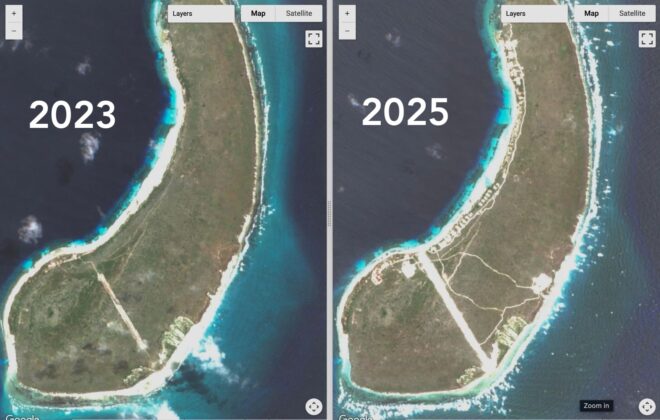
Assets Group plans 40 ultra-luxury villas on the sand dunes of Assomption
The Seychelles Commission of Inquiry into the sublease and development of Assomption Island handed its final report to President Herminie, supporting the concerns of environmental risk and institutional failure that Friends of Aldabra has been raising since 2024.
In her remarks at the handover ceremony, Commissioner Judge Mathilda Twomey described the environmental chapter of the report — almost 100 pages long — as “very concerning,” pointing to instances of executive interference and forwarding recommendations to the Attorney General, the Anti-Corruption Commission, and the Financial Intelligence Unit for further investigation.
Her remarks give weight to what Friends of Aldabra has been arguing for nearly two years: that the development on Assomption Island moved forward without due process, was riddled with environmental breaches, lacked proper oversight, and poses serious, insufficiently studied environmental risks to the atoll and its surrounding ecosystem. Friends of Aldabra was named and thanked by the Commission for its contribution to proceedings.
UNESCO: A Pattern of Selective Silence
Is UNESCO being paid off by Qatar? Since November 2024, Friends of Aldabra says it has led an international campaign raising evidence-based concerns about the threat posed to Aldabra Atoll by the Assomption hotel development. The campaign has mobilised scientists, conservation organisations, and the general public across Seychelles and internationally.
The most recent IUCN World Heritage Outlook (2025) rates the invasive species risk associated with the Assomption development as a Very High Threat. It remains unclear whether these findings have been formally communicated to or acted upon by UNESCO HQ. Reports and observed activities suggest that construction is ongoing.
On May 15, 2026, Friends of Aldabra says it wrote to UNESCO raising urgent concerns about the governance and scientific independence of the Seychelles Islands Foundation (SIF) — UNESCO’s partner institution mandated to protect Aldabra Atoll.
SIF has since been given a second mandate by the Seychelles Government to lead biosecurity and environmental oversight for the very hotel development on Assomption Island that threatens Aldabra. In response, Friends of Aldabra received what appears to have been a message sent in error by SIF’s CEO, Dr. Frauke Fleischer-Dogley.
According to Friends of Aldabra, it read: “Thank you I am copied in, UNESCO will not entertain them.”
This silence stands in stark contrast to UNESCO’s own stated commitments to youth. UNESCO has declared that engaging young people “is not just a matter of right, it is a matter of principle.”
Yet Friends of Aldabra — a youth-led organisation that has mobilised young people from across the globe — has received no direct response from UNESCO HQ in nearly two years.
Meanwhile, UNESCO has been an active partner in publicity about Aldabra, including a collaboration with Plastic Odyssey and a partnership with photographer Alexis Rosenfeld. This raises an uncomfortable question: is UNESCO selectively engaging with Aldabra? Celebrating its beauty and burnishing its reputation with selectively positive partnerships on the international stage while turning away from the locals and global youth raising the alarm about its survival?
The 48th session of UNESCO’s World Heritage Committee in Busan, Korea, opening on July 19, 2026, is an opportunity for accountability. The situation warrants formal attention given the pace of developments on the ground, the fact that so many processes have not been respected, and that environmental commitments have been sidelined. Aldabra needs attention — and Busan is the moment to provide it.
Follow Green Prophet’s investigations into Qatari terror-linked financing and the Seychelles Islands development
Before and after Qatari development on Assomption Island
A arrowhead from your mother’s jaw? A carving tool from Dad’s femur? Iron Age people made no bones about making tools from their ancestors’ bones, finds research in a new Scottish study on Iron Age people. The new research also showed how bones and funerals connected people living in communities.
The discovery was made after a team of researchers examined the rare, well-preserved remains of two individuals discovered at Loch Borralie in Sutherland, near the north-west tip of the Scottish mainland.
Iranians bury their dead at the Tower of Silence, where crows can come and pick at the flesh of those laid out.
Identifying funerary practices in Iron Age Britain c. 800 BC–AD 43 is notoriously difficult, the researchers say, because human remains rarely survive. However, the unique environmental conditions of north-west Scotland support the preservation of bone, allowing scientists to take a rare glimpse into the prehistoric past.
The two individuals – an adult female and a juvenile male – were found buried together in a low stone cairn. When experts conducted an osteological examination of the bones, they discovered evidence of postmortem skeletal modification.
Dr Laura Castells Navarro, from the University of York’s Department of Archaeology, said: “To find bodies of this age so well preserved is rare, but to discover evidence of a funeral ritual we previously knew nothing about was such a surprise, and very exciting.
“The adult female displayed incisions on the inside of her cranium, suggesting her brain had been intentionally removed after death. We have no other comparison of this type of practice, but we know that the dead were curated and treated carefully in Iron Age Britain, so our understanding is that this bone modification is within that same tradition of care,” she added.
A bizarre brain removal procedure was witnessed
Bones, including both humeri, ulna, and femur, had also been carefully tapered toward the ends into sharp points, suggesting they may have had use as tools before being carefully buried, the researchers said.
The results, published in the journal Antiquity, revealed that the two individuals were closely related, most likely second cousins. Isotope analysis showed that both had grown up around 50 miles south-east of where they were buried at Loch Borralie.
Location of Iron Age bones on Loch Borralie
“The motivation behind the extensive manipulation of the skeletal remains is very difficult to interpret, but the care with which she was reassembled and deposited in the cairn possibly suggests she commanded a level of reverence and respect by her community,” said Castells Navarro.
The genetic data revealed family connections stretching much further across the sea: to the Orkney Islands, roughly 108 miles to the north-east, and to Applecross, about 140 miles to the south-west. Researchers argue that this web of DNA proves that family groups in prehistoric Britain were highly mobile and interconnected by water.
Dr Castells Navarro noted: “I think we can assume that the Iron Age dead were not forgotten, and still had meaning to the living, with a continued interaction between the living and the dead across time and distance.”
Whether the shaped bones were used, is anyone’s guess, but they were altered suggesting an unusual funeral rite or right of passage.
In California’s self-proclaimed State of Jefferson, a small agricultural technology company is challenging the dominant laser-weeding business model.
Based in the as-yet aspirational State of Jefferson, Laudando & Associates approaches laser-weeding differently than the big dogs. Laser-weeding is a relatively new technology, having entered the market when chatbots started burrowing into public consciousness.
While many companies operate on a subscription model, L&A aims to give farmers more ownership over their tools. Though RaaS (Robotics as a Service) and SaaS (Software) are standard business models in laser-weeding and robotic electric weeding generally, that default setting runs counter to the independence that right-to-repair activism calls for. Between these divergent approaches is not just the question of independence, but the practicality of wide-scale robotics use.
Before getting into the philosophy of how best to serve ag-robotics (these robots build solar panels in farm fields), it helps to understand that the State of Jefferson is an idea that stems from counties in California and Oregon that since the 1940s have intermittently called for leaving those neighboring states in order to unite together and form a new state in the USA’s Pacific Northwest.
While some of these counties overlap with another new state movement’s footprint, that of the Greater Idaho movement, the State of Jefferson grows from feelings of isolation from the urban centers and governments of California and Oregon who some see as lacking the perspective to serve the needs of rural counties.
Chris (Christopher) Laudando is an American agricultural technology entrepreneur and founder of Laudando & Associates, a small California-based company developing AI-powered laser weeding systems for farmers.
Thus L&A’s location within the aspirational state of Jefferson is implicitly a statement about the motivations of founder Chris Laudando to give farmers tools that keep working even when the company that made them either is too far away to practically help in reasonable time frame, too expensive, or simply unavailable.
Carbon Robotics founder and CEO Paul Mikesell with the LaserWeeder G2. | Source: Carbon Robotics
L&A is a wildcard in other ways too, taking on the reigning giant in the laser-weeding field, the NVIDIA-backed Carbon Robotics. And that courtroom drama has had L&A exiled to sell abroad to Australia and other markets while Carbon Robotics confidently states its dominance of the field while other companies like Verdant Robotics carve out their own niches.
L&A, whether based in Chico, CA or Chico, State of Jefferson, sells laser-weeding modules and AI models of each crop. They also provide access to AWS (Amazon’s cloud computing services), allowing farmers to develop and update their own crop models. Physically each model consists of a blue laser driven by the AI edge computing power of an NVIDIA Jetson Orin with USB, Bluetooth, WiFi, and a M12 multiuse port that allows for interfaces such as RS-485, RS-232, and CAN (the same communications system used in cars and other vehicles called the Controller Area Network protocol) in order to allow each module to interface with whatever robotics systems and tools the farmer is using.
This means farmers get a tool open to their needs and resources, ready to be integrated into whatever systems they have or prefer.
It’s possible that in the struggle between L&A and Carbon Robotics, that L&A may be in the right on technical merits if not legal outcome, much like the hopeful residents of the State of Jefferson. While Carbon Robotics sued L&A for patent infringement, court filings indicate that Carbon Robotics focused on the 300 to 100 nanometer wavelength range of lasers while the specifications of L&A’s L&Aser module are in the higher 400nm wavelength.
L&A had counter-sued, though the last filings indicate a default judgment in favor of Carbon Robotics. L&A is down, but not out except in the American market, while Carbon Robotics’ other competitors are also growing stubbornly and won’t be uprooted quite yet. If anything, laser-weeding is spreading through the electric weed control industry faster than bindweed.
Etihad, the UAE’s national carrier has decided to offer free travel insurance to visitors heading to the UAE.
The decision came as a partnership with the Department of Culture and Tourism (DCT) Abu Dhabi to provide complimentary medical travel insurance with The National Insurance Company – Daman, to all international visitors arriving in Abu Dhabi on Etihad-operated flights.
The initiative illustrates the ambition of both Etihad and DCT Abu Dhabi to meet travel demand to Abu Dhabi, with an offering that goes beyond the flight itself and ensuring every visitor arrives well-travelled and well-protected, they said in a press release sent to Green Prophet.
Valid from July through December 2026, the insurance is underwritten and administered by The National Insurance Company – Daman, part of PureHealth, and covers eligible visitors for up to 15 days in the UAE.
There is no formal application required, cover is automatically given with every qualifying Etihad ticket. Any guest flying to Abu Dhabi on an Etihad-operated service, with point of origin and point of sale outside the UAE, is eligible. Travellers using Etihad’s complimentary Stopover Programme to spend time in Abu Dhabi are also covered for the duration of their stay. Terms and conditions apply.
The attacks by Iran on the UAE have had an impact on both international travels, global nomads, and temporary workers. But the new travel insurance perk might not guarantee you a ride on the Mile High Club but it will save you about $100 in travel insurance. If the UAE is part of a series of stops or stopovers make sure you get insurance for the fist or last leg of the journey.
This is an ecological or sustainable issue because access to healthcare is a concern to many travelers looking for work in the UAE. The two weeks can be a buffer until they find gainful employment.
Etihad crew, the UAE airline will give free travel insurance to anyone coming to visit for 2 weeks.
His Excellency Saleh Mohamed Al Geziry, Director General for Tourism at DCT Abu Dhabi, said: “Global interest in Abu Dhabi continues to grow, reflecting the destination’s unparalleled year-round cultural, tourism and entertainment offering. This initiative ensures we meet that demand with an exceptional, end-to-end visitor experience.
“Our partnership with Etihad will set a new benchmark for destination standards and ensure our guests feel welcomed, valued, and cared for from the moment they book.”
What do do in the UAE?
Seramic materials and the facade at Masdar, a zero-energy city that failed to create community but which passed tests in building standards