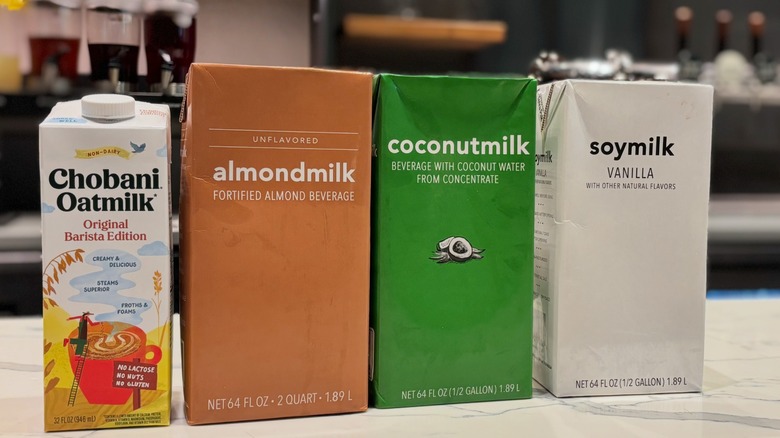

We were sold a beautiful idea. Drink oat milk (even though it’s full of pesticides). Drink almond milk (even though it’s terrible for the planet). Drink soy milk, even if it contains estrogen. Save the planet, bkinder to animals, lower your footprint and feel good about the choices you make. Then you walk into a Starbucks coffee shop and get punished for it.
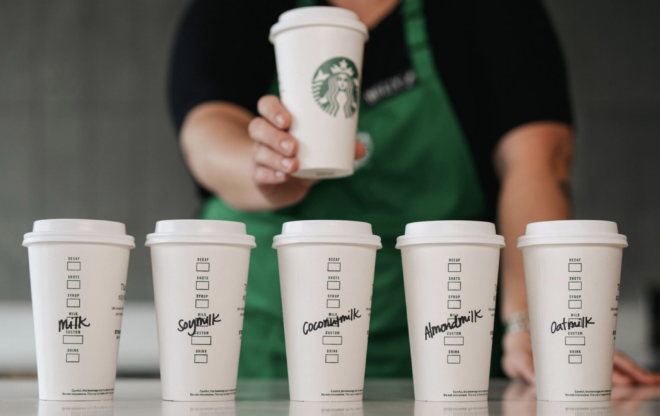
For years, ordering a latte with a non-dairy milk meant paying an extra 50 cents, 80 cents, sometimes more. It always felt odd when I saw that on a menu. Now Quebec is launching a class action suit against Starbucks, Tim Hortons and Second Cup for levying a fee on alternative milk, sometimes 6 times more what the supplement is worth.
The lawsuit was launched by Liel Ohayon, a vegan and regular ay Starbucks and Tim Horton’s. She says she pas an extra $0.80 for plant-based milk in a matcha latte, increasing the price from $6 to $6.80 if she asks for soy or oat milk.
Starbucks noted the supplement costs $0.12 more than regular milk.
Ohayon wrote, “By its own admission, Starbucks therefore charges consumers more than six times the cost it incurs when it replaces cow’s milk with plant-based or lactose-free milk in its beverages. Indeed, it does not appear frivolous or manifestly unfounded to argue that it is disproportionate to charge the consumer more than six times what it costs the merchant to substitute cow’s milk with plant-based milk in their tea or coffee, and that this disproportion is sufficiently significant to cause serious harm to the consumer.”
We are told that plant-based alternatives are part of a more sustainable future, yet somehow the customer choosing them is the one paying the penalty.
Related: Health Canada approves Remilk
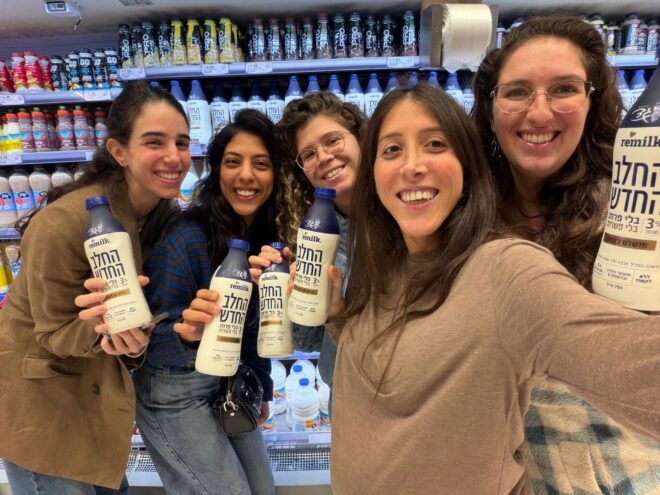
I say this as someone who isn’t even a vegan. I like dairy. I drink coffee with dairy. It’s one of my weaknesses and I’ve made peace with it. I don’t particularly enjoy oat milk. I can’t stand soy milk. Almond milk often tastes watery to me. The one exception I’ve found is Remilk, the precision-fermented milk protein developed in a lab. For people keeping kosher or looking for an alternative to conventional dairy, it comes surprisingly close to the real thing. A faint coconut note lingers in the background, yet the texture and taste profile are far better than most alternatives I’ve tried.
Still, even if alternative milks aren’t my first choice, the economics never made sense.
A couple months ago, I stopped at a Starbucks in Amman, Jordan. Expecting the familiar coffee cream offered in North America, I asked for it and was met with confusion. They didn’t have it. Instead, the barista improvised, blending whipping cream with whole milk to create something approximating the rich half-and-half I was used to. It wasn’t quite right, but there was something charming about the effort. It was a reminder that coffee culture needs to adapt to local realities. I was not made to pay extra on the already expensive coffee.
What is less charming is discovering that some of the largest coffee chains in North America have apparently been charging customers far more than the actual cost of swapping dairy for plant milk. A class-action lawsuit authorized in Quebec is now targeting Starbucks, Tim Hortons and Second Cup over allegations that consumers were charged excessive surcharges for oat, soy, almond and other non-dairy alternatives. According to court filings, Starbucks acknowledged that a plant-milk substitution cost the company about 12 cents while customers were charged 80 cents, more than six times the company’s admitted cost.
The lawsuit argues that these fees were disproportionate and potentially abusive under Quebec consumer protection laws. Quebec also has funny language laws, and the Yiddish word Nosh used to advertise a local eatery has been smacked down by the language police. But whatever crazy happens in Canada you can be sure will move over to LA, and then to NY, and spread widely around the US and with the world.
Starbucks eventually dropped the surcharge in company-owned stores in Canada and the United States in late 2024, while Tim Hortons and Second Cup followed with similar changes. If you see a surcharge on alternative milk, speak up.
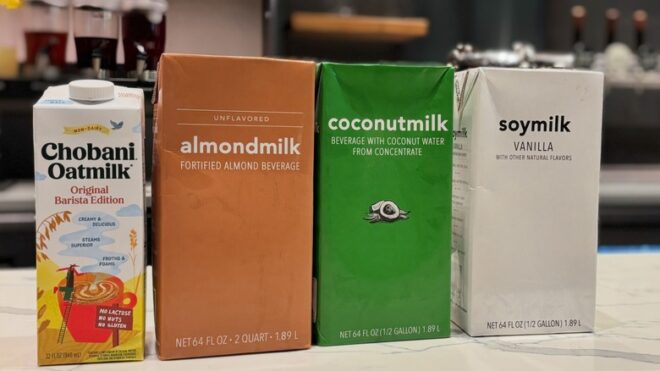
The irony is hard to ignore: According to research from the University of Oxford, producing plant-based milks generally generates significantly lower greenhouse gas emissions and uses less land than conventional dairy milk. Oat milk, soy milk and almond milk each have environmental tradeoffs, but as a category they tend to have a much smaller climate footprint than cow’s milk.
So why were consumers trying to make a lower-impact choice paying extra for the privilege? Independent cafés have a reasonable argument. They operate on thinner margins and often pay more for specialty ingredients. A neighborhood coffee shop may genuinely need to charge more for alternative milks because it lacks the purchasing power of a multinational chain.
Large corporations, however, are a different story. When the surcharge bears little resemblance to the actual cost difference, it is opportunity.
Consumers notice when sustainability becomes a premium product. They notice when doing the “right thing” costs more. And they certainly notice when companies wrap themselves in environmental messaging while quietly charging extra for the greener option. If businesses genuinely want customers to make more sustainable choices, they should stop treating those choices as luxury upgrades. Reward people for using plant-based milk instead.