Flip flops take over shores of the Seychelles

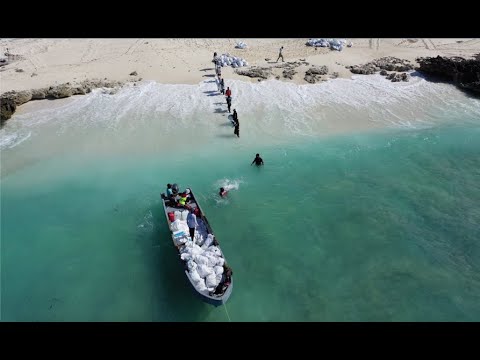
seychelles island boat full of plastic
Your tuna is contributing to more than 80% of the plastic waste clogging up the Seychelles Islands. It would make David Attenborough cry. 

You are a good citizen. You post selfies cleaning up trash from your hike or swim at the sea. You buy fair trade tuna only. As for shoes – maybe like Natalie Portman or (not Miley Cyrus who quit veganism) – you are going to go for the plastic flipflop or hemp option. But all your life choices affect everything else, especially that which is far away from you. 

Tuna nets and 360,000 now pollute the once pristine island. It is the largest accumulation of plastic waste reported for any single island in the world. And we are all responsible for it. Boyan Slat – where are you already?

Seychelles Island, ocean cleanup, flip flops, tuna fish nets

A new Oxford study following a five-week clean-up on Aldabra Atoll, one of Seychelles’ UNESCO World Heritage Site, found that it would take $4.68 million, 18,000 person‐hours of labor to clean up the entire atoll. The plastic sample they collected in their new study amounted to 25 tonnes.

Some 513 tonnes remain on the island, dominated by waste from regional fishing – buoys, ropes, nets – and 360,000 individual flip flops. 

Seychelles Island, ocean cleanup, flip flops, tuna fish nets

“We highlight that the main sources of the pollution arriving on Aldabra are related to the fishing industry in Seychelles, which provides tuna to EU countries and other high-income markets around the world.

“There should be some recompense for the damage being caused,” says one of the study’s authors. 

Seychelles Island, ocean cleanup, flip flops, tuna fish nets

Removing the plastic waste equates to $10,000 per day of clean‐up operations or $8,900 per tonne of litter —well beyond the capacity of non-profit organisations like the Seychelles Islands Foundation.

Small island developing states receive unprecedented amounts of the world’s plastic waste. In March 2019, a team from the University of Oxford and Seychelles Islands Foundation, a public trust which manages Aldabra, removed just 5% of the litter washed up on Aldabra’s shores in a five-week mission. 

“This eye-watering price-tag makes the economic burden of the unsanctioned import of plastic litter on small island states abundantly clear,” Oxford authors state. “The project has highlighted how even remote highly-protected island ecosystems are now being impacted by global pollution and how difficult and costly it is to remedy.”

Seychelles Island, ocean cleanup, flip flops, tuna fish nets

Aldabra is an iconic site, described by David Attenborough as one of the world’s last remaining natural treasures. It has remained relatively pristine and is home to an array of incredible wildlife.

Lindsay Turnbull, co-author of the study, said: “Our research spells out the unfairness and inequality whereby small island states and islands like Aldabra are paying the bill, both ecologically and financially for actions – or the lack of them – taken elsewhere.

“As with the climate crisis, small island states are at the frontline in dealing with the impacts of actions in which they played very little part. It is time this inequality was addressed with direct financial assistance to rectify and ameliorate these threats.”

The team, led by April Burt and Jeremy Raguain from the Seychelles Islands Foundation recorded all costs associated with the clean-up, and the effort required to do so, by timing clean-up sessions and estimating the amount of litter collected per person per unit time.

The waste collected was weighed and categorised and additional surveys were conducted in each coastal habitat type to estimate the total remaining marine plastic litter on Aldabra and its composition. The composition data was used to determine the main sources of litter arriving on Aldabra. 

Burt said: “The biggest surprise was that the composition by weight was dominated by waste from the fishing industry: 83% of the estimated 500 tonnes of litter remaining on Aldabra is fishing-industry related. This is extremely alarming because it shows that waste generated by the local fishing industry is polluting island ecosystems and having indirect negative impacts on the fish communities it needs to sustain.”

Given the serious detrimental effects of plastic litter on marine ecosystems, the researchers conclude that clean‐up efforts are a vital management action for islands like Aldabra, despite the high financial cost and should be integrated alongside policies directed at ‘turning off the tap’.

They recommend that international funding be made available for such efforts, highlighting the transboundary nature of both the marine plastic litter problem and the ecosystem services provided by biodiversity‐rich islands.

The scientists are continuing their data collection on litter accumulation rates and other aspects of the impact of plastics to Aldabra’s ecosystems. There is still 500 tonnes of litter to remove from Aldabra and the scientists say, ‘the project is not over yet.’

Karin Kloosterman
Karin Kloostermanhttp://www.greenprophet.com
Karin Kloosterman is an award-winning journalist, innovation strategist, and founder of Green Prophet, one of the Middle East’s pioneering sustainability platforms. She has ranked in the Top 10 of Verizon innovation competitions, participated in NASA-linked challenges, and spoken worldwide on climate, food security, and future resilience. With an IoT technology patent, features in Canada’s National Post, and leadership inside teams building next-generation agricultural and planetary systems — including Mars-farming concepts — Karin operates at the intersection of storytelling, science, and systems change. She doesn’t report on the future – she helps design it. Reach out directly to [email protected]

Read More

TRENDING

Is Qatar paying UNESCO to turn a blind eye on the Seychelles?

Is UNESCO being paid off by Qatar so it can own a private airstrip in a strategic location in the Seychelles?

The US leaves 66 United Nations organizations to “put America first”

The world needs a reset and to restart well intentioned cooperation projects from start. Because right now the UN and EU projects look like software built on code from the 80s, rickety, patched, slow to adapt, and prone to crashing under the weight of outdated assumptions.

UNESCO forest being developed in Iran

Environmental activists in Iran often face significant personal risk when speaking out about illegal land grabs, deforestation, or the destruction of protected areas. In recent years, several high-profile environmentalists have been detained, interrogated, or imprisoned on broad national-security charges, sometimes without transparent legal proceedings.

Iran’s rarest forest is on fire

It's full of rare and endemic species, and it's a UNESCO heritage site. Iran's natural treasure, a 1000-kilometer forest, the Hyrcanian forest has been on fire for several days. It stretches from the Caspian Sea and into neighboring Azerbaijan and is home to more than 3,200 kinds of plants. 

Images of Assomption Island development show extensive beach development

Researchers who have studied the island for decades describe it as a key ecological buffer for Aldabra, helping to protect the atoll from pollution, invasive species, and light disturbance. If Assomption’s natural systems collapse, they warn, Aldabra could be next.

Yerukim Forms a New Green Economy Where the Money is Really Green

The Yerukim members who pick up the recyclables get to keep the monetary reward, the public earns "green" bills that can be used in shops, and business owners get to be associated with environmentalism.

Choosing Riyadh over Dubai? What Investors Should Know

Saudi Arabia is deploying capital at unmatched scale to catalyze tourism and advanced industry while rewiring its power-and-water backbone. The investable frontier is widening—especially in renewables, grid storage, water efficiency/desal retrofits, and hospitality operating platforms. Prudent investors will insist on phased delivery, enforceable KPIs (energy, water, biodiversity), and RHQ/zone compliance—while pricing political-economy and reputational risks alongside growth upside.

Sell your cooking oil for biodiesel money

Want to make money on old french fry oil? Sell it.

Qatar Alternative Energy Summit Pairs Investors And Innovators

Alternative energy investors and innovators can meet n' greet in Doha, Qatar March 16 and 17.

Here’s How To Implement The Four Pillars Of Employee Engagement

If you throw a party for your work team and they are vegans, don't make it a barbecue. Know the sustainability values of your team to boost moral and retain good people.

Locals From Rishon Fight IKEA

Big Box stores are a pretty new concept in Israel, and thank God that not every Israeli city wants them in their backyard. A word from someone who has see the beautiful farmland around her hometown Newmarket, Ontario stripped and converted into vulgar strip malls of big box shops: they have no place in a healthy and sustainable town or city.

The Jewish National Fund Meets An Inconvenient Truth

According to the JNF, it has transformed thousands of acres of barren land into green forests in Israel. They state that each person emits about 23 tons of carbon per year, estimating that each tree planted can absorb one ton of carbon in its lifetime. That's a whole lot of trees you'd need to be planting. Could so many fit in Israel?

How to quiet noise from construction in your office

Streets need to be resurfaced in New York but the humming and grinding noise is unsettling. Noise is environmental pollution. 

Popular Categories