
Iron age folks made tools from dead peoples’ bones

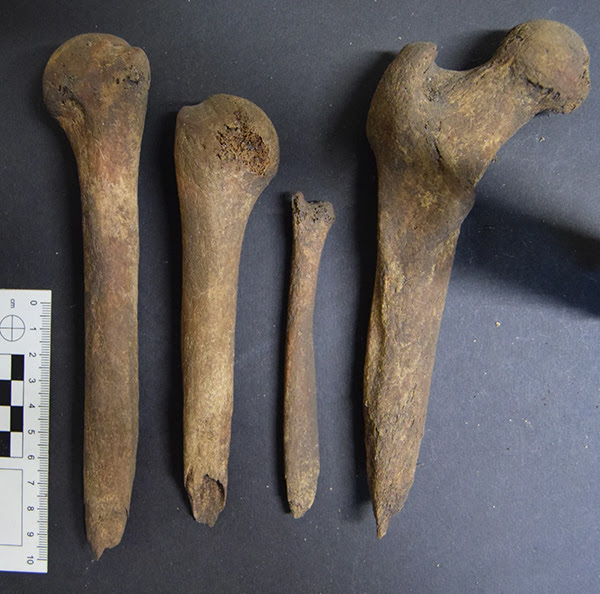
A arrowhead from your mother’s jaw? A carving tool from Dad’s femur? Iron Age people made no bones about making tools from their ancestors’ bones, finds research in a new Scottish study on Iron Age people. The new research also showed how bones and funerals connected people living in communities.
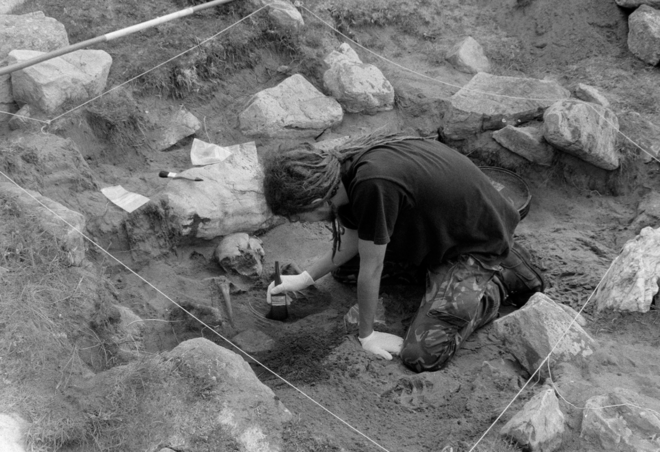
Excavation photograph of Individual 1 (SC 1061426 © Crown Copyright: HES. Excavation photograph by GUARD).

The discovery was made after a team of researchers examined the rare, well-preserved remains of two individuals discovered at Loch Borralie in Sutherland, near the north-west tip of the Scottish mainland.

RELATED: Iranians bury their dead on the Tower of Silence
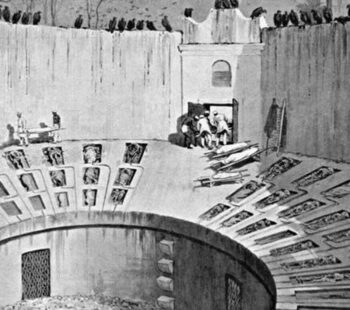
Iranians bury their dead at the Tower of Silence, where crows can come and pick at the flesh of those laid out.

Identifying funerary practices in Iron Age Britain c. 800 BC–AD 43 is notoriously difficult, the researchers say, because human remains rarely survive. However, the unique environmental conditions of north-west Scotland support the preservation of bone, allowing scientists to take a rare glimpse into the prehistoric past.

The two individuals – an adult female and a juvenile male – were found buried together in a low stone cairn. When experts conducted an osteological examination of the bones, they discovered evidence of postmortem skeletal modification.

Dr Laura Castells Navarro, from the University of York’s Department of Archaeology, said: “To find bodies of this age so well preserved is rare, but to discover evidence of a funeral ritual we previously knew nothing about was such a surprise, and very exciting.

“The adult female displayed incisions on the inside of her cranium, suggesting her brain had been intentionally removed after death.  We have no other comparison of this type of practice, but we know that the dead were curated and treated carefully in Iron Age Britain, so our understanding is that this bone modification is within that same tradition of care,” she added. 
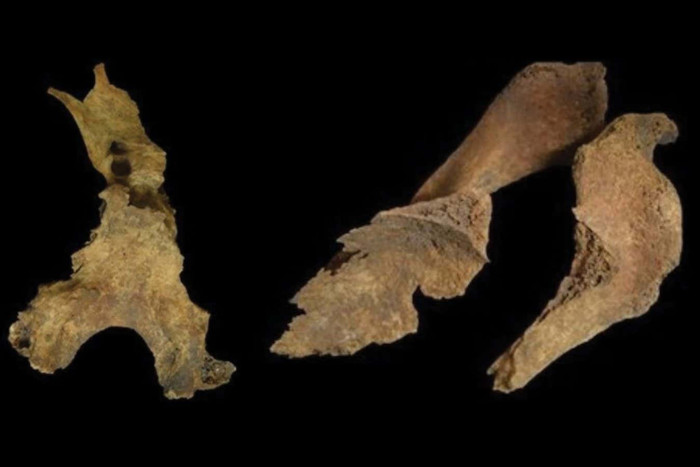
A bizarre brain removal procedure was witnessed

Bones, including both humeri, ulna, and femur, had also been carefully tapered toward the ends into sharp points, suggesting they may have had use as tools before being carefully buried, the researchers said. 

The results, published in the journal Antiquity, revealed that the two individuals were closely related, most likely second cousins. Isotope analysis showed that both had grown up around 50 miles south-east of where they were buried at Loch Borralie.
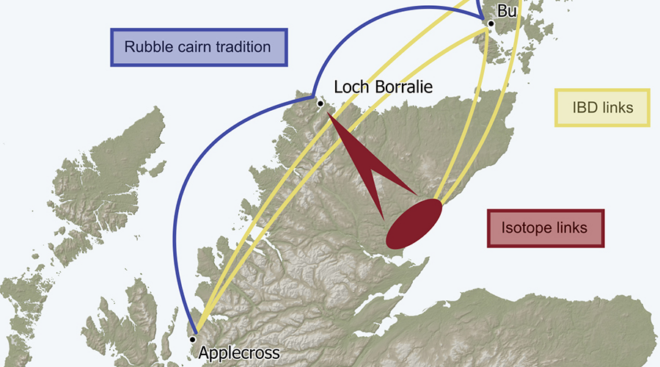
Location of Iron Age bones on Loch
Location of Iron Age bones on Loch Borralie

“The motivation behind the extensive manipulation of the skeletal remains is very difficult to interpret, but the care with which she was reassembled and deposited in the cairn possibly suggests she commanded a level of reverence and respect by her community,” said Castells Navarro.

The genetic data revealed family connections stretching much further across the sea: to the Orkney Islands, roughly 108 miles to the north-east, and to Applecross, about 140 miles to the south-west. Researchers argue that this web of DNA proves that family groups in prehistoric Britain were highly mobile and interconnected by water.

Dr Castells Navarro noted: “I think we can assume that the Iron Age dead were not forgotten, and still had meaning to the living, with a continued interaction between the living and the dead across time and distance.”

Whether the shaped bones were used, is anyone’s guess, but they were altered suggesting an unusual funeral rite or right of passage. 
Read More

TRENDING

Ancient Clay Jug with Camel Art Unearthed in Israel’s Yatir Forest

The striking red-painted jug was found in a cave that had once been an underground olive press before being repurposed as a dwelling. Researchers believe the cave was in use during the Abbasid period (9th-10th centuries CE), when camels dominated trade routes, helping to move goods across vast distances.

Unplug, Create, and Sail: Build Your Own Boat on the Isle of Mull

In a world where screens dominate our time and digital experiences often replace tangible ones, there’s something profoundly refreshing about using your hands to create. Imagine stepping away from the virtual world for a week and immersing yourself in the craft of boat building—transforming raw materials into something both beautiful and functional.

Ancient potters in Syria were child laborers

In ancient times in Syria kids were the potters

Ireland gets electric car fast charge stations as it aims to gain 1 million EVs by 2030

There are over 100 electric vehicle options in Ireland. Volkswagen is one option.

Biblical red dye found in a cave in Israel

Scarlet red, a pigment made from insects, is used to make frapacinos pink at Starbucks but it was the dye of choice to make the color scarlet in ancient Biblical times. A piece of ancient scarlet-colored cloth was found in a cave in Israel recently.

Yerukim Forms a New Green Economy Where the Money is Really Green

The Yerukim members who pick up the recyclables get to keep the monetary reward, the public earns "green" bills that can be used in shops, and business owners get to be associated with environmentalism.

Choosing Riyadh over Dubai? What Investors Should Know

Saudi Arabia is deploying capital at unmatched scale to catalyze tourism and advanced industry while rewiring its power-and-water backbone. The investable frontier is widening—especially in renewables, grid storage, water efficiency/desal retrofits, and hospitality operating platforms. Prudent investors will insist on phased delivery, enforceable KPIs (energy, water, biodiversity), and RHQ/zone compliance—while pricing political-economy and reputational risks alongside growth upside.

Sell your cooking oil for biodiesel money

Want to make money on old french fry oil? Sell it.

Qatar Alternative Energy Summit Pairs Investors And Innovators

Alternative energy investors and innovators can meet n' greet in Doha, Qatar March 16 and 17.

Here’s How To Implement The Four Pillars Of Employee Engagement

If you throw a party for your work team and they are vegans, don't make it a barbecue. Know the sustainability values of your team to boost moral and retain good people.

Locals From Rishon Fight IKEA

Big Box stores are a pretty new concept in Israel, and thank God that not every Israeli city wants them in their backyard. A word from someone who has see the beautiful farmland around her hometown Newmarket, Ontario stripped and converted into vulgar strip malls of big box shops: they have no place in a healthy and sustainable town or city.

The Jewish National Fund Meets An Inconvenient Truth

According to the JNF, it has transformed thousands of acres of barren land into green forests in Israel. They state that each person emits about 23 tons of carbon per year, estimating that each tree planted can absorb one ton of carbon in its lifetime. That's a whole lot of trees you'd need to be planting. Could so many fit in Israel?

How to quiet noise from construction in your office

Streets need to be resurfaced in New York but the humming and grinding noise is unsettling. Noise is environmental pollution. 

Popular Categories