

 Okay, first the bad news.
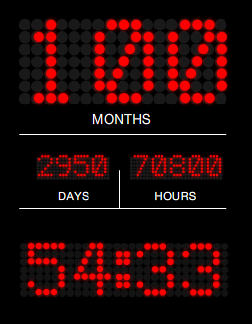
Well, perhaps we’d had better warn you that there is no good news in this piece: A new campaign has been launched in the UK by the NEF (new economics foundation) warning the world that according to their analysis, the world is just 100 months away from reaching the tipping point for the start of irreversible Climate Change.
This figure of 100 months, said by Andrew Simm, policy director of the NEF to be a “conservative estimate”, is the length of time remaining before the concentration of CO2 (carbon dioxide) reaches such a high level that the planet simply cannot process it anymore.
With CO2 at a level in the atmosphere that is the highest for 650,000 years, and 1000 tonnes of CO2 being released into the atmosphere every second from human activity, the oceans have a decreasing ability to absorb it, and the resulting disruption of weather patterns (as we are already seeing) are simply the early warning signs.
Amongst several scenarios presented by the campaign, who used scientific data from varied sources including that used by the IPCC (Intergovernmental Panel on Climate Change) are these: “A rise of 2 degrees may mask big problems that [actually] begin at a lower level of warming”, and “the disintegration of the Greenland ice sheet could correspond to a sea-level rise of up to 7 metres.” This news isn’t actually new news – Al Gore and others have presented this to the world before – but what is startling is the stark time frame given to the start of what is irreversible.
Here’s some more from Andrew Simm:
“Today is just another Friday in August. Drowsy and close. Office workers’ minds are fixed on the weekend, clock-watching, waiting perhaps for a holiday if your finances have escaped the credit crunch and rising food and fuel prices. In the evening, trains will be littered with abandoned newspaper sports pages, all pretending interest in the football transfers. For once it seems justified to repeat T.S. Eliot’s famous lines: “This is the way the world ends/Not with a bang but a whimper.
“But does it have to be this way? Must we curdle in our complacency and allow our cynicism about politicians to give them an easy ride as they fail to act in our, the national and the planet’s best interest? There is now a different clock to watch than the one on the office wall. Contrary to being a counsel of despair, it tells us that everything we do from now matters. And, possibly more so than at any other time in recent history.
“It tells us, for example, that only a government that was sleepwalking or in a chemically induced coma would countenance building a third runway at Heathrow, or a new generation of coal-fired power stations such as the proposed new plant at Kingsnorth in Kent. Infrastructure that is fossil-fuel-dependent locks in patterns of future greenhouse gas emissions, radically reducing our ability to make the short- to medium-term cuts that are necessary.”
A recent report from the Israeli Ministry for Environmental Protection, written by its chief scientist, Dr Yishayahu Baror, gave a catalogue of the short to medium effects of climate change upon Israel. These will be greater in number and more extreme due to the understanding of the International scientific community that countries on the Mediterranean Basin will be the most severely affected (imagine that 7 foot sea level increase sweeping through Tel Aviv).
Drinking water will become much more scarce, possibly by up to a quarter of the current levels by the end of the century, and the normally sweet water of the Kinneret will become saltier. Agriculture here will be threatened by less water (and presumably the rising cost of water) and biological diversity will be threatened due to species moving north to try to escape the rising heat.
The list continues: more extreme weather patterns – hotter June/July/August, and colder winters…not much to look forward to really. However: (quote from the Jpost article, written by Green Prophet’s friend Ehud Zion Waldoks):
Baror added that at least NIS 10 million a year was needed for research to “close knowledge gaps.”
Environmental Protection Minister Gideon Ezra admitted that “the government was not acting in the spirit of these recommendations.”
While great strides had been made in recent years, “the ministries themselves need to provide a personal example by becoming more energy efficient and environmentally friendly,” Ezra added.
Baror said Ezra had ordered an inter-ministerial committee established two weeks ago to formulate Israel’s response to climate change. Ezra himself concluded on a somewhat more optimistic note, saying he expected that the country would be in a different place on this issue a decade from now.”
::Guardian
::JPost
::Carbon Catalog


[…] 2008 It’s kind of ironic, but good news: As the world suffers from rising fuel costs and weighs the consequences of global warming, investors and oil barons in Dubai may play a pivotal role in a swift move towards green technology […]
[…] more proposed regulation, intrusiveness, calls for McCarthy-style witch hunts and show trials, irrational hysteria, and […]
thanks for all these comments & the debate. keep it coming.
According to a top climate scientist in the UK, we should now start preparing for a temperature rise of 4 degrees…instead of a maximum of 2:
http://www.guardian.co.uk/environment/2008/aug/06/climatechange.scienceofclimatechange
The current levels of CO2 in the atmosphere are at about 385 ppm and rising, measured by NOAA at the Mauna Loa observatory in Hawaii as part of the longest available record (since the 1950’s).
graphs at http://www.esrl.noaa.gov/gmd/ccgg/trends/
and at http://www.esrl.noaa.gov/gmd/ccgg/trends/co2_data_mlo.html.
Pre-industrial levels (from around 1850) were at about 280 ppm.
The levels of CO2 talked about for stabilization targets range from 450 to 550 ppm (with an “increased but bearable” probability of catastrophe) to a reduction to 350 ppm. It’s difficult enough to talk about “only increasing up to 450 ppm”, so it will be a tremendous challenge to reduce to 350 ppm.
http://switchboard.nrdc.org/blogs/plehner/whats_the_right_target_for_co2.html
The cautions are being sounded not by “environmentalists” but by respected and skeptical environmental scientists. The IPCC is a group of thousands of the leading scientists in the climate field, and they do not use “fuzzy statistical work.” In fact, they started out being overly skeptical of the “anthropogenic climate change” scenario, and became convinced of it based on scientific research over a period of 2 decades.
This does sound eerily familiar to other alarms like “The Population Bomb” by Paul Ehrlich in the 70s that predicted that we would have already been annihilated due to atomic war over lack of supplies as a result of overpopulation. To this day Ehrlich keeps saying, “just wait,” though he’s been widely discredited. I feel like these alarmist tendencies among environmentalists are meant to scare people into action and are thus somewhat respectable, though they do get a bit frustrating when they make such specific claims backed by somewhat fuzzy statistical work.
Nevertheless, we do have a real problem on our hands and Israel and the rest of the world is far from prepared to tackle it. Thanks for the post (and the scare), James.
whistle-blowers only? i don’t really undertsand how can anyone measure and predict the CO2 content of the atmosphere. and why they think that their alarm will be much more believeable, if they refer to IPCC data and sources.
NIMBYs find these kind of messages rather a smart PR trick to get into the mainstream media.
anyway, the critical level of CO2 is 350ppm … according to the 350.org:
http://www.youtube.com/watch?v=s5kg1oOq9tY