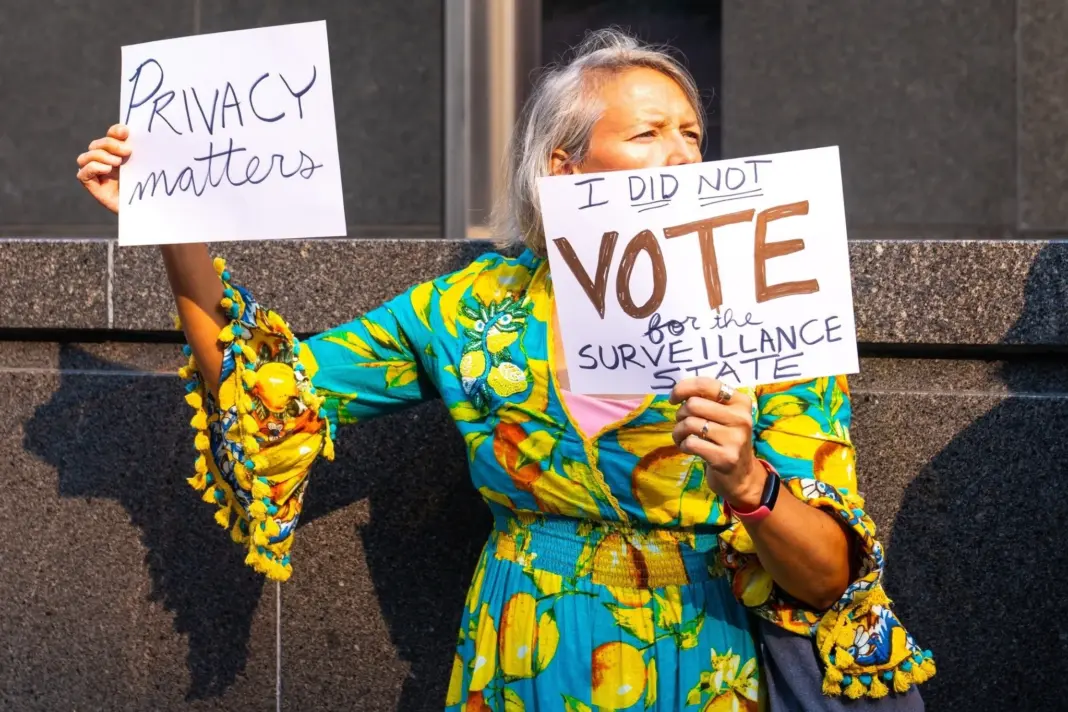
Flock Safety Cameras Are Watching American Cities. What Is the Environmental Cost?

AI cameras are spreading across American cities faster than the rules governing them. The debate has focused largely on privacy and policing in the United States, but we have seen similar stories elsewhere, including Iran, where surveillance cameras have been used to identify women accused of violating mandatory hijab rules.

Women in Iran are being watched by the morality police

Safety and privacy aside, there is another question hiding behind all those cameras: what is the environmental cost of watching everything?

That debate is playing out in Virginia around Flock Safety, whose automated license plate recognition cameras, or ALPRs, are used by police departments across the United States. According to a 2025 Virginia State Police report cited by the Virginia Center for Investigative Journalism at WHRO, at least 159 Virginia law enforcement agencies used ALPRs, including 139 using Flock Safety.

The cameras can help police locate vehicles associated with crimes. But they also create searchable records of vehicles moving through communities.

What happens when an officer uses that power for personal reasons? What happens if enormous collections of location data are retained or shared far beyond their original purpose?

Just because we can collect all this data, should we?

The Virginia Center for Investigative Journalism obtained thousands of public records revealing confusion among residents, police departments and elected officials about how Flock information was collected, shared and stored.

In Bridgewater, data from just five Flock cameras had been accessed more than seven million times nationwide before Virginia banned out-of-state sharing, VCIJ reported.

Attorney Michael Soyfer of the Institute for Justice told VCIJ that police departments sometimes acquire new surveillance technology with little scrutiny.

“Oftentimes, the department vetting is very minimal,” he said.

In Williamsburg, when a resident asked William & Mary police how its Flock data was shared, Police Chief Don Butler turned to Flock for help answering the question.

Flock vice president Chris Colwell sent talking points that could be forwarded to residents. According to VCIJ, the response did not directly answer Butler’s original question.

Flock itself acknowledges the political challenge. One company training document obtained by VCIJ tells police: “Don’t avoid the concept of mass surveillance because you are not going to convince opponents that it’s not.”

Flock says customers control their data and sharing permissions, searches are logged, access is role-based and data is encrypted. The company says its ALPR technology does not use facial recognition.

There are also legitimate public-safety uses. Norfolk police told VCIJ that Flock cameras had assisted investigations into two shootings since March.

But anti-surveillance advocate Clayton Tye argues cities should demonstrate that benefit.

“If you claim that this has been solving crime, then prove it,” he told VCIJ.

If cities are exchanging some privacy for increased security, shouldn’t they measure exactly what they are getting in return?

The environmental cost of surveillance

Then there is a cost almost nobody discusses.

Every image captured, analyzed, transmitted and stored requires physical infrastructure: cameras, telecommunications networks, servers, data centers, electricity and cooling.

Surveillance isn’t driving the AI boom, but it belongs to the same larger question: how much information do we actually need to collect, move and store?

This is where privacy and sustainability unexpectedly meet.

The greener surveillance system may also be the more private one.

Process information locally when possible. Transmit only useful information. Delete unnecessary data quickly. Restrict sharing and duplication.

The greenest byte may be the one we never send to a data center.

Cities should establish retention limits, audit searches and publish evidence showing how often cameras actually help solve crimes. They should also ask vendors where information is processed, how much is transmitted, how long it is stored and what computing infrastructure is required.

Before we build cities that see everything, perhaps we should decide what is actually worth seeing — and worth storing.

And the people living underneath those cameras should get a say.surveill

Read More

TRENDING

How a tick bite can lead to a life-threatening meat allergy AFG

Imagine developing a severe allergy to steak after a single tick bite. That's the reality for people with alpha-gal syndrome, a rapidly emerging condition linked to lone star ticks and other tick species. As researchers uncover how tick saliva rewires the immune system, health officials warn that hundreds of thousands of Americans may already be living with this unusual red meat allergy.

Can a one trillion-Dollar SpaceX IPO change life on earth?

A SpaceX IPO could become one of the most consequential financial events of the century, creating thousands of millionaires and fueling investment across the New Space economy. From orbital robotics and African space programs to launch infrastructure and satellite networks, the ripple effects may extend far beyond Earth—while forcing investors to reconsider whether generative AI remains the most compelling technology bet of the decade.

Anthropic, Google and Stripe put nearly $1 Billion on carbon removal

A coalition led by Frontier, backed by Stripe, Google, Salesforce and newly joined AI company Anthropic, has committed an additional $915 million to remove carbon dioxide from the atmosphere. The pledge adds to a previous $1 billion commitment and brings Frontier's total buying power to nearly $2 billion.

Black fathers live longer than non-fathers, new study

Researchers found that fatherhood was associated with lower rates of early death among Black men, while early fatherhood was linked to poorer long-term health outcomes.

Can Scientists Predict Coral Bleaching Before It Happens?

Now researchers at the Woods Hole Oceanographic Institution (WHOI) in the US say they have developed a way to predict coral bleaching five to six months before it occurs, potentially giving reef managers enough time to intervene and save vulnerable corals.

The Essential Guide To Sustainability in Project Management

Sustainability is an approach where businesses and individuals balance the environmental, social, and economic aspects of a project such that current and future stakeholders are not overburdened with the impacts of the project in future.

Yerukim Forms a New Green Economy Where the Money is Really Green

The Yerukim members who pick up the recyclables get to keep the monetary reward, the public earns "green" bills that can be used in shops, and business owners get to be associated with environmentalism.

Choosing Riyadh over Dubai? What Investors Should Know

Saudi Arabia is deploying capital at unmatched scale to catalyze tourism and advanced industry while rewiring its power-and-water backbone. The investable frontier is widening—especially in renewables, grid storage, water efficiency/desal retrofits, and hospitality operating platforms. Prudent investors will insist on phased delivery, enforceable KPIs (energy, water, biodiversity), and RHQ/zone compliance—while pricing political-economy and reputational risks alongside growth upside.

Sell your cooking oil for biodiesel money

Want to make money on old french fry oil? Sell it.

Qatar Alternative Energy Summit Pairs Investors And Innovators

Alternative energy investors and innovators can meet n' greet in Doha, Qatar March 16 and 17.

Here’s How To Implement The Four Pillars Of Employee Engagement

If you throw a party for your work team and they are vegans, don't make it a barbecue. Know the sustainability values of your team to boost moral and retain good people.

Locals From Rishon Fight IKEA

Big Box stores are a pretty new concept in Israel, and thank God that not every Israeli city wants them in their backyard. A word from someone who has see the beautiful farmland around her hometown Newmarket, Ontario stripped and converted into vulgar strip malls of big box shops: they have no place in a healthy and sustainable town or city.

The Jewish National Fund Meets An Inconvenient Truth

According to the JNF, it has transformed thousands of acres of barren land into green forests in Israel. They state that each person emits about 23 tons of carbon per year, estimating that each tree planted can absorb one ton of carbon in its lifetime. That's a whole lot of trees you'd need to be planting. Could so many fit in Israel?

Popular Categories