
Who buys purebred dogs anymore? I know people do, and there are breeders, bloodlines, dog shows and people who know exactly what shape a German shepherd’s hips should be. But as someone who lives with two spectacular rescue dogs, the whole idea of buying a dog for its pedigree increasingly feels ridiculous when there are so many puppies and dogs already here, waiting for someone to love them.
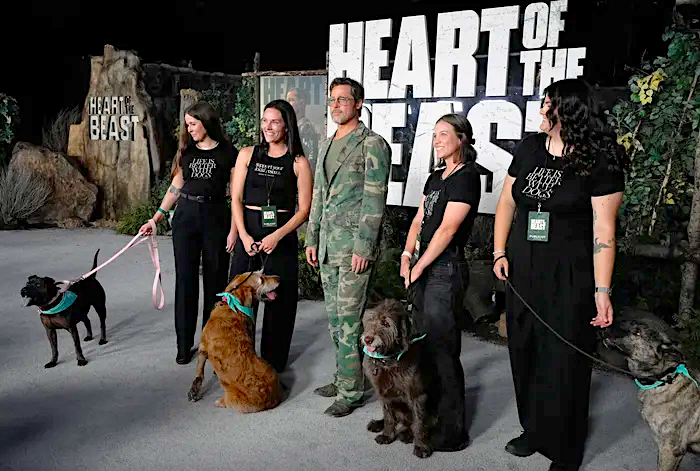
Sometimes even the expression “rescue dog” seems redundant. Shouldn’t that simply be a dog? That was what I thought when I saw Brad Pitt on the red carpet for the world premiere of his new film, Heart of the Beast, in Franklin, Tennessee. Four adoptable dogs from Wags and Walks joined Pitt at the September 16 premiere. The organization, which operates adoption centers in Nashville and Los Angeles, has placed thousands of dogs in homes and focuses on animals that can be harder to place, including bully breeds, nursing mothers and dogs with medical needs.
The film itself is about a Special Forces officer, played by Pitt, stranded in the Alaskan wilderness with his combat dog Odin after a plane crash. Odin is played by Uber, a highly trained German shepherd from a military and law-enforcement breeding line.
There are obviously cases where dogs are bred for very specific working characteristics, but most of us are not looking for an elite military dog. We are looking for the animal who sleeps at the end of the bed, follows us into the kitchen, watches us leave the house and somehow knows exactly when we are sad.
My two dogs are gorgeous rescues from Ramallah in the West Bank.

They came to us through Diana Babish in Bethlehem, a remarkable woman who has effectively created an emergency-response network for animals. People call her when they find abandoned puppies, injured dogs, abused animals or dogs that are simply in danger, and she somehow works out what to do next. She finds veterinarians, foster homes, transportation and eventually, when everything goes right, permanent homes.
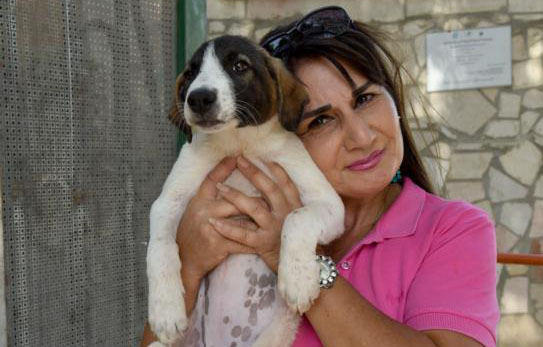
Green Prophet has written about Diana before and about her work through the Animal Environment Association, rescuing dogs, cats and other animals throughout the West Bank while trying to build a permanent no-kill shelter. Her work has also brought her into some very ugly situations.
In 2022, the mayor of Hebron announced that the municipality would pay 20 shekels, roughly seven dollars at the time, for every dead stray dog brought to local authorities. It was an extraordinary idea: putting a cash bounty on the bodies of unwanted dogs because the municipality had failed to develop a humane system for dealing with its stray population.
The result was predictable. Dogs were killed, disturbing photographs circulated, and animal welfare activists protested. Diana challenged what was happening until the municipality eventually backed away from the bounty.
The underlying problem was real. There were too many stray dogs, people were frightened of packs, and municipalities did not have adequate systems for sterilization, sheltering or adoption. But killing dogs because humans failed to control their reproduction is not a particularly sophisticated solution.
Turkey has wrestled with the same problem on a far larger scale. In 2024, the country passed legislation requiring municipalities to remove millions of stray dogs from the streets and place them in shelters, with euthanasia permitted under certain circumstances. Animal welfare groups warned that there simply was not enough shelter capacity and that the policy could lead to mass killing.
There is still an enormous amount of work to be done in the Middle East when it comes to protecting animals, including sterilization programs, shelters, veterinary care, education and changing the basic assumption that an unwanted dog is disposable.
That is why something as apparently trivial as a Hollywood red carpet can matter. Four rescue dogs standing beside Brad Pitt will not solve the stray-dog crisis, but culture changes partly through the images we normalize.