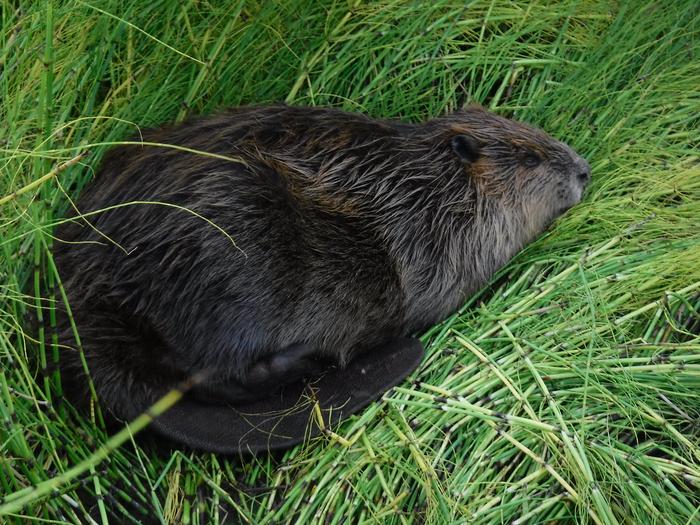

Beavers are heading north. Far north. The North American beaver, Castor canadensis, is expanding into parts of the Canadian Arctic where, not long ago, the landscape simply did not offer enough woody material for a beaver to make much of a living.
Now warming temperatures are changing the tundra. Willows and alders are growing taller and becoming more abundant, giving beavers both food and construction material. And once the beavers arrive, they begin changing the landscape themselves. A new study published in Ecosphere has tracked that expansion using an unusual combination of tree rings and satellites.
Researchers from Anglia Ruskin University in the UK worked with the Imaryuk Monitors, an Indigenous environmental guardian and monitoring group in Canada’s Inuvialuit Settlement Region, surveying territory from Inuvik north toward Tuktoyaktuk on the Arctic Ocean.
They recorded 60 beaver lodges or dam sites and collected willow and alder stems bearing the scars left when beavers chewed them. Those scars turned out to be timestamps. Tree-ring science, or dendrochronology, is normally associated with figuring out the age of ancient trees or reconstructing droughts and fires. Here the researchers used it almost like forensic evidence.
They matched scars in browsed willow and alder stems against regional growth-ring chronologies reaching back to the late 1960s and early 1970s. That allowed them to identify when beavers had been active at particular sites. The evidence points to beaver colonisation in the region beginning around 2008.
“Beavers effectively write their history into the landscape with each shrub they cut and every pond they create by damming streams,” said lead author Dr Georgia Hole, who carried out the research at Anglia Ruskin University and is now based at Durham University.
The researchers then looked from above. Satellite images showed that at one large lodge and dam complex, surface water expanded suddenly and significantly between 2015 and 2019. That flooding coincided with a period of heavy beaver browsing recorded in shrub rings at the same site.
Two completely different records — one written into wood and another visible from space — told the same story.
That matters because the Arctic is enormous, remote and poorly monitored. Scientists frequently lack decades of observations showing what an ecosystem looked like before a major change began.
The beaver is not just another animal moving north. Beavers are what ecologists call ecosystem engineers. They do not simply occupy a habitat, they rebuild it. And can stop flash floods and catastrophic damage with their beaver dams.
A dam can turn moving water into a pond, flood surrounding land, change drainage patterns and alter habitat for fish and other species. In the Arctic, those changes have another dimension: permafrost.
Flooding and changing water flows can affect frozen ground, with consequences that are still being investigated as the region warms. The arrival of beavers therefore is not simply a charming story about furry Canadian animals finding new territory. It can change lakes and rivers, fish populations, access to land and traditional practices for people who live there.
“Arctic Indigenous communities are already observing rapid environmental change, and beaver range expansion is part of that shift,” said senior author Dr Helen Wheeler, Associate Professor of Ecology at Anglia Ruskin University.
The work was carried out in close collaboration with Inuvialuit research partners and communities through the BARIN project, part of the Canada-Inuit Nunangat-United Kingdom Arctic Research Programme.