Earth building with Dead Sea salt bricks

Dead Sea
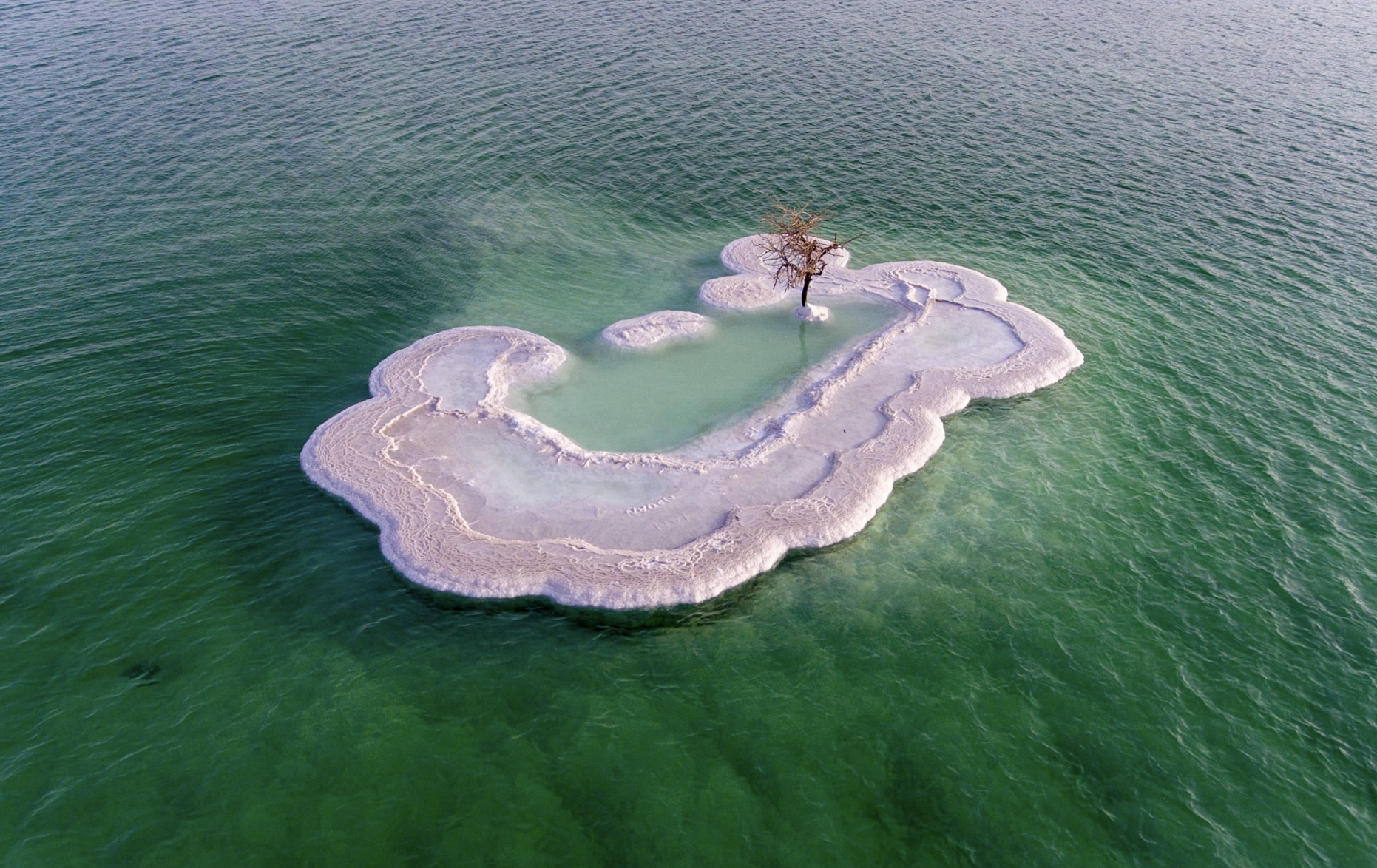
A Dead Sea island and tree. Illustrative photo.

R

Over the past decade, scientists and designers have increasingly recognized that the climate challenge is not only how we build, but what we build with. The construction industry is among the world’s largest polluters, and cement production alone accounts for roughly 8 percent of global carbon emissions.

In response, researchers worldwide are developing alternative building materials with lower environmental footprints—often based on recycled or locally abundant resources. One such innovation is now emerging from Israel: a building brick made largely from recycled Dead Sea salt.

Related: she makes pretty things out of Dead Sea crystals

Turning waste into raw material

Construction places an enormous burden on natural resources. According to the United Nations Environment Program, the sector consumes around 36 percent of global energy, contributes nearly 40 percent of CO₂ emissions, and is responsible for significant air and ecosystem pollution.

Israel, meanwhile, has limited natural construction resources. One of its most abundant materials is found at the Dead Sea, one of the world’s largest sources of industrial salt and potash. Each year, millions of tons of excess salt accumulate in evaporation ponds as a byproduct of mineral extraction. The buildup raises the lakebed, alters shorelines, and presents a long-term environmental challenge.

For decades, this surplus salt was treated as waste.
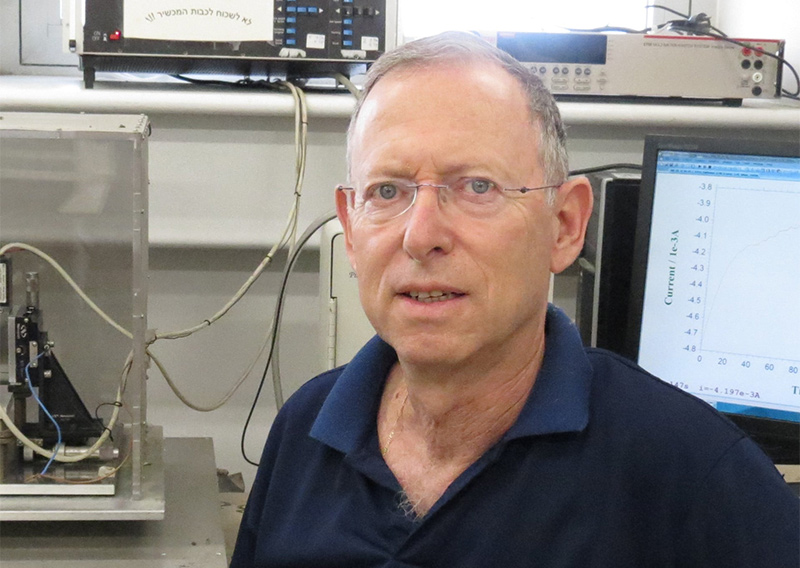
Prof. Daniel Mendler, Hebrew University

Since 2015, Danny Mendler, a professor in the Chemistry Department at the Hebrew University of Jerusalem, has been working to change that perception. His research treats Dead Sea salt not as a nuisance to be removed, but as a raw material that can be refined and reused.

Mendler developed a process that compresses salt with a small percentage of additional materials—around five percent—under high pressure to create solid bricks with strength approaching that of conventional concrete.

“If we can replace even a fraction of cement with salt, the environmental impact would be substantial,” Mendler explains. “Reducing cement use directly reduces carbon emissions.”

From chemistry lab to architectural design

Dead Sea crystal jewelry, salt crystal jewelry, Dead Sea salt crystals, handmade crystal jewelry, natural salt jewelry, healing crystal jewelry, mineral jewelry, Dead Sea minerals, unique crystal jewelry, artisan salt jewelry, spiritual jewelry, holistic jewelry, Dead Sea gifts, salt gemstone jewelry, eco-friendly jewelry, metaphysical jewelry, raw crystal jewelry, Dead Sea wellness, ethical crystal jewelry, salt energy jewelry
Jewellery from naturally occurring dead sea salt crystals via Michal Rothschild.

In 2025, the research moved beyond the laboratory through a collaboration with architecture students at the Technion – Israel Institute of Technology. As part of the Faculty of Architecture and Town Planning’s Studio 1:1 program, led by Michal Bleicher and Dan Price, students translated the material into a workable building system.

The group examined the physical qualities of salt—its mass, translucency, and structural behavior—and designed a prototype structure they called the Mediterranean Igloo. Through this process, they defined a standardized brick size of 8 × 8 × 24 centimeters, a 1:3 ratio that allows modular flexibility in construction.

The outcome was a uniform, scalable brick made primarily from Dead Sea salt—adaptable in shape, thickness, and surface texture, and compatible with contemporary building needs. Compared with conventional materials, the salt bricks offer a lower-pollution alternative while repurposing an existing environmental burden.

International recognition
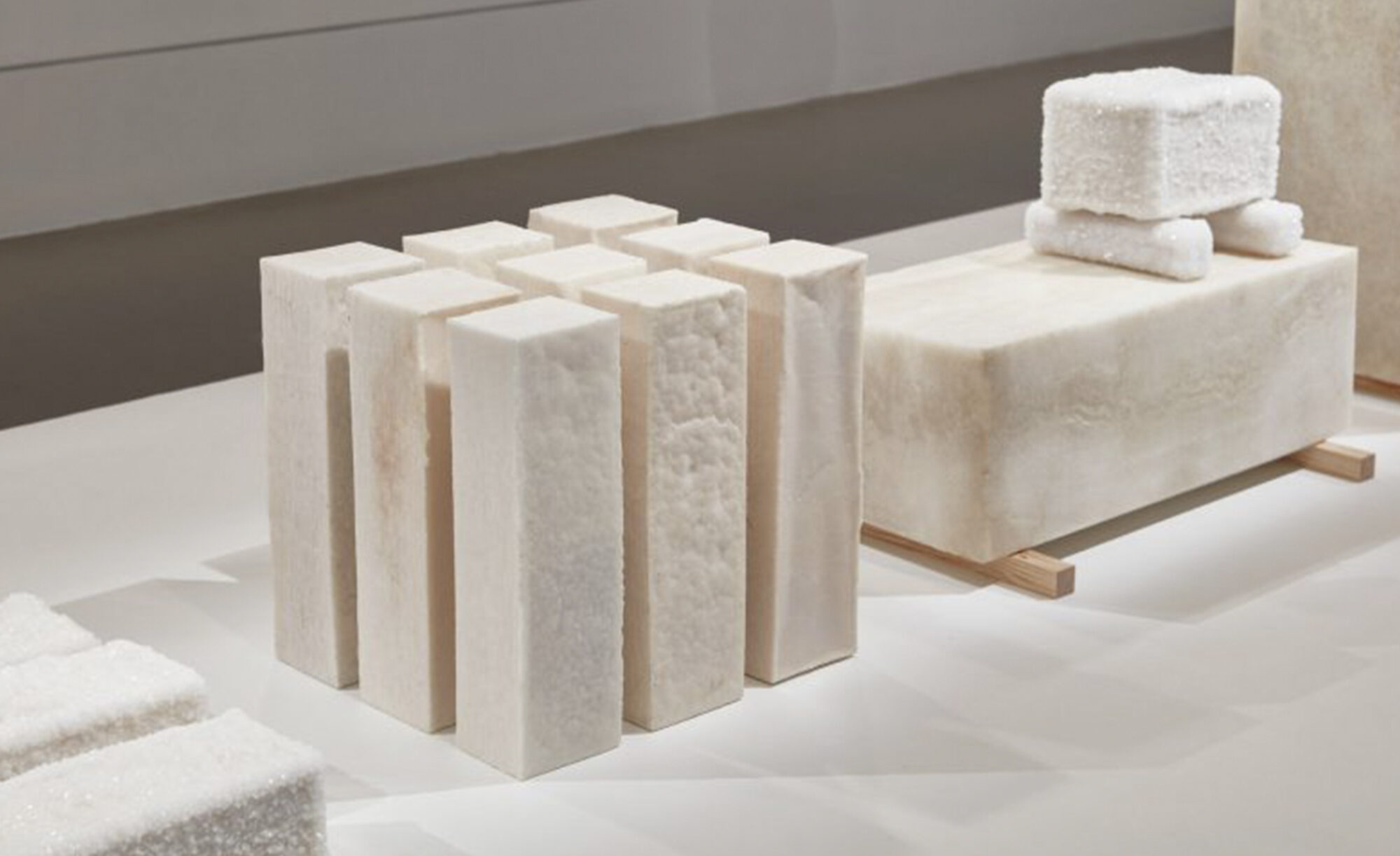
Designer Erez Nevi Pani designed bricks from Dead Sea salt in 2021. This new research takes the inspiration to a commercial scale. Image via Erez Navi Pana.

The project was presented in October at Change: The Shape of Transformation, part of the Venice Architecture Biennale. Selected from 55 academic institutions worldwide, the Technion team was among just ten invited to exhibit.

The students transported physical salt bricks to Venice, drawing significant interest from architects and researchers. According to Bleicher, the response underscored growing global attention to material innovation in architecture.

“This is a material that is both natural and engineered,” she says. “Our next goal is to construct a full-scale structure in Israel using these bricks. We believe this approach can turn a serious environmental problem into a practical solution.”

What stands in the way
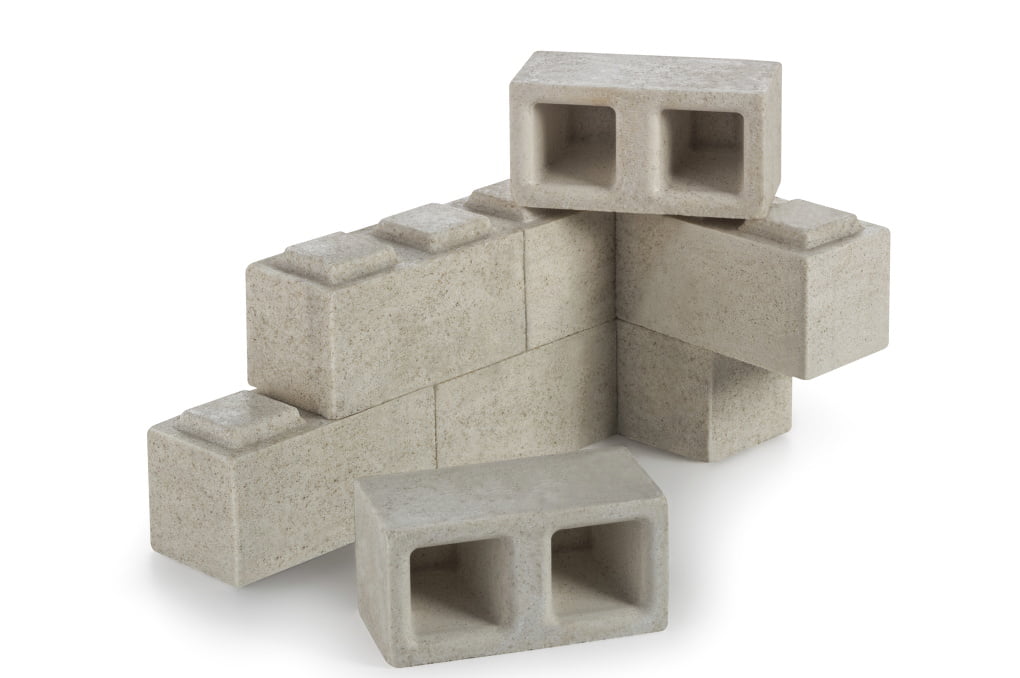
Dead Sea salt building bricks sample. Via the Hebrew University.

Despite its promise, widespread adoption is not imminent. The construction industry is notoriously conservative, and introducing new materials requires years of testing, certification, and regulatory approval.

“Every new building material must pass extensive strength, durability, and safety standards,” Bleicher notes. “That takes time, funding, and supportive regulation—which is often lacking.”

Still, the idea that decades of accumulated salt waste could become part of a cleaner construction future reflects a broader shift in environmental thinking: viewing crisis not only as a risk, but as a catalyst for innovation.

This article was prepared by Zavit, the news agency of the Israeli Society for Ecology and Environmental Sciences. It is republished with permission.

Read More

TRENDING

Mona Khalil, Orange House Project founder, sea turtle protector killed in Lebanon

Mona Khalil spent decades protecting Lebanon's sea turtles and coastal ecosystems. Her death in the ongoing conflict between Israel and Hezbollah shines a light on a broader environmental tragedy unfolding across northern Israel and southern Lebanon. From damaged wetlands and disrupted bird migrations to threatened seed banks and endangered wildlife, the region's ecosystems are becoming casualties of a war with no clear end in sight.

Dan Zaslavsky’s energy tower dream is rising again in Iran and China

The Energy Tower idea never made the leap from drawings and engineering studies to full-scale construction. But nearly two decades after most people stopped talking about it, the concept is quietly evolving in two unexpected places: China and Iran. The concept let dreamers dream and doers do - figuring out more pleasing designs and engineering.

A visit to Amirim, Israel’s first all-vegetarian village in the Galilee

Just 15 kilometers from Tzfat there is a moshav that was founded in the late 50s that was ideologically influenced by organic, vegetarian and vegan principles. My hostess at Ohn-Bar, the tzimmer where I stayed, explained that the people of Amirim were among the pioneers of Israel’s strong vegetarian movement.

Israeli Hydrogen Startup H2Pro Are Trying to Solve Clean Energy’s Hardest Problem

The company has attracted backing from major investors including Breakthrough Energy Ventures, the climate fund founded by Bill Gates, along with industrial partners such as Sumitomo, ArcelorMittal, and Temasek, a multi-billion dollar company that owns Singapore airlines. H2Pro has raised more than $100 million USD and is moving from pilot projects toward commercial-scale deployments.

Desalination experts debunk Aqua Solaire, the floating desalination barge

AI makes it easy to dream, develop, and create images of what could be world-changing ideas, until the reality sets in. A new project making the rounds is Aqua Solaire, an allged French concept for a solar-powered desalination vessel designed to bring drinking water to coastal communities facing drought, storms, and infrastructure failures.

Yerukim Forms a New Green Economy Where the Money is Really Green

The Yerukim members who pick up the recyclables get to keep the monetary reward, the public earns "green" bills that can be used in shops, and business owners get to be associated with environmentalism.

Choosing Riyadh over Dubai? What Investors Should Know

Saudi Arabia is deploying capital at unmatched scale to catalyze tourism and advanced industry while rewiring its power-and-water backbone. The investable frontier is widening—especially in renewables, grid storage, water efficiency/desal retrofits, and hospitality operating platforms. Prudent investors will insist on phased delivery, enforceable KPIs (energy, water, biodiversity), and RHQ/zone compliance—while pricing political-economy and reputational risks alongside growth upside.

Sell your cooking oil for biodiesel money

Want to make money on old french fry oil? Sell it.

Qatar Alternative Energy Summit Pairs Investors And Innovators

Alternative energy investors and innovators can meet n' greet in Doha, Qatar March 16 and 17.

Here’s How To Implement The Four Pillars Of Employee Engagement

If you throw a party for your work team and they are vegans, don't make it a barbecue. Know the sustainability values of your team to boost moral and retain good people.

Locals From Rishon Fight IKEA

Big Box stores are a pretty new concept in Israel, and thank God that not every Israeli city wants them in their backyard. A word from someone who has see the beautiful farmland around her hometown Newmarket, Ontario stripped and converted into vulgar strip malls of big box shops: they have no place in a healthy and sustainable town or city.

The Jewish National Fund Meets An Inconvenient Truth

According to the JNF, it has transformed thousands of acres of barren land into green forests in Israel. They state that each person emits about 23 tons of carbon per year, estimating that each tree planted can absorb one ton of carbon in its lifetime. That's a whole lot of trees you'd need to be planting. Could so many fit in Israel?

How to quiet noise from construction in your office

Streets need to be resurfaced in New York but the humming and grinding noise is unsettling. Noise is environmental pollution. 

Popular Categories