

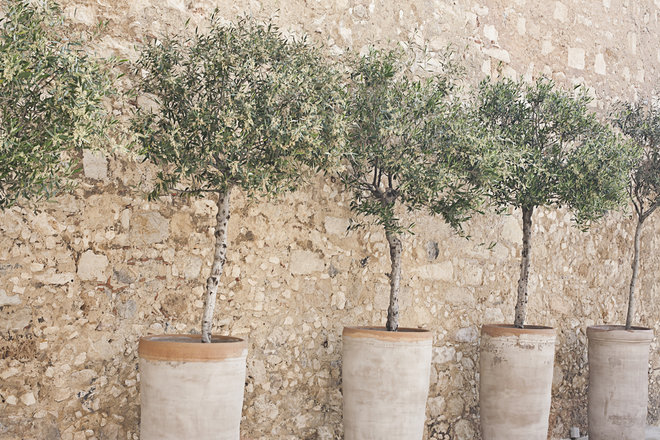
 Don’t have a garden? You can still own a fruiting olive tree, grown in a container. A sunny balcony and the right climate are the essential things; that, and time.
Italians have grown fruit trees in containers for centuries, keeping them protected in special sheds during the winter.
Come spring, the trees are wheeled out to the sunshine again. While we can dream of owning an olive grove like the one we visited in the Galilee, olive trees successfully grow in pots too.
Assuming your climate suits the olive, you should acquire a sapling from a nursery or buy one online. Olive trees grown from pits revert to the original wild olive, and if they produce fruit at all, it will be wizened and not very good to eat. So don’t do it. Consult the nursery manager and choose the variety you’d like best. To maximize fruiting potential, you should actually have two of the same variety in the area. This may be impractical where there’s limited space, of course.
When to plant an olive tree in a pot?

Spring is the best time to re-pot the sapling into its permanent container. Tender saplings suffer under frost or harsh winter weather, so it’s best to transplant after all danger of frost has passed. When the temperature threatens to dip under 50°F/10ºC, the tree should be brought indoors. It may be taken out to enjoy the sunshine on warmer days. A trolley, on which the container stands permanently, is useful there.

Choose a spot that gets plenty of full sun and only partial shade. Have a clay pot about 2 feet/61 centimeters deep and the same width at the ready. No need for pebbles or other drainage device at the bottom. Pour enough soil in to cover the bottom thickly. Knock the sapling out of its original container and place in the new pot. Fill the pot with soil around the tree and make sure it stands stable. Water thoroughly.
Soil and watering olives trees in a container
Ordinary potting soil; no special fertilizers or compost at first. Wait until there are signs of growth in the following spring to add compost or concentrated fertilizer to the soil. Keep the soil lightly moist, but not over-watered. A mature tree can withstand drought, but until a sapling is established and thriving in its new environment, it needs light moisture.
Care of the tree
We recommend pruning with caution for the first four years: remove branches under 3 feet/91.5 centimeters as well as suckers. Others recommend watching for flowering and then pruning off the tips of the branches, above a pair of leaves, as well.
Plant hygiene
Watch out for scale infestation. Buy a natural insecticide product from the plant nursery. Traditional Mediterranean farmers whitewash the bottom half of the trunk to keep ants away. Weed out any wind-born seedlings the minute you notice them.
The next step is to enjoy the lovely sight of the tree’s silvery-green foliage moving while the breeze rustles through it. Because it may take up to five years before it produces any fruit for you. You’ll need to discuss when you can expect fruit with the gardener at the nursery. But by then you and the tree will have become good friends, and the fruit will be a nice bonus.
If you can’t find local, search online for olive tree sapling delivery to your home. Once you get one growing you can grow clones from the original using patience or a rooting hormone.
What kind of olive tree to plant in a container?

Barnea, suri, kalamata? Your supermarket or farmer’s market usually offers a good variety of olives. Juicy green, black, brown or purple olives glistening in their own oil. Olives seasoned with chilies, lemons and herbs; olives pitted and left empty; olives stuffed with red pimentos; olives in brine or in wine marinade – enough olives to make your senses reel.
And like grape varieties for wine, there are more kinds of olives in the world than you’ll ever know. Every region where olives are grown yields a particular variety, each with its unique shape, size, and flavor. Get the low down on olive varieties here. Having problems? Check out the olive tree guide to longer-term
More about olive trees and olives:




[…] How to grow an olive tree in a container | Green Prophet – Don’t have a garden? You can still own a fruiting olive tree, grown in a container. A sunny balcony and the right climate are the essential things; that, and time. […]
Should i put worms in the hard soil in my olive tree tubs to losen it?
I know of olive trees in bonsai style. I would love to know what type of soil to use for my new babies. Someone please help 🙁
[…] INFORMATION ON HOW TO GROW AN OLIVE TREE CONTINUES HERE: […]
A couple of things I did not see in your article is what size pot to use plus a source for them and what zone here in the US would they grow well in?
[…] How To Grow An Olive Tree In A Container + How To Cure Olives […]
Can you graft olive branches? Say for instance I have an apple ore even a maple tree; can I graft my olive branch onto it?
Hi Richard
You can graft Olives. This is how olive groves are established.
The trick is to graft a rich fruit bearing variety on to a natural hardy root stock.
As the article pointed out… new tree grown from pits normally revert to the natural variant. These can be used as grafting root stock on to which you would graft a cutting from developed cultivar ( ie: a cutting from a variant that has the characteristics that you want. Depending on where you are situated availability of suitable /desirable cuttings may be a problem.
Regards
Mike