OAXIS: solar-powered hydroponic food belt proposed for the Arabian Peninsula

Linear hydroponic farm, Arabian Peninsula, Forward Thinking Architecture, hydroponics, solar power, renewable energy, desert agriculture, food belt, food security, carbon emissions, food miles

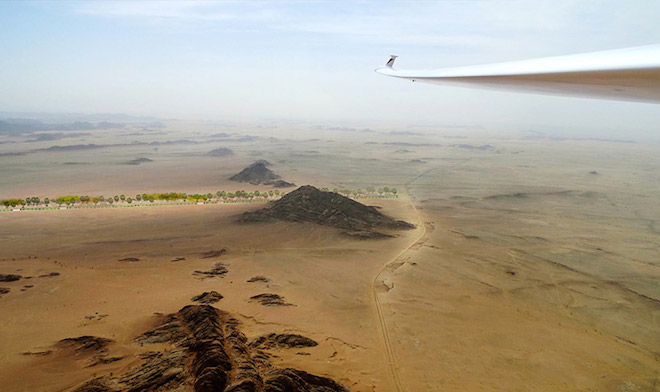
Most Gulf countries import up to 90 percent of their food, which neither bodes well for food security no climate change – since the food that is brought in from Europe and elsewhere has a lot of what are called “food miles.” True to their name, Forward Thinking Architecture proposes a solar-powered hydroponic food belt as a solution.
Linear hydroponic farm, Arabian Peninsula, Forward Thinking Architecture, hydroponics, solar power, renewable energy, desert agriculture, food belt, food security, carbon emissions, food miles
Acknowledging that they are not designing anything new – because there are already several projects throughout the Arabian peninsula that utilize the sun and hydroponics to deliver food in the desert. One project that comes to mind is the Sahara Forest Project which has received a great deal of international press.

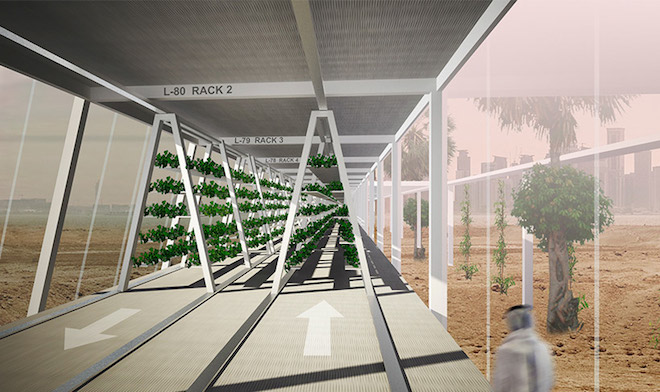
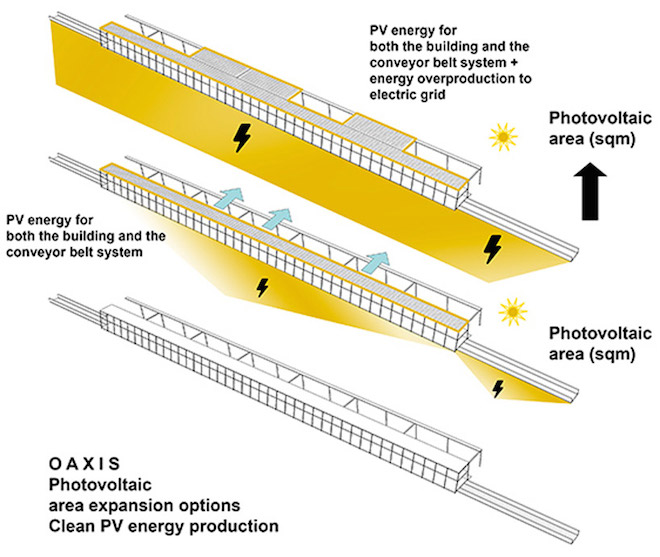
The OAXIS system aims to fuse existing technology in a modular, linear arrangement. The growing medium will consist of prefabricated and recycled steel structures equipped with super efficient irrigation technology that uses roughly 80 percent less water than most farms require. Rooftop solar panels provide energy not only for the architecture itself, but also to power artificial LED lighting that will help promote greater crop growth.

Related: Qatar’s Sahara Forest Project Produces Cucumbers with Saltwater
Linear hydroponic farm, Arabian Peninsula, Forward Thinking Architecture, hydroponics, solar power, renewable energy, desert agriculture, food belt, food security, carbon emissions, food miles

In order to transport these crops directly to cities throughout the peninsula, the design team proposes an underground transportation network that would also be powered by solar energy. In this way, the system is completely self-sufficient, and hardly contributes at all to harmful greenhouse gas emissions.

“…our objective is not to compete with nature and its amazing processes or with an existing oasis such as Al-Hasa, the design team says in their brief. “What we propose is a safe and controlled hydroponic facility based on a modular linear pattern, a city new ‘green axis.’

Linear hydroponic farm, Arabian Peninsula, Forward Thinking Architecture, hydroponics, solar power, renewable energy, desert agriculture, food belt, food security, carbon emissions, food miles

“It will produce solar energy to become self-sufficient and capable of running an underground transportation system that deliver the crops directly to the cities, shortening long distance food transportation (imports) and therefore reducing CO2 emissions.”
Linear hydroponic farm, Arabian Peninsula, Forward Thinking Architecture, hydroponics, solar power, renewable energy, desert agriculture, food belt, food security, carbon emissions, food miles

We particularly love the use of recycled steel, which has a very high embodied energy footprint, as well as the ubiquitous use of renewable energy. And the crops will grow year-round and could include strawberries, tomatoes, rocket, potatoes, thyme, lettuce, bell peppers, basil and more.

It’s an impressive design, and it could work!
Tafline Laylin
Tafline Laylinhttp://www.greenprophet.com
As a tour leader who led “eco-friendly” camping trips throughout North America, Tafline soon realized that she was instead leaving behind a trail of gas fumes, plastic bottles and Pringles. In fact, wherever she traveled – whether it was Viet Nam or South Africa or England – it became clear how inefficiently the mandate to re-think our consumer culture is reaching the general public. Born in Iran, raised in South Africa and the United States, she currently splits her time between Africa and the Middle East. Tafline can be reached at tafline (at) greenprophet (dot) com.

Read More

TRENDING

Anthropic, Google and Stripe put nearly $1 Billion on carbon removal

A coalition led by Frontier, backed by Stripe, Google, Salesforce and newly joined AI company Anthropic, has committed an additional $915 million to remove carbon dioxide from the atmosphere. The pledge adds to a previous $1 billion commitment and brings Frontier's total buying power to nearly $2 billion.

5 Reasons Why You Should Save Seeds (and plant them)

Saving seeds from tomatoes, peppers, herbs and flowers helps preserve biodiversity, strengthen food security, and keep heirloom varieties alive. Even a small balcony garden can make a difference.

How you create green steel on a blockchain

The thing about raw materials is that once they are melted down, you can't prove the source of the material. Same is true with gold, cucumbers and even forged products that look the same as the real thing. When it comes to steel, and how we produce it, it has a massive carbon problem. What's happening in Japan right now could change how we think about heavy industry and climate action.

Green finance in Saudi Arabia, can “Davos in the Desert” change the planet?

As world leaders and billionaires descend on Riyadh for this year’s Future Investment Initiative — better known as “Davos in the Desert” — we wonder where the planet fairs in all this political business talk. Saudi Arabia’s Vision 2030 plan has turned the kingdom into an unlikely global stage for innovation and investment, drawing over 20 heads of state, 50 ministers, and hundreds of financiers, tech executives, and policy shapers.

EPA May Repeal Key Climate Health Ruling — But Scientists Warn of Dire Consequences

The endangerment finding has been the scientific and legal backbone of US climate policy for more than a decade. Without it, the EPA loses its authority to regulate carbon emissions under the Clean Air Act.

Yerukim Forms a New Green Economy Where the Money is Really Green

The Yerukim members who pick up the recyclables get to keep the monetary reward, the public earns "green" bills that can be used in shops, and business owners get to be associated with environmentalism.

Choosing Riyadh over Dubai? What Investors Should Know

Saudi Arabia is deploying capital at unmatched scale to catalyze tourism and advanced industry while rewiring its power-and-water backbone. The investable frontier is widening—especially in renewables, grid storage, water efficiency/desal retrofits, and hospitality operating platforms. Prudent investors will insist on phased delivery, enforceable KPIs (energy, water, biodiversity), and RHQ/zone compliance—while pricing political-economy and reputational risks alongside growth upside.

Sell your cooking oil for biodiesel money

Want to make money on old french fry oil? Sell it.

Qatar Alternative Energy Summit Pairs Investors And Innovators

Alternative energy investors and innovators can meet n' greet in Doha, Qatar March 16 and 17.

Here’s How To Implement The Four Pillars Of Employee Engagement

If you throw a party for your work team and they are vegans, don't make it a barbecue. Know the sustainability values of your team to boost moral and retain good people.

Locals From Rishon Fight IKEA

Big Box stores are a pretty new concept in Israel, and thank God that not every Israeli city wants them in their backyard. A word from someone who has see the beautiful farmland around her hometown Newmarket, Ontario stripped and converted into vulgar strip malls of big box shops: they have no place in a healthy and sustainable town or city.

The Jewish National Fund Meets An Inconvenient Truth

According to the JNF, it has transformed thousands of acres of barren land into green forests in Israel. They state that each person emits about 23 tons of carbon per year, estimating that each tree planted can absorb one ton of carbon in its lifetime. That's a whole lot of trees you'd need to be planting. Could so many fit in Israel?

How to quiet noise from construction in your office

Streets need to be resurfaced in New York but the humming and grinding noise is unsettling. Noise is environmental pollution. 

Popular Categories