

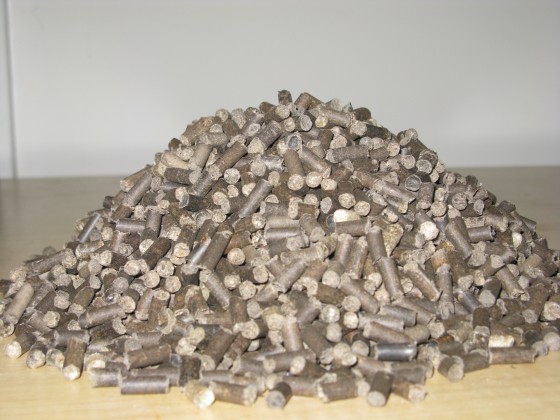
 I catch up with Applied Clean Tech to know more about their recycled toilet paper project Above: recycled poo pellets that serve as raw material for recycled paper
It will probably take a certain market approach and finesse to get people to accept, let alone truly appreciate, recycled toilet paper. But Refael Aharon, the CEO and founder of Applied Clean Tech, is convinced that his company has landed on a sort of goldmine. It has refined the process of turning the cellulose in sludge — toilet paper, fecal matter and washing machine lint — into new paper.
The finished product has no odor and poses no biological hazard. “It’s a real recycled paper,” Aharon tells ISRAEL21c, and not just paper leftovers from printing presses and the like that have been put back in the cycle. This is material that if not reclaimed would literally go down the drain and eventually biodegrade.
Aharon knows that using recycled toilet paper in food packaging might not fly with a lot of consumers, but the company is using its cellulose-based raw material in envelopes in Israel, where it has set up one of its installations at a local waste-treatment plant. (See examples of what the paper looks like here).
The company is also in advanced negotiations with a wastewater facility in the Palestinian Authority, has a joint project with Jordan and is in talks with US and British companies.
“We are under negotiations to open our activities in Western Europe and the United States and are considering China too, which is of great interest because they are currently building about 1,000 wastewater treatment plants,” he explains.
“Countries like India and Thailand, where the people use a hand-wash method, aren’t the right kind of places to develop recycled toilet paper, but more analysis needs to be done on which countries do in fact have the highest amount of cellulose going to the wastewater treatment plants,” says Aharon. Because it’s not just paper that can be found in sludge.
It’s nature’s call
Applied Clean Tech originally developed a solution to turn sludge into biofuel, but given a conservative market in that area, they have switched to using their technology for paper and other recycled products based on paper. They will be operating both ideas in parallel, and will wait for the biofuel industry to mature.
“Actually we have made a lot of progress since 2009, and have since sold local licenses to Israel and the Palestinian Authority, two different licenses from which we can produce almost any kind of paper,” Aharon says. This includes writing paper and high-quality A5 graphics paper with a unique texture. “This is because of the source,” he explains.
Reclaiming water that would otherwise go down the drain.
After analyzing the cellulose composition in sludge, Applied Clean Tech determined that they can make a wide array of paper products from about 60 percent of the materials that get flushed down the drain. Since any plant-based cellulose we eat goes straight into the toilet as cellulose, fecal material is a useful part of the sludge.
“We’ve actually discovered a new source of paper,” says Aharon. “A real good source if you collect it from the point we do, the point before the biological processes of the wastewater treatment plant destroy it.”
Besides being a bankable commodity, the fact that Applied Clean Tech can help reduce the amount of sludge going to the treatment process means that processing costs can be slashed by as much as 20% to 30%, Aharon estimates.
“We can decrease operations costs by 30% due to less need for aeration, and less energy that’s consumed in the process, with less sludge being formed. We can reduce the number of digesters needed, and give the possibility for smaller reactors to be built. Also when you have an existing plant we can increase the capacity from 20-30%. When you reduce the load, you can increase capacity,” he explains.
Carbon credits shouldn’t be flushed down the drain
Companies that use the system can file for carbon credits because using Applied Clean Tech’s solution means fewer virgin trees will be turned into paper. If sludge is 60% cellulose that can be turned back into paper, wastewater treatment plants can really be sitting pretty.
Now the big challenge is how to help his licensees market the end result. “It’s a psychological issue that I am aware of,” says Aharon.
Paper made from sludge is odorless and biologically harmless.
A similar issue is at play in Singapore, where there are wastewater plants that create drinking water from sewage water. “The problem there is that no one will drink it. We are thinking right now of how to give guidelines to our customers on how to educate consumers about the product.”
After crunching the numbers, Aharon estimates that recycled toilet paper, and every other solid matter that gets flushed down the drain, can serve the needs of 10% of the market. That’s huge news for the paper industry, especially if people will agree to use envelopes, paper and possibly food packaging that was once in someone else’s toilet.
Applied Clean Tech was founded in 2007, is based in Jerusalem and has previously been financed by venture capital funds such as Saturn Venture Partners in Boston.
This story first appeared on ISRAEL21c.org


