

My 20s were spent dealing with contact lenses. First with monthlies that dried my eyes, then dailies that I would flush down the drain. But daily contact use is a lot of plastic and microplastics. Can there be a more sustainable way?
Contact lenses are a great vision correction option for many (I now enjoy the effects of a laser treatment), but if one of them gets damaged, there is little to do other than throw it away. This is challenging for people with speciality lenses and of course those working on their plastic footprint.
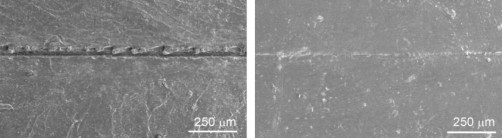
A team reporting in the journal Applied Polymer Materials has a solution: special polymer hydrogels and UV light. Scratches on lenses made from their new material were easily repaired with an hour of UV light exposure. This demonstration is a first step toward the next generation of contact lenses.
How do these lenses self-repair?
Commonly used “soft contacts” are made from hydrogels: porous, water-filled networks of polymers. Hydrogel lenses can be scratched or become cloudy from normal wear and tear or from dust and debris. Currently, there are no methods for repairing a contact lens once it’s damaged, which can be annoying and expensive.
Researchers Jung-Hyun Choi and Byoung-Ki Cho of Korea wanted to develop a self-healing hydrogel material for repairable contact lenses.
Previously, the researchers created a hydrogel that repaired itself after being heated for several hours; however, this was not ideal for contact lenses because extended heating causes the delicate lens to dry out. So, this time they used UV light to initiate a self-healing chemical reaction at room temperature.
Choi and Cho built the hydrogel using a disulfide cross-linker and methacrylate polymer. Then they coated it with a different polymer to help prevent bacterial growth and surface scratches. When a damaged hydrogel was exposed to UV light (365 nanometers in wavelength) at room temperature for one hour, the energy from the light induced a process known as disulfide exchange.
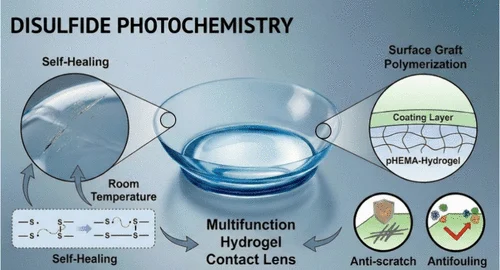
Here, existing sulfur-to-sulfur bonds break and form new bonds with other sulfur atoms, slowly knitting the hydrogel back together. In tests, this healing process was highly efficient, resulting in a near-seamless lens. And, according to Cho, the repair process can be repeated and could even be conducted using at-home UV lamps, such as those used as cleaning devices or for curing gel nail polish.
In addition, a lens formed from the coated hydrogel had mechanical properties, including water retention, similar to those expected for soft contacts. The specialized anti-scratch coating even prevented scratches from fine-grit sandpaper, dropping in transparency only by about 2% after abrasion.
Before these lenses can be found on store shelves, they’ll need to go through additional stability testing and regulatory approval. But the researchers hope that this work could lead to contact lenses that are more robust.
Other sustainable applications?
For sustainability advocates, the real promise may not be in contact lenses at all. The same chemistry could eventually find its way into water infrastructure, solar energy systems, healthcare products, and consumer goods.
Imagine solar panel coatings that repair scratches caused by desert sandstorms, extending the lifespan of renewable energy installations. Imagine filtration systems in drought-prone regions that can regenerate rather than be replaced. Even modest improvements in durability can have a profound environmental impact when applied at scale.
The greenest products are those you can repair before replacing.