 Jerusalem belches out its untreated waste to area of beauty, holy sites
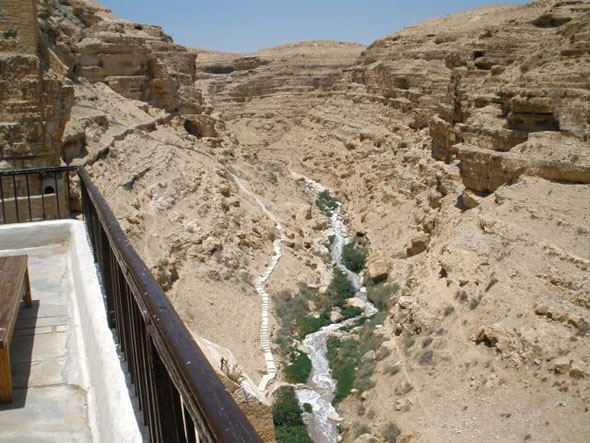
Mohammed Nakhal is normally a calm man, but he’s seething now. The stench of raw sewage is overpowering. It is rushing by, down the biblical Kidron Valley through the Judean Desert toward the Dead Sea where even you know what floats.
Nakhal, an urban planner, has been instrumental in clearing out the mounds of debris dumped in the valley and is lobbying hard for the sewage to be channeled through underground conduits and treated. It’s all part of an ambitious plan to turn what had been for millennia a pilgrimage route for Jews, Christians and Muslims going up to Jerusalem but over the past few decades has become a way down and out for the holy city’s refuse, into a green tourism path.
Neglected and treated as the city’s dirty backyard and a polluted dump, the Kidron Valley will become a green tourism path if Nakhal and his allies get their way. It won’t be easy. In Jerusalem, even the simplest problems with win-win solutions almost always contain political undertones that get them bogged down in the wider context of the Israel-Palestinian conflict.
Sewage on the streets in Jerusalem
“We’re inside the boundaries of Jerusalem, just 3,000 meters from the Old City and the holy sites and the tourists and pilgrims and we see raw sewage flowing freely here. We’re in Jerusalem. We’re not in Somalia, you know,” Nakhal says with incredulity.
On this day, bloated dead sheep are splayed out amid ancient but neglected olive trees. For thousands of years, the Kidron supplied local folk with water but now some 35,000 tons of raw sewage flow daily flow through it from Israeli to Palestinian territory. About 500 meters short of the municipality boundary it emerges from its concrete culverts and crosses the heavily fenced security barrier toward the Palestinian village of Ubeidya.
This rocky canyon is laden with famous cultural and historical sites, ancient tombs, monasteries and gorgeous landscapes. It leads up to Mount Moriah – today the Temple Mount or Haram Al-Sharif – where the Bible says Abraham took his son and bound him as a sacrifice and thus beginning the very first covenant between human beings and God.
“This is what took Jerusalem from being a physical place and made it into quite a spiritual entity. That didn’t need to rely on the physical conditions but on the faith and spirituality of the people that believe in God and look upon this place,” archaeologist Avner Goren told The Media Line “When this faith spread to Christianity and Islam and others join, it becomes important for about half of the population in the world now.”
Jerusalem sits on a mountain ridge. Towards it west, all the rain and sewage that collects in its streets and goes down its drains flows is treated and purified in state-of-the-art sewage facilities before it reaches the Mediterranean Sea. It handles some 23 million cubic meters of sewage from the Sorek and Rafa’im rivers every year. However, the effluent that runs off from the eastern, Arab neighborhoods acquired by Israel in the 1967 Six Day War surges down the Kidron River untreated and into the Judean Desert.
Many plans have been drawn up over the years to deal with it, but none of come to fruition mainly because of politics. In 1993, in the wake of the Oslo peace accords, the Germans offered to finance a sewage-treatment plant, but the Palestinians refused to accept a joint project contending that it would be tantamount to recognizing Israeli authority over the territory. The two sides also disputed the use of the treated waters.
“When we come to an area like the Kidron, we are daring to address ecological challenges and cultural challenges even though the geopolitical clock never stops ticking,” says Naomi Tzur, deputy mayor of Jerusalem and head of the planning and environmental committees on the city council. “We can’t wait for geopolitical peace in order to achieve ecological peace and that ecological peace can create very positive energy for all of the populations in the basin.”
Tzur, a native of Bristol, England, who moved to Israel over 40 years ago, told The Media Line she has a vision for the Kidron Basin.
“Some of the sewage is Palestinian. Some is Israeli. We all know that sewage, like water, knows no boundaries. It is a crying shame that 40,000 cubic meters, which is about 15 million geopolitically disputed cubic meters of sewage a year, should not become disputed cubes of water that can bring prosperity to the area,” Tzur says.
Part of the Green Pilgrimage Network
The vision is to join Jerusalem to the Green Pilgrimage Network that wants to devise sustainable solutions for pilgrims. According to the Alliance of Religions and Conservation (ARC), around 100 million people go on pilgrimages every year. Meeting in Italy recently, the representatives of 10 different religions worldwide discussed ways of greening sacred places.
“Religions of the world agree that climate change is one of the burning issues of our time,” says Tzur, who represented Jerusalem at the launch of the Green Pilgrimage Network in Assisi, Italy.
Tzur notes that Jerusalem has the unique challenge of being a pilgrimage city for not one, but three major religions. She believes that the pilgrim’s sense of seeking a life-changing experience can be harnessed to support green tourism. Tzur and her team are working to get the sewage cleaned up and make the Kidron basin a place of pilgrimage again.
“In Jerusalem we have to start with small issues. You are not going to succeed if you start with very, very big issues because you will face political issues very fast,” says Osnat Post, a former head of planning for Jerusalem’s municipality and today a private consultant working with Tzur.
They envision restored springs and holy sites, modest hotels, perhaps inside the ancient caves, catering to pilgrims, serving locally produced food. Mohammed Nakhal, the urban planner, is aiding Tzur’s team. Besides organizing the clearing of debris, he is also pushing for the Arab houses in the area to be hooked to a central sewage system in place of the cesspools most use today. That way, more water could be diverted to treatment and reuse for the quarter of a million people living along the Kidron basin.
On the upper slopes of the Kidron is the neighborhood of Silwan, built on ruins going back more than 3,000 years. Residents here have little faith the plans will bear fruit, saying the municipality neglects and discriminates against the Arab neighborhoods.
“If you go to the Jewish side and someone calls about a cat that died, you can get the police to come right away. Here if you have a dead donkey or horse in the street and you call hundreds of times, only after two or three days maybe they will come and pick it up,” says Ismail Kanan, a merchant.
Indeed, mounds of dumped garbage and building material line the main valley road and fill empty lots, while raw sewage collects in pools. While it is still not clear how the sewage will be treated, work has begun on clearing the rubble. Bulldozers and trucks recently hauled out 1,000 tons of debris, but that is estimated to be just 1% of what needs to be cleared.
“This is a really big concept. It’s much bigger than we thought at first. …It’s not just making a city green. It is not just making pilgrimage green. It is creating a global dialogue of faith and cities in a very powerful mix,” Tzur says.
This article is reprinted with permission from the Middle East News Source, The Media Line. Image via Jeff Wheelwright