
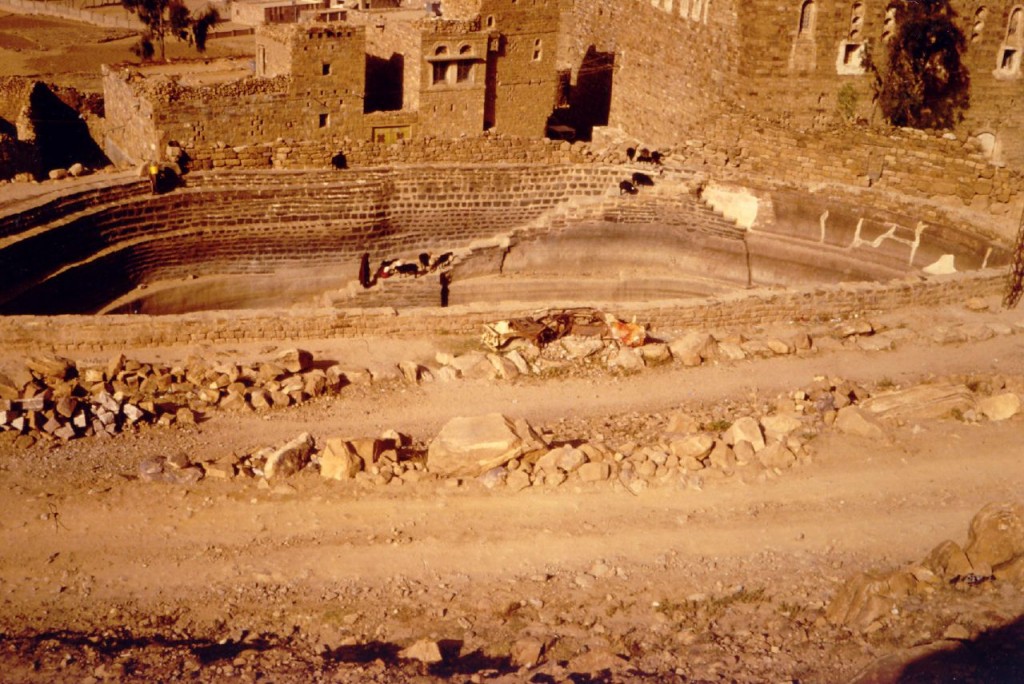

 Yemen’s water crisis is worsening as the country struggles with armed conflicts on three fronts. Above: a village well almost runs out of water.
As delegates head to the United Kingdom for a key conference on Yemen, experts warn that Sanaa could become the first capital in the world to run out of water within a decade. “Water is one of the underlying challenges that needs to be addressed in order to secure the long term development and stability of Yemen,” Ginny Hill, an associate fellow at Chatham House’s Middle East and North Africa Program told The Media Line.
“Everybody is so focused on immediate concerns about anti-terrorism, but there are a number of underlying issues that are facing the Yemeni government,” she said. “Resources like water and oil are running out.”
“Oil underpins the economy and water underpins population patterns,” Hill explained. “If the challenge around oil and water can’t be addressed, the danger is that there will be less stability because the state will have less revenue and less control.”
Delegates at Wednesday’s conference, hosted by British Prime Minister Gordon Brown in London, will discuss ways to boost Yemen’s national economy and fight terrorism.
Oil reserves in the impoverished country are dwindling, while its population is growing and the water supply depleting. Civil society organizations say the conference organizers must take a comprehensive approach to the challenges facing Yemen including the water problem.
The government is establishing water-management projects in urban areas but has failed to establish water administration in areas where tribal authorities dominate.
Yemen’s army has been engaged in a protracted conflict in the north of the country with Houthi rebels since 2004. The rebels wish to restore the Zaidi imamate, which was overthrown in a 1962 coup and they accuse the Yemenite government of being too closely allied with the United States.
In addition, Yemen has also become a hotbed for Al-Qa’ida activity, a major concern for Western countries, including the United States.
Secessionist groups in the south are pressing for independence from the north. A police officer was crushed to death in a protest on Monday and eleven others were wounded. Southern separatists have declared a strike and are protesting against discrimination and lack of financial aid ahead of Wednesday’s conference.
In a report issued in September, the Carnegie Endowment warned that the capital Sanaa, whose population is growing at a rate of 7% a year, could be the first capital in the world to run out of water.
“The concern is the population growth, which means there is a higher demand on the already-stressed water resources,” Walid Salih, a water expert and regional coordinator for the MENA region at the United Nations University told The Media Line.
“Yemen has a dual problem when it comes to water resources,” he said. “They don’t have proper management and they lack the financial resources to do more water-resource-management plans. Sometimes they have floods, but if you don’t have the facilities to capture this water, it’s lost.”
“Most experts believe that the whole region will be hit as far as climate change is concerned,” Salih said. “And of course the first victim of climate change is water.”
According to the Carnegie report, the water crisis is a result of several factors, including rising domestic consumption, poor water management, corruption, and wasteful irrigation techniques.
Yemen is ranked by the United Nation’s Food and Agriculture Organization as one of the thirstiest nations in the world, with one of the lowest rates of fresh water availability.
Extracted faster than repleted
Water is being extracted from underwater aquifers faster than it can be replaced, with extraction rates in Sanaa estimated at four times the pace of replenishment, the report said. The water basins in Sanaa and in Amran in the northwest are close to collapse.
The water table in Yemen has fallen about two meters (6.6 feet) in recent years, resulting in deeper wells being dug, which in turn affects the quality of the water.
Because of the water scarcity and lack of management, private diggers take water from depleting wells that are dug without a license.
Large amounts of the country’s water is used to irrigate Qat, a semi-narcotic plant which constitutes a major part of Yemen’s informal economy and is consumed extensively by the Yemeni population, who chew on it, sometimes for several hours a day, to achieve a rush.
The plant generates cash quickly and is more profitable than other crops such as grapes or potatoes. Farmers often over-irrigate their fields and there are few incentives given to conserve the water.
Production and smuggling of Qat is one of the main sources of income for many families in northern Yemen, including rebels who are suspected of using the revenue to finance military activities.
(This article by Rachelle Kliger first appeared on The Media Line, the Mideast News Source.)
More on the environment in Yemen:
Yemen’s Environmental Problems Based On Chewing Gat
Yemen Funnels Seawater to Drinking Water With Low-tech Watercone
Eco-tourism Hot Spots in Yemen
Image via ahron



[…] Sanaa is predicted to be the first capital in the world to run out of economically viable water supp…. Experts say this is due to a rapid increase in Sanaa’s population in recent years because of rural-urban migration, and the widespread planting; and inefficient irrigation of `qat’, a water-thirsty plant believed to consume 40 percent of all irrigated water. […]
[…] our chests at the audacity of Masdar City’s “zero” footprint claim, and we have decried the potential consequences of unsustainable approaches to building and planning. “USD22 billion” for a building project […]
[…] countries like Jordan. We’ve explored how Yemen’s capital, Sanaa, may well become the world’s first waterless capital, much of which is being caused by mismanagement, wars, and climate […]
Yemen to Soon Have the World’s First Waterless Capital | Green Prophet http://ow.ly/1nSjgZ
Yemen to Soon Have the World’s First Waterless Capital http://ow.ly/12zXJ
RT @GreenProphet Yemen to Soon Have the World’s First Waterless Capital http://www.greenprophet.com/2010/01/31/16708/yemen-water/
RT @SydneyHomeless: RT @RadioYerevan: Yemen to Soon Have the World’s First Waterless Capital | Green Prophet http://bit.ly/atQy1A
News:: Yemen to Soon Have the World’s First Waterless Capital http://www.greenprophet.com/2010/01/31/16708/yemen-water/
RT @RadioYerevan: Yemen to Soon Have the World’s First Waterless Capital | Green Prophet http://bit.ly/atQy1A
Interesting post, thanks for sharing!
RT @RadioYerevan: Yemen to Soon Have the World’s First Waterless Capital | Green Prophet http://bit.ly/atQy1A
Yemen to Soon Have the World’s First Waterless Capital | Green Prophet http://bit.ly/atQy1A
RT @greenprophet: News:: Yemen to Soon Have the World’s First Waterless Capital http://www.greenprophet.com/2010/01/31/16708/yemen-water/