

 With a $23 million investment, SolarEdge takes PV systems to the next level of efficiency.
GE just invested in them. Now, Guy Sella, founder and CEO of Israeli company SolarEdge, is planning a revolution. Don’t be alarmed though, this one isn’t dangerous. His goal is to transform the way photovoltaic systems are now operated, in terms of efficiency, safety and cost.
“People haven’t been looking at photovoltaic systems from a holistic point of view,” Sella tells ISRAEL21c. “Panel manufacturers care only about the panels and panel conversion efficiency. The people that develop classical inverters only care about the efficiency of the inverter. I asked: can we create a system that is better than we currently have?”
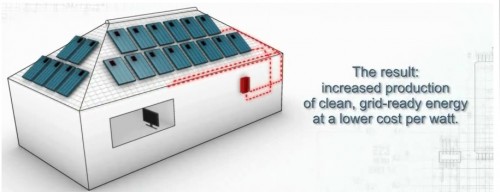
The answer, according to SolarEdge, is yes. The Herzliya-based has created “intelligent panels” that work together with a central Power Box, which would replace the passive panels that are the current norm. These new panels provide 25 percent more energy as well as solutions to some of the serious problems that plague current systems.
No feedback, no function
Today’s photovoltaic systems have a number of major disadvantages, according to Sella. For instance, there is no feedback from individual panels. If a panel is broken or not functioning properly, there is no monitoring system to detect the problem.
“In fields today you have hundreds of thousands of panels,” says Sella. “Even if some of them are not working, they don’t have any monitoring level, so you as the field owner can’t know if they are working. After a big hailstorm, people habitually walk through the field with a notebook, visually checking each panel and writing down its condition.”
Another problem with having no monitoring system is that people can easily steal the panels, which are worth between $600 to $800 each. These antediluvian conditions would be abolished by SolarEdge’s technology.
Turning passive panels into intelligent devices
In current systems, all the panels in a photovoltaic system are connected to an inverter box, which in turn connects the system to the power grid. SolarEdge, however, has taken all the technology in the inverter box and put it into an electronic chip, or ASIC.
Each photovoltaic panel contains its own ASIC chip, turning each panel into an electronic device that can alert the owner both to its functionality and possible theft. The system will also be connected to the internet, so the owner can go online to check the status of each panel.
These intelligent panels also provide more energy than current photovoltaic panels. “The panel can now optimize its energy output, and can verify that it is converting the maximum energy that it has,” explains Sella.
An additional advantage is that the very different voltage system created by this technology is much safer, says Sella. Current systems use thousands of volts in their DC lines, and are impossible to turn off, a serious hazard in cases of fire. The inability to shut off powerful voltages also makes these systems potentially dangerous to install.
With the SolarEdge system, the panel-embedded electronics can be shut down individually, either through the central power box or via the panel itself.
An excellent rate of growth
Confidence in SolarEdge is high. Founded in 2006, by Sella and co-founders Yoav Galin, Lior Handelsman, Meir Adest and Amir Fishelov, who met in an elite technology unit of the Israel Defense Forces, the 70-member company has raised $23 million in the past year, despite the poor economic climate.
It plans to start shipping products from mass production lines in Israel late this month.
“SolarEdge has partners all over the globe – in the US, Germany, Spain, France, and Japan,” explains Sella. “Through our partners we have access to 40-50 percent of the world market, which is basically wherever there is solar energy.”
This market is in the range of $30-40 billion; and Sella estimates that the worth of his own product is somewhere in the region of $3 billion.
Not surprisingly then, Sella is optimistic about the solar energy market even in the current recession. “The growth rate of the solar energy market makes it interesting. I’m not aware of any market since bubble days that has had this level of growth rate,” he says.
Eventually, Sella predicts, “Solar energy will be cheaper than fuel cells, and energy harvested from photovoltaics will either be cheaper or the same as fossil fuels.”
(This story was first published on ISRAEL21c – www.israel21c.org)
Want to know more about solar energy efficiency? Read:
BP and SolarEdge Develop Power Harvesting Systems
Tigo Energy Squeezes More Power From The Sun




[…] SolarEdge has created “intelligent panels” that work together with a central Power Box, which would replace the passive panels that are the current norm. The PowerBoxes can enable the production of up to 25% more energy and significantly reduce costs. […]
SolarEdge Plans Holistic Approach to Solar Energy Efficiency http://ff.im/-aQdIy
SolarEdge Plans Holistic Approach to Solar Energy Efficiency | Green Prophet http://ow.ly/yjXi
.@greenprophet SolarEdge Plans Holistic Approach to Solar Energy Efficiency http://j.mp/3QIfFO http://j.mp/2uHln8