
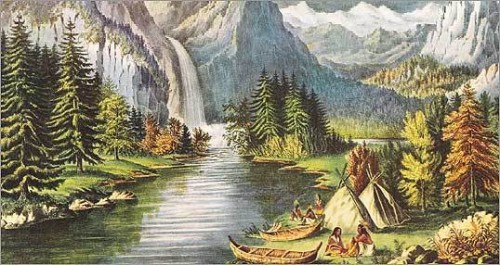


Israeli nature advocates are proud of their efforts at both nature conservation and cultivating a love of hiking among the people. However, an article this week in the Boston Globe points out that creating nature preserves often means expelling the indigenous people who once lived in them. Author Mark Dowie writes that the practice began in the American parks of Yosemite and Yellowstone, but spread worldwide to places as diverse as Kenya, Botswana, Thailand, Peru and Panama. Conservation groups as a result must grapple with this unflattering picture:
“Not only has it dispossessed millions of people who might very well have been excellent stewards of the land, but it has engendered a worldwide hostility toward the whole idea of wildland conservation – damaging the cause in many countries whose crucial wildland is most in need of protection.”
Reading about this global phenomenon made me think about the Israeli case. I have heard that human rights organizations and Palestinians take a skeptical eye to Israeli tree planting efforts. Nature preserves here also have a political cast, according to a report on planning in the West Bank issued by the organization Bimkom: Planners for Building Rights (The report, called The Prohibited Zone, is here).
 According to Bimkom, the northern West Bank village of Umm al-Rihan has suffered greatly because it is in what Israel has declared to be a forest preserve (map from report, p.70). As a result, the dozens of residential buildings, the mosque, the local clinic and part of the school have been built without permits. This makes them illegal and subject to demolition orders from the army (see pages 92-95).
Bimkom adds that while Israel enforces the forest preserve rules against the Palestinians, Jewish settlements of Reihan, Shaked and Hinanit have grown unhindered.
“Thus, the Civil Administration’s planning police in the Umm ar-Rihan area exhibits flexible use of various definitions of the boundaries of the forest reserve, according to political needs and according to the ethno-national identity of the people for whom the construction is intended” (p. 94).
 One bright light for indigenous people in Middle Eastern conservation efforts may be the Dana Natural Reserve, located in western Jordan (photo courtesy of Wild Jordan). Although I have not been there, tourbooks and the Royal Society for the Conservation of Nature claim that this national site was built around the people already living there. The government built water lines to provide the people with a drinking supply, and helped craft a business scheme for the locals to market the jam they made from the fruit trees of the preserve. When visitors go through the park, they see the natural beauty of both the plants and views, as well as the people who grew up in the surroundings and tailored their lives to the unique environment.
(Top picture taken from BostonGlobe.com. Full Globe article here)




You might also want to look at the situation in Wadi Qelt, once a popular hiking and picnic destination for Palestinians in the West Bank. Now it’s been declared a nature reserve by the Israeli administration, so that they can throw out Bedouins who’ve lived there for decades or even centuries – some of them formerly employed to keep the place tidy. The local settlements, which are building in the desert and disturbing the ecosystems there, have unilaterally declared that the reserve is closed from 6pm, which basically means closed to non-settlers – if you go up side-roads you can see settlement boys hiking all over the hills, but if a Gentile or a Palestinian go near the place they get slung off by armed settlement guards (I know; it happened to me). It seems like the main thing that Israeli ‘nature reserves’ want to do is keep Arabs off as much land as possible.
NA: You sound a bit paranoid to me. What the Israeli government does want is the stoppage of unregulated building – something that any country in the West would enforce, whether you live in Tel Aviv, in the desert, or in Toronto. My family lives in a small town in Ontario. They can’t put up a porch without a building permit. So, please: Relax.
Had you gotten a second quote from an employee at the Jewish National Fund, the organization that plants the trees in Israel, I’d have been more impressed with your article. I’ve met Beduin and Arab Israeli JNF forest rangers and their communities see the arrival of work and forests at their village borders as double blessings – go speak to the Beduins at Yattir Forest for example. OR ask the good folks at Bimkom what the Palestinians of Jabbal Mukabber think about JNF’s “Peace Forest” planted on the border of their village – again – double blessing! Bimkom is a great organization, but this article is really sloppy work. You also claim that “Israeli nature advocates are proud of their efforts” – yeah, we’re proud, but we’re also ashamed at how far backwards Israel is in many environmental respects – like how the country’s systems of rivers and streams were openly polluted for 60 years while the country was built, though we are also ironically so proud of how fast Israel was developed. If you wanted to make an absurd blanket statement like that about a group of serious thinkers and doers, you should have sourced a quote to back it up, because it looks like a)either you only know one single Israeli environmentalist AND he/she’s a new immigrant or b)again you did not do your homework and call SPNI, established in the 1950s, and ask their Environmental Protection Division if they’re merely proud as you claim, or deeply concerned about the environmental situation in Israel today. Show an interest in journalism, get the other side and then I might read more of your blogs.
Canada has built nationally and provincially preserved sites around people, indigenous and those who’d been settled in the land when it was declared a protected site. These people do act as stewards to the land, but sometimes just use their special status to throw reckless bush parties . . . it’s a tough call.