
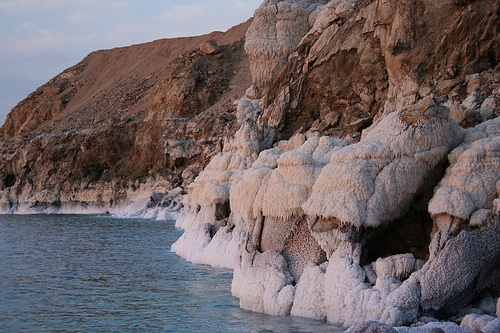


In a move that will have environmentalists and government officials in Israel reeling, the Jordanian government announced this week that it will go ahead with the controversial Dead Sea-Red Sea Canal from Aqaba in the Red Sea to the Dead Sea in central Jordan.
The announcement for the $10 billion project (some reports say $5 billion) was made this week at the World Economic Forum on the Middle East in Jordan, and reported by the Jordan Times, the Times in the UK, the Boston Herald, and Haaretz in Israel. It will take 20 years to finish, while Jordan hopes to start producing desalinated water by 2014.
According to the Jordanian plan, the Jordanian version of the Dead Sea-Red Sea canal will channel 1.9 billion cubic meters of water per day from the Red Sea to the Dead Sea, reports Haaretz:
“The difference in altitude will enable the production of energy, which in turn will fuel huge desalination plants to be constructed in Jordan. The 850 million cubic meters of desalinated water produced annually will be used for agriculture and urban water systems. The idea of a regional joint project was raised more than a decade ago, but petered out after the feasibility studies were conducted.”
While alarming to hear, it is likely that in order to proceed, Jordan may require thumbs up from bodies such as the World Bank and the United Nations. It may be Jordan’s way of saying, yalla. Israel has been interested in helping Jordan develop the canal but has been waffling over its committment to the idea proposed a decade ago. Environmentalists in Israel believe such a plan will create a whole new host of problems, like sinkholes, and deterioration of the already threatened corals in the Red Sea.
Others believe this canal will kill two birds with one stone: it will help create energy for Jordan while replenishing the dying Dead Sea.
Calling it the Jordan National Red Sea Water Development Project, officials said the desalination project is separate from the Red-Dead Canal (project with Israel) and is supported by the government.
The Boston Herald also has a good sum up of Jordan’s recent announcement.
“The project is Jordanian and will be built on Jordanian land… The World Bank environmental and feasibility studies of the Red-Dead Canal Project are vital for our scheme,” said the Ministry of Water and Irrigation Secretary General Maysoun Zu’bi to press.
The Boston Herald adds that the canal “is not a replacement for the Red-Dead Canal Project.”
So if it’s not, then will there be 2 canals?
This is a prime example of what can and might happen if governments who share precious resources do not work together to create a long term sustainable vision. Personally, I am against the Dead Sea – Red Sea canal. I think it will create new environmental tragedies, and turn the region between these bodies into a Disneyland theme park, much like what we see today in Dubai.
The Dead Sea is one of the most beautiful natural resources in the world. We need to leave it alone, people, as nature intended. See how Canada manages Lake Louise. This is a perfect example of how to turn a natural wonder into something that still looks wonderful.


First the South basin is very shallow. The deep part of the DS is North of the Lisan peninsula.
Second the use of “canal” is an invitaton to extra evaporation losses and loss of power and a longer route. It makes more sense to use a pipe so that the contents are part of the “head” of the power drop – and cut out the lake at the top of the hydro power plant penstocks.
More seriously sea water and DS water will be a clash of chemistries affecting the return on the existing extraction plants -and the whole area is tectonic ie subject to earthquakes eg 1927(?).
It makes far more sense for both Jordan and Israel to put solar power stations into the area – either mirrors or Zaslavsky Towers North of Eilat /Aqaba, and use that energy to desalinate at the Red Sea and run the water along the Arava and pump to Jordan’s cities without the disposal problem of piles of salt along the project.
Whatever Jordan does, Israel should build a water tunnel from north of Haifa to Lake Kinneret, desalinating the water before it enters the lake. The distance is much shorter (45 km) than all competing proposals, Med-Dead or Red-Dead. That water can be used to replenish the river Jordan and the Dead Sea if need be; but mainly it will supply the Kinneret as Israel’s reservoir and irrigate the entire Jordan valley. This is something Israel can do alone, without consulting any neighbors. Can and should!
Well, with all my respect to the environmental view of the issue; I think Jordan is in need for water more than anything in this time. I agree it might harm dead sea nature, but it has been not proven yet. In addition, did anybody suggest to split dead sea to two halves by building a dam in the south side of it. So once they launch the canal, all the water will go to the second half which is empty now anyway. In this case everybody will be happy!
Cut the Dead Sea in half? Are you insane?
[…] Lastly, the only water that’s heading into the Dead Sea from the Jordan is reportedly sewage from the Palestinian Authority. The Dead Sea needs natural run-off from rivers and springs to enter its shores. If not it will be a natural disaster for this natural wonder. I think we can do a whole lot better than through messing with nature than supporting the Red-Dead canal which is to bring saline water to the Dead Sea via a pipeline from the Red Sea. […]
Green Prophet » Jordan To Launch Red-Dead Canal Without Israel http://tinyurl.com/yh9kfd9
For a suitably Zionist response to Jordan’s decision to “go it alone” with the controversial Red-Dead Canal Project, please see my recent blog post below.
Israel needs to look for a practical, cost-effective alternative to the grandiose Red-Dead Canal Project, and I believe this can be provided by my Med-Kinneret Canal proposal.
Go2.me – Altneuland: Jordan to Go Ahead With Red-Dead Canal Project
http://go2.me/3CG
RT @kloostermania Jordan to launch Red-Dead Canal without Israel: http://bit.ly/16ljV3
Jordan to launch Red-Dead Canal without Israel:
http://bit.ly/16ljV3
I think the canal is a necessary evil that should be done and should have been done jointly. This is yet another fail on the part of the Israeli government to do anything substantial to significantly address Israel’s water shortage, i.e., continuing to extend a temporary water plan instead of creating a real one.
Regarding your concern about the region being turned into a “Disneyland theme park” like in Dubai, I was under the impression that the plans for the area are much more subtle than that.
Drat! @greenprophet beat me to it! Jordan To Launch Red-Dead Canal W/O Israel HT @tova_s http://ow.ly/7Ncj http://ow.ly/7NcX
And now Jordan is going it alone with the Red-Dead Canal? What happened to the World Bank study I/P/J agreed to? http://tinyurl.com/qmvpu2
Jordan To Launch Red-Dead Canal Without Israel http://tinyurl.com/p2mxpu
Jordan To Launch Dead Sea-Red Sea Canal Without Israel http://ow.ly/7Kpt