

Crops Safe, No Frost for Now, Reports Jordan

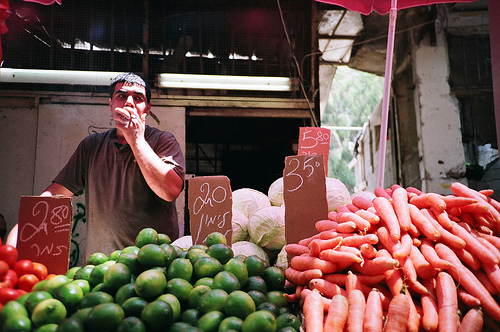
vegetable market shuk israel photo
(Does this guy look worried about the frost? A smokin’ vegetable vendor in a Petach Tikva market, Israel. Credit anyalogic)

While North Americans in the higher latitudes are sipping hot cocoa, and have Jack Frost nipping at their noses, farmers in the Middle East pray that the frost won’t come. Last year, sub-zero temperatures wiped out millions of dollars worth of crops in the region, causing basics like lemons to cost a fortune in the supermarket.

Farmers so far, reports The Jordan Times, are in the clear from frost. Although temperatures dipped to sub-zero this week night as a cold and dry air mass overwhelmed the region, Jordan’s Agriculture Ministry officials said no reports on crop damage were received.

The officials, however, renewed a call on farmers to take precautionary measures against frost formation to avoid vast crop damages similar to what happened early last year when over 15,000 dunums of vegetables were damaged in Jordan alone.

In cold times, farmers are urged to irrigate their crops during the night as it helps raise the temperature by five degrees, preventing damage to plant roots.

Farmers growing protected crops should close down their greenhouses early in the afternoon to store as much heat as possible and use heaters to warm up the atmosphere.

Crops like tomatoes, potatoes, zucchinis and grains are most susceptible to the effects of frost.

With the arrival of the marbaniyeh, the coldest forty days of winter which began in late December, several depressions and frost spells are expected to affect the Kingdom until the end of January, reports the newspaper.

The Kingdom receives 25 to 35% of its rainfall during this time, but agriculture and water officials say the country received so far only 10 per cent of the long-term annual average of 8.5 billion cubic metres.

::Jordan Times

Read More

TRENDING

Who Owns the Farm Robot? A State of Jefferson Startup Takes on Carbon Robotics

In California's self-proclaimed State of Jefferson, a small agricultural technology company is challenging the dominant laser-weeding business model. Laudando & Associates believes farmers should own and repair their AI-powered weeding tools rather than pay ongoing subscription fees. The approach has put the company on a collision course with industry leader Carbon Robotics, sparking a patent dispute that has pushed the Jefferson startup toward overseas markets while raising broader questions about ownership, right-to-repair, and the future of farm automation.

Health Canada approves lab grown milk

Canada's approval of animal-free dairy proteins marks a milestone for precision fermentation and the growing alternative-protein industry. Will consumers embrace milk made without cows?

Regenerative Wool or Greenwashing? Zentera Responds to Critics

Zentera responds to questions about ZQ wool, animal welfare, regenerative farming, ethical fashion and the fallout from PETA's New Zealand investigation.

Tanner Winterhof on the Custom Harvesters Quietly Holding American Agriculture Together

In late January, in a Des Moines hotel ballroom that smelled faintly of diesel and convention coffee, Tanner Winterhof spent three days hosting the members and attendees of the  U.S. Custom Harvesters Inc. annual convention on his podcast as Farm4Profit’s official media partner for the show.

Hormuz 2026 Conflict Poses an Energy and Food Security Dilemma in a Warming World

As tensions rise in one of the world’s most critical maritime chokepoints, the ripple effects go far beyond oil—touching food systems, climate pressures, and regional stability

Yerukim Forms a New Green Economy Where the Money is Really Green

The Yerukim members who pick up the recyclables get to keep the monetary reward, the public earns "green" bills that can be used in shops, and business owners get to be associated with environmentalism.

Choosing Riyadh over Dubai? What Investors Should Know

Saudi Arabia is deploying capital at unmatched scale to catalyze tourism and advanced industry while rewiring its power-and-water backbone. The investable frontier is widening—especially in renewables, grid storage, water efficiency/desal retrofits, and hospitality operating platforms. Prudent investors will insist on phased delivery, enforceable KPIs (energy, water, biodiversity), and RHQ/zone compliance—while pricing political-economy and reputational risks alongside growth upside.

Sell your cooking oil for biodiesel money

Want to make money on old french fry oil? Sell it.

Qatar Alternative Energy Summit Pairs Investors And Innovators

Alternative energy investors and innovators can meet n' greet in Doha, Qatar March 16 and 17.

Here’s How To Implement The Four Pillars Of Employee Engagement

If you throw a party for your work team and they are vegans, don't make it a barbecue. Know the sustainability values of your team to boost moral and retain good people.

Locals From Rishon Fight IKEA

Big Box stores are a pretty new concept in Israel, and thank God that not every Israeli city wants them in their backyard. A word from someone who has see the beautiful farmland around her hometown Newmarket, Ontario stripped and converted into vulgar strip malls of big box shops: they have no place in a healthy and sustainable town or city.

The Jewish National Fund Meets An Inconvenient Truth

According to the JNF, it has transformed thousands of acres of barren land into green forests in Israel. They state that each person emits about 23 tons of carbon per year, estimating that each tree planted can absorb one ton of carbon in its lifetime. That's a whole lot of trees you'd need to be planting. Could so many fit in Israel?

How to quiet noise from construction in your office

Streets need to be resurfaced in New York but the humming and grinding noise is unsettling. Noise is environmental pollution. 

Popular Categories