Will Climate Change Reduce Or Increase Middle East Rainfall?

Well, that depends on how you look at it…

Scientists are predicting that climate change will cause upheavals in the patterns of rainfall, drought, floods, and desertification.  The latest report by the Intergovernmental Panel on Climate Change (IPCC) warns that temperatures in the Middle East have increased between 2-3 degrees Celsius in the last century, faster than the global average of about 1 degree.  As a result, our region is expected to have fewer – but more violent -rain events, increased drought, and decreasing resources of fresh water.  We are currently experiencing a water crisis that is considered severe, although a large part of it is due to chronic mismanagement of freshwater resources. 

The latest projections of the IPCC predict a decrease of 15-25% in rainfall over large regions of the Fertile Crescent, leading to water shortages, and increased competition for increasingly scarce water resources.

But is the “conventional wisdom” accurate?  Any modeller will tell you that the only certain thing about any forecast that we make is that it will be wrong.  The only question is, how wrong?  All models are a simplification of reality, and contain inherent errors.  The closer the assumptions of the model are to reality, the better the results will be.  

The Environmental News Network (ENN) reports on a pair of studies conducted by Dr Jason Evans from the University of New South Wales Climate Change Research Centre, looking at projections of rainfall in the Middle East given by different models.  The IPCC projections were based on a global model, which does not capture regional conditions, and is not the best tool to use for predicting climate change effects on smaller scales.  A reanalysis of the IPCC data by Dr. Evans confirmed the findings of decreased rainfall.

However, a regional scale model, which included more detailed information about topography and inter-annual variations, predicted a different scenario.  According to this preliminary study, even though overall storm activity would decrease, channeling of cool, humid air further inland could lead to an increase of 50% in precipitation over the Tigris-Euphrates watershed.  ENN quotes Evans: “We need to confirm this result with other models, but a 50 per cent increase in rainfall in such an important agricultural area is a much more hopeful scenario than a 15 per cent decline.”

So what does this mean? Most importantly, it emphasizes that our knowledge of the climate system of the Earth is quite limited, and all of the predictions about global warming and the resulting climate change are only our best guess.  This is a far cry from certainty: the picture is being fine tuned constantly, and the predictions and conclusions could differ in each iteration.

On the other hand, if we are critical of these predictions (as we should be), we should be even more critical of the alternative explanations to global warming caused primarily by human actions.  This is because no one has presented a different explanation that fits with our observations.  If there are holes in the consensus view, any other scenario is riddled with many more problems and inconsistencies.  As scientists, we must accept the best available explanation, until it is supplanted by a more successful model.  So even though there is disagreement on the future rainfall in our region, that does not invalidate the overall consensus prediction.

Bottom Line:  Since we don’t know for sure what will happen, and our best guess indicates we might experience, um, “slight technical difficulties,” we should work to prevent the uncertain future, rather than gamble on a favorable outcome.

:: ENN – Climate change may boost Middle East rainfall

(mideast photo credit:  Courtesy of NASA)

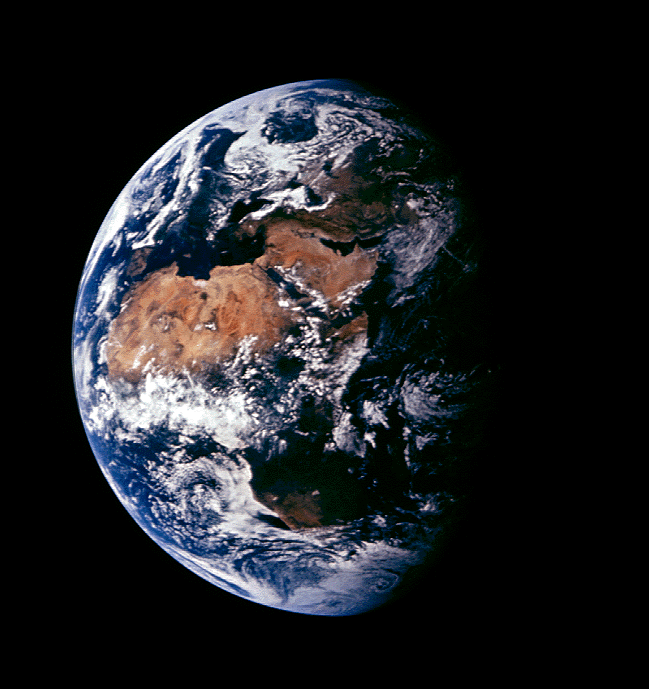
(earth photo credit: Courtesy of NASA)


Daniel Pedersen
Daniel Pedersenhttp://www.greenprophet.com
Having spent my Jerusalem childhood ear-deep in science fiction stories, I’m still waiting for clean and abundant fusion power. On the way, I dabbled in solar-powered desalination and alternative building technologies at Swarthmore College, and studied the chemistry and mutagenic effects of particulate air pollution at MIT for a PhD in environmental engineering. Since returning to Jerusalem in 2002, I’ve directed air quality research campaigns from Rosh Hanikrah to Eilat & Aqaba for Hebrew University. I’ve led cooperative regional projects, wrote a successful proposal for the largest air-quality study in the history of the Middle East, and established the first monitoring network in Palestinian cities. Last year I edited a weekly TV environmental spot on Channel 2 and wrote a companion blog. At Hadassah College I train the next generation of environmental science professionals, audit Israel’s chemical and environmental laboratories for the Israel Laboratory Accreditation Authority, and provide environmental consulting services to diverse clients. Daniel can be reached at daniel (at) greenprophet.com.

Read More

2 COMMENTS
  1. Thank you for a great post based on the facts where available and that also expresses the uncertainty. We live in a high desert area here in Steamboat Springs that is much cooler than most areas in in the middle east but have the same questions on what will happen going forward. We also have similar water issues given the system in the American west where you use all of your water rights or lose them no matter how in-efficiently you use them. This past year we had a very cold winter with record snows which may represent a the shift in precipitation you refer to or just be a random event.

TRENDING

Mona Khalil, Orange House Project founder, sea turtle protector killed in Lebanon

Mona Khalil spent decades protecting Lebanon's sea turtles and coastal ecosystems. Her death in the ongoing conflict between Israel and Hezbollah shines a light on a broader environmental tragedy unfolding across northern Israel and southern Lebanon. From damaged wetlands and disrupted bird migrations to threatened seed banks and endangered wildlife, the region's ecosystems are becoming casualties of a war with no clear end in sight.

Wave wind energy for Nvidia’s next AI energy boom?

As AI factories consume unprecedented amounts of electricity, NVIDIA is looking beyond chips and data centers to the ocean. The company recently spotlighted Israel's Eco Wave Power and its wave energy projects in Jaffa and Los Angeles, highlighting how AI, digital twins and renewable energy can work together to meet future power demands. The collaboration reflects a growing realization that the future of artificial intelligence may depend as much on clean energy infrastructure as it does on computing power.

Anthropic, Google and Stripe put nearly $1 Billion on carbon removal

A coalition led by Frontier, backed by Stripe, Google, Salesforce and newly joined AI company Anthropic, has committed an additional $915 million to remove carbon dioxide from the atmosphere. The pledge adds to a previous $1 billion commitment and brings Frontier's total buying power to nearly $2 billion.

Dan Zaslavsky’s energy tower dream is rising again in Iran and China

The Energy Tower idea never made the leap from drawings and engineering studies to full-scale construction. But nearly two decades after most people stopped talking about it, the concept is quietly evolving in two unexpected places: China and Iran. The concept let dreamers dream and doers do - figuring out more pleasing designs and engineering.

A visit to Amirim, Israel’s first all-vegetarian village in the Galilee

Just 15 kilometers from Tzfat there is a moshav that was founded in the late 50s that was ideologically influenced by organic, vegetarian and vegan principles. My hostess at Ohn-Bar, the tzimmer where I stayed, explained that the people of Amirim were among the pioneers of Israel’s strong vegetarian movement.

Yerukim Forms a New Green Economy Where the Money is Really Green

The Yerukim members who pick up the recyclables get to keep the monetary reward, the public earns "green" bills that can be used in shops, and business owners get to be associated with environmentalism.

Choosing Riyadh over Dubai? What Investors Should Know

Saudi Arabia is deploying capital at unmatched scale to catalyze tourism and advanced industry while rewiring its power-and-water backbone. The investable frontier is widening—especially in renewables, grid storage, water efficiency/desal retrofits, and hospitality operating platforms. Prudent investors will insist on phased delivery, enforceable KPIs (energy, water, biodiversity), and RHQ/zone compliance—while pricing political-economy and reputational risks alongside growth upside.

Sell your cooking oil for biodiesel money

Want to make money on old french fry oil? Sell it.

Qatar Alternative Energy Summit Pairs Investors And Innovators

Alternative energy investors and innovators can meet n' greet in Doha, Qatar March 16 and 17.

Here’s How To Implement The Four Pillars Of Employee Engagement

If you throw a party for your work team and they are vegans, don't make it a barbecue. Know the sustainability values of your team to boost moral and retain good people.

Locals From Rishon Fight IKEA

Big Box stores are a pretty new concept in Israel, and thank God that not every Israeli city wants them in their backyard. A word from someone who has see the beautiful farmland around her hometown Newmarket, Ontario stripped and converted into vulgar strip malls of big box shops: they have no place in a healthy and sustainable town or city.

The Jewish National Fund Meets An Inconvenient Truth

According to the JNF, it has transformed thousands of acres of barren land into green forests in Israel. They state that each person emits about 23 tons of carbon per year, estimating that each tree planted can absorb one ton of carbon in its lifetime. That's a whole lot of trees you'd need to be planting. Could so many fit in Israel?

How to quiet noise from construction in your office

Streets need to be resurfaced in New York but the humming and grinding noise is unsettling. Noise is environmental pollution. 

Popular Categories