Rooftop Hydroponic Farms in Egypt Scrub the Air and Uplift Urban Poor

rooftop farming, egypt, maadi, hydroponic farms, soilless farming, agriculture, aquaculture, urban farming, organic farming

Urban farming in Egypt has soared. Read about Schaduf – a soilless solution taking root in Maadi.

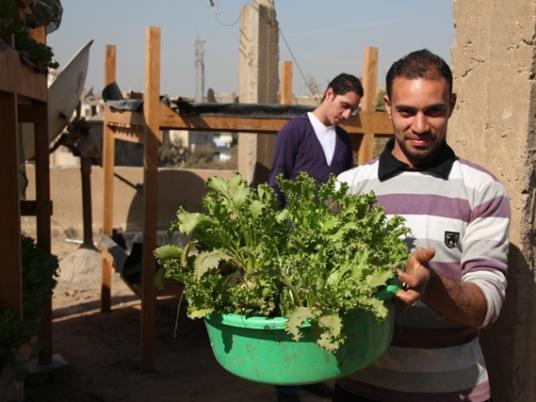
Two Egyptian brothers have received enough donations to set up three rooftop farms in Maadi – a once wealthy suburb of Cairo. Due for full installation by April, these won’t be any old farms. Sherif and Tarek Hosny have developed closed-loop, vertical hydroponic systems that use recycled water and mineral nutrient solutions to grow cheaper, healthier produce.

Designed to become a secondary source of income for poor families living in the less-privileged areas of Maadi, where many expatriates and wealthy Egyptians seek shelter from Cairo’s bustling urban center, Schaduf’s farms have great potential to scrub the neighborhood’s polluted air and give struggling families a much-need fiscal boost.

A healthy supplemental income

Sherif Hosny is an engineer who quit his job in Dubai to work on an organic farm in the United States. He told Egypt Independent that he became taken with farming  and decided to return to his home country with his new-found learning.

Through Schaduf, which name refers to a weighted pole device that is used to lift heavy buckets of water, the Hosny brothers hope to uplift families that live below the poverty line. They are well on their way to achieving this goal.

Already they have received enough donations to build three rooftop systems that cost up to $2,500 – an amount of money that poor families could never produce. Schaduf has implemented a scheme that allows them to provide the hydroponic system and training upfront, for which new part-time urban farmers should be able to pay within a year by selling their produce.

Not only does the system support a new generation of urban farmers, but the supplies used to create the systems all come from local manufacturers, which further fosters a proudly-Egyptian economy.

Supporting the local economy

Egypt Independent reports:

All of the products used from the wooden frames, the perelite (a soil conditioner), the peat moss to the tarps are locally manufactured. Schaduf has already received enough donations to set up three rooftop farms and is working with local NGOs to find families who are interested and have the appropriate amount of space.

In addition to the rooftop hydroponics farm, the Hosny brothers are testing an “aquaponic” systems that combines principles of aquaculture and hydroponics. Although they have managed to raise Tilapia fairly successfully, the fish die off during unusually cold weather, so Schaduf is testing various low-tech solutions that will maintain warmth in the rooftop fish tanks.

Critics worry that Egypt’s pollution will compromise the quality of produce grown on Maadi rooftops, but Sherif dismisses these claims.

“Trees in the neighborhood may filter out some of the pollution sediments before they reach roofs, and the plants create CO2, pulling pollution out of the air,” he told Egypt Independent, adding that if rooftop gardens “could have a big impact on Cairo air.”

:: Egypt Independent

More on urban farming solutions in Egypt:

Egyptian Organic Farm Declared Sustainability World Leader

What Urban Rooftop Gardening Could do for the Middle East
Egypt’s Urban Agriculture Movement is Growing
Tafline Laylin
Tafline Laylinhttp://www.greenprophet.com
As a tour leader who led “eco-friendly” camping trips throughout North America, Tafline soon realized that she was instead leaving behind a trail of gas fumes, plastic bottles and Pringles. In fact, wherever she traveled – whether it was Viet Nam or South Africa or England – it became clear how inefficiently the mandate to re-think our consumer culture is reaching the general public. Born in Iran, raised in South Africa and the United States, she currently splits her time between Africa and the Middle East. Tafline can be reached at tafline (at) greenprophet (dot) com.

Read More

4 COMMENTS
  1. Hydroponics simply means growing plants without soil. All required food elements for the plants are called hydroponic nutrients, which are dissolved in water and fed directly to the roots automatically. Plants form smaller roots and grow in inert grow media (i.e. gravel, sand, water or even air). If you haven’t seen it for yourself, you will be amazed.

  2. I personally think it is a great concept, Hydroponic rooftops look like a better option, with the easy availability of hydroponic nutrients. Green roofs can significantly reduce the surface run off volumes, improve air quality and rates of rainfall leaving roofs, people can grow vegetables like tomatoes, carrots and many more with the help of it thus reducing their food bills and also avoid eating contaminated vegetables that we get in the super markets. I would rather suggest going for hydroponic green rooftops rather than organic green roofs. It will not only help in getting bigger and better yields, but also the time required for the garden to sprout will be less compared to organic gardening and vegetables can be grown throughout the year.People can start off with it on a small scale using products root shooters from advancednutrients.com

    http://advancednutrients.com/hydroponics/products/root_shooters/root_shooters_product_information.php

TRENDING

Who Owns the Farm Robot? A State of Jefferson Startup Takes on Carbon Robotics

In California's self-proclaimed State of Jefferson, a small agricultural technology company is challenging the dominant laser-weeding business model. Laudando & Associates believes farmers should own and repair their AI-powered weeding tools rather than pay ongoing subscription fees. The approach has put the company on a collision course with industry leader Carbon Robotics, sparking a patent dispute that has pushed the Jefferson startup toward overseas markets while raising broader questions about ownership, right-to-repair, and the future of farm automation.

Regenerative Wool or Greenwashing? Zentera Responds to Critics

Zentera responds to questions about ZQ wool, animal welfare, regenerative farming, ethical fashion and the fallout from PETA's New Zealand investigation.

A visit to Amirim, Israel’s first all-vegetarian village in the Galilee

Just 15 kilometers from Tzfat there is a moshav that was founded in the late 50s that was ideologically influenced by organic, vegetarian and vegan principles. My hostess at Ohn-Bar, the tzimmer where I stayed, explained that the people of Amirim were among the pioneers of Israel’s strong vegetarian movement.

Tanner Winterhof on the Custom Harvesters Quietly Holding American Agriculture Together

In late January, in a Des Moines hotel ballroom that smelled faintly of diesel and convention coffee, Tanner Winterhof spent three days hosting the members and attendees of the  U.S. Custom Harvesters Inc. annual convention on his podcast as Farm4Profit’s official media partner for the show.

Monitoring farmers’ tillage patterns from space

Tillage is one of the clearest signals of how a farm treats its soil. Intensive plowing can degrade structure, release carbon, and increase erosion. Conservation practices—no-till, cover cropping, minimal disturbance—do the opposite. They build soil, retain water, and support biodiversity. But until now, measuring these practices at scale has been slow, expensive, and often self-reported.

Yerukim Forms a New Green Economy Where the Money is Really Green

The Yerukim members who pick up the recyclables get to keep the monetary reward, the public earns "green" bills that can be used in shops, and business owners get to be associated with environmentalism.

Choosing Riyadh over Dubai? What Investors Should Know

Saudi Arabia is deploying capital at unmatched scale to catalyze tourism and advanced industry while rewiring its power-and-water backbone. The investable frontier is widening—especially in renewables, grid storage, water efficiency/desal retrofits, and hospitality operating platforms. Prudent investors will insist on phased delivery, enforceable KPIs (energy, water, biodiversity), and RHQ/zone compliance—while pricing political-economy and reputational risks alongside growth upside.

Sell your cooking oil for biodiesel money

Want to make money on old french fry oil? Sell it.

Qatar Alternative Energy Summit Pairs Investors And Innovators

Alternative energy investors and innovators can meet n' greet in Doha, Qatar March 16 and 17.

Here’s How To Implement The Four Pillars Of Employee Engagement

If you throw a party for your work team and they are vegans, don't make it a barbecue. Know the sustainability values of your team to boost moral and retain good people.

Locals From Rishon Fight IKEA

Big Box stores are a pretty new concept in Israel, and thank God that not every Israeli city wants them in their backyard. A word from someone who has see the beautiful farmland around her hometown Newmarket, Ontario stripped and converted into vulgar strip malls of big box shops: they have no place in a healthy and sustainable town or city.

The Jewish National Fund Meets An Inconvenient Truth

According to the JNF, it has transformed thousands of acres of barren land into green forests in Israel. They state that each person emits about 23 tons of carbon per year, estimating that each tree planted can absorb one ton of carbon in its lifetime. That's a whole lot of trees you'd need to be planting. Could so many fit in Israel?

How to quiet noise from construction in your office

Streets need to be resurfaced in New York but the humming and grinding noise is unsettling. Noise is environmental pollution. 

Popular Categories