
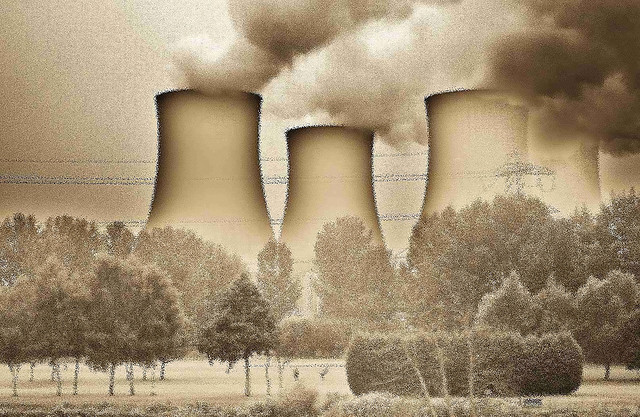

Despite Best Intentions, Gulf Countries Can’t Quit CO2

carbon emission pollutionThe Gulf countries badly need to cut fuel subsidies in order to drive renewable generation projects, but in the current political climate, that would be suicidal.

The nuclear travesty in Japan has gripped news headlines, while the Middle East political drama has taken back stage. But it is still having huge ramifications in the region. Among the world’s worst polluters, and the biggest suppliers of emissions-causing fuel, the Gulf countries do have great intentions to boost their renewable energy supply. And not for purely altruistic reasons. By eating into their own oil supply, the United Arab Emirates, Kuwait, and Saudi Arabia among others limit the amount of oil that can be used for export. Increasing their renewable energy portfolio, however, depends richly on doing away with oil subsidies. And that, Reuters reports, is seemingly impossible amidst the current unrest.

The recent unrest throughout the Middle East is partly fueled by discontent at the high cost of living: food and electricity prices have skyrocketed (while the rich, like Mubarak and other elite, pad their own pockets) and ordinary people struggle to make a decent living.

Before the crisis in Egypt escalated, people had gathered several times during the heat of summer to protest blackouts. During Ramadan, many residents were unable to purchase decent food, or rely on the energy required to cook it.

In this environment, it would be political suicide for governments in Oman, Saudi, or Kuwait,  where average price breaks of 83% are given to local fuel production, to propose cutting said subsidies. Unfortunately, this is a major impediment to adopting renewable energy projects.

Despite Saudi Arabia’s intention to produce 10% of its annual energy output from renewable sources by 2020, and the UAE’s commitment to 7% in the same time frame, the Middle East received only 1% of last year’s worldwide $250 billion in renewable energy investments, according to Eric Usher from the United Nations Environment Program.

And many of the projects that were originally planned are being shelved. Perhaps the most visible sustainability initiative in the Middle East, Masdar City was expected to develop a $2.2 billion clean hydrogen project with energy giant BP. But that project was “mothballed,” according to the news agency.

Gulf countries are faced with a vicious circle, which will require a series of steps to fix. Perhaps the best place to start would be with more reasonable construction projects (in Saudi especially, which uses $300 million of its own oil every day) and more circumspect spending on high.

:: Reuters

More on carbon emissions and energy in the Middle East:

Solar Energy’s Not So Sunny Side

MENA’s Top Five Countries For Solar Energy Generation

What Holds Israeli Renewable Energy Back?

Image via jemasmith
Tafline Laylin
Tafline Laylinhttp://www.greenprophet.com
As a tour leader who led “eco-friendly” camping trips throughout North America, Tafline soon realized that she was instead leaving behind a trail of gas fumes, plastic bottles and Pringles. In fact, wherever she traveled – whether it was Viet Nam or South Africa or England – it became clear how inefficiently the mandate to re-think our consumer culture is reaching the general public. Born in Iran, raised in South Africa and the United States, she currently splits her time between Africa and the Middle East. Tafline can be reached at tafline (at) greenprophet (dot) com.

Read More

1 COMMENT

TRENDING

Wave wind energy for Nvidia’s next AI energy boom?

As AI factories consume unprecedented amounts of electricity, NVIDIA is looking beyond chips and data centers to the ocean. The company recently spotlighted Israel's Eco Wave Power and its wave energy projects in Jaffa and Los Angeles, highlighting how AI, digital twins and renewable energy can work together to meet future power demands. The collaboration reflects a growing realization that the future of artificial intelligence may depend as much on clean energy infrastructure as it does on computing power.

Anthropic, Google and Stripe put nearly $1 Billion on carbon removal

A coalition led by Frontier, backed by Stripe, Google, Salesforce and newly joined AI company Anthropic, has committed an additional $915 million to remove carbon dioxide from the atmosphere. The pledge adds to a previous $1 billion commitment and brings Frontier's total buying power to nearly $2 billion.

How you create green steel on a blockchain

The thing about raw materials is that once they are melted down, you can't prove the source of the material. Same is true with gold, cucumbers and even forged products that look the same as the real thing. When it comes to steel, and how we produce it, it has a massive carbon problem. What's happening in Japan right now could change how we think about heavy industry and climate action.

EPA May Repeal Key Climate Health Ruling — But Scientists Warn of Dire Consequences

The endangerment finding has been the scientific and legal backbone of US climate policy for more than a decade. Without it, the EPA loses its authority to regulate carbon emissions under the Clean Air Act.

Sustainable Banking: Dame Alison Rose’s Approach to Climate Change and Corporate Responsibility

When Dame Alison Rose assumed leadership of NatWest Group in 2019, she recognised that climate change represented not just an environmental challenge but "probably the biggest existential threat that we will face as a society." Her response was to position the bank at the forefront of sustainable finance, implementing what she describes as "a very clear strategy on climate" that would fundamentally reshape how NatWest operates and lends.

Yerukim Forms a New Green Economy Where the Money is Really Green

The Yerukim members who pick up the recyclables get to keep the monetary reward, the public earns "green" bills that can be used in shops, and business owners get to be associated with environmentalism.

Choosing Riyadh over Dubai? What Investors Should Know

Saudi Arabia is deploying capital at unmatched scale to catalyze tourism and advanced industry while rewiring its power-and-water backbone. The investable frontier is widening—especially in renewables, grid storage, water efficiency/desal retrofits, and hospitality operating platforms. Prudent investors will insist on phased delivery, enforceable KPIs (energy, water, biodiversity), and RHQ/zone compliance—while pricing political-economy and reputational risks alongside growth upside.

Sell your cooking oil for biodiesel money

Want to make money on old french fry oil? Sell it.

Qatar Alternative Energy Summit Pairs Investors And Innovators

Alternative energy investors and innovators can meet n' greet in Doha, Qatar March 16 and 17.

Here’s How To Implement The Four Pillars Of Employee Engagement

If you throw a party for your work team and they are vegans, don't make it a barbecue. Know the sustainability values of your team to boost moral and retain good people.

Locals From Rishon Fight IKEA

Big Box stores are a pretty new concept in Israel, and thank God that not every Israeli city wants them in their backyard. A word from someone who has see the beautiful farmland around her hometown Newmarket, Ontario stripped and converted into vulgar strip malls of big box shops: they have no place in a healthy and sustainable town or city.

The Jewish National Fund Meets An Inconvenient Truth

According to the JNF, it has transformed thousands of acres of barren land into green forests in Israel. They state that each person emits about 23 tons of carbon per year, estimating that each tree planted can absorb one ton of carbon in its lifetime. That's a whole lot of trees you'd need to be planting. Could so many fit in Israel?

How to quiet noise from construction in your office

Streets need to be resurfaced in New York but the humming and grinding noise is unsettling. Noise is environmental pollution. 

Popular Categories