
Park Slope food coop boycotts “Gay Tahini” already boycotted by Muslims in Israel

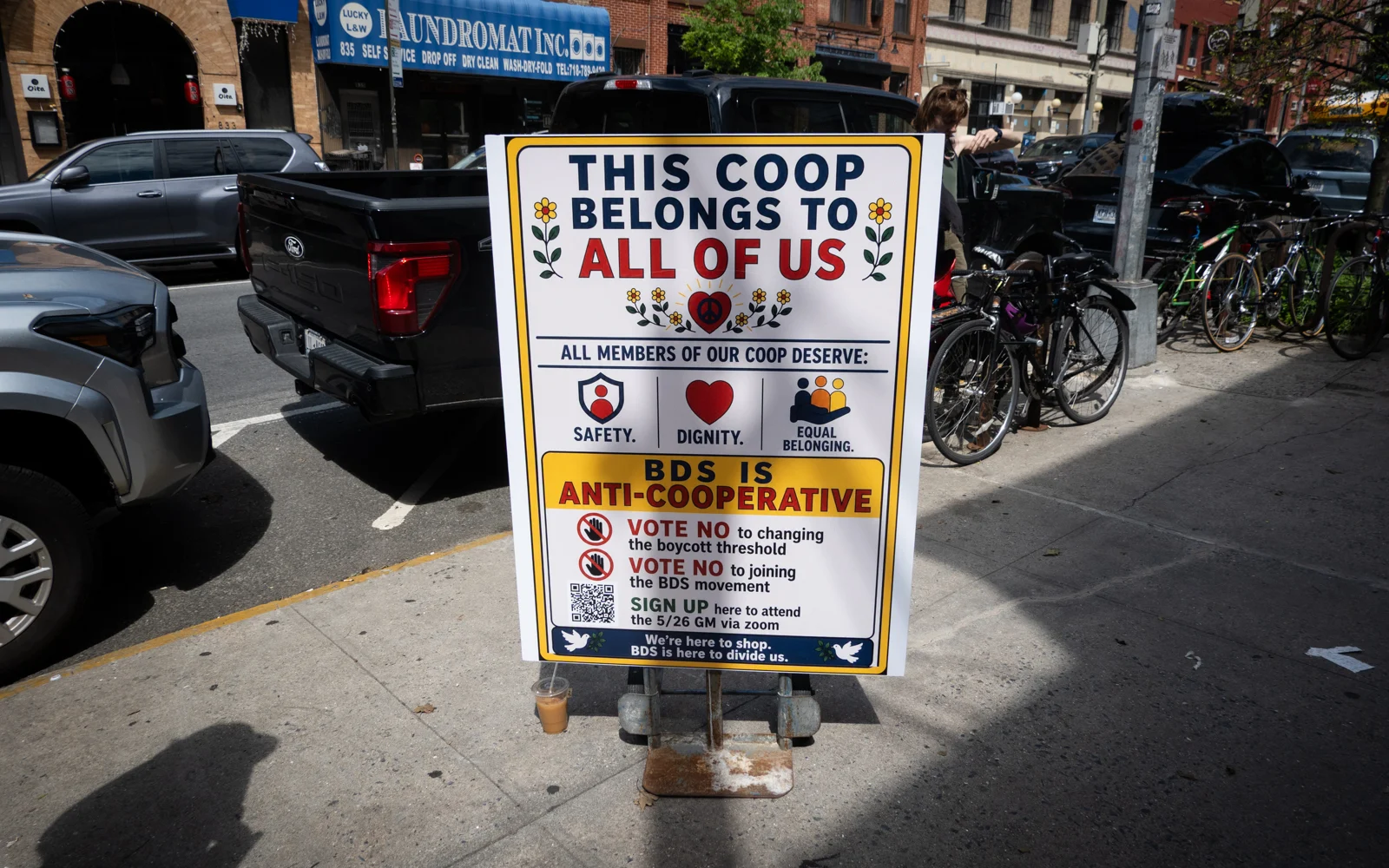
A sign for a campaign against an Israel boycott at the Park Slope Food Coop in Brooklyn, New York City, May 26, 2026. (Luke Tress/Times of Israel)
A sign for a campaign against an Israel boycott at the Park Slope Food Coop in Brooklyn, New York City, May 26, 2026. (Via Luke Tress/Times of Israel)

This is not an Onion article. I repeat. This is not an Onion satire piece. The Park Slope Food Coop in Brooklyn has voted to remove Israeli products from its shelves after years of pressure from BDS activists. What this means is that Israeli tahini, snacks, olive oil and frozen herbs were pulled almost immediately after the vote passed. The co-op has about 16000 members and of those that voted, more than half voted to boycott Israeli-sourced products. The co-op buys in bulk and offers members discounts to members with purchasing power and in exchange you need to work there for several hours a month. It’s been operating for about 50 years.

But the moral math here, as usual when it comes to Israel feels strangely selective. And when you read on you will see they boycotted an Israeli product once boycotted by Muslims for being “gay”. You can read that story here because we covered it.

Muhammad Zoabi, gay, Arab and a vegetarian. Don’t mess with his tehini.

The Coop still stocks products from countries such as Vietnam and Mexico, routinely accused of labor exploitation, child labor, environmental destruction and political repression. Where are the emergency votes over dragon fruit imported from Vietnam that use child labor? Where is the outrage over avocados or produce tied to cartel-controlled regions in Mexico? Goods linked to forced labor allegations in China? Why is the Israeli pepper suddenly the ethical breaking point in Brooklyn?

And what exactly is being boycotted here? Israelis? Zionists? Jews? Because one of the products reportedly targeted is tahini from Al Arz, an Israeli Arab-owned company. This is the same Israeli Arab-made tehini that was also boycotted by Muslims in Israel in 2020, for being “gay”, showing the hypocrisy of liberal activism eating itself. Al Arz is actually a minority-run business in Israel and the founder is Christian.

The Brooklyn Slope Coop boycotts a product made by a Christian minority in Israel boycotted by Muslims for being "gay"
The Brooklyn Slope Coop boycotts a product made by a Christian minority in Israel boycotted by Muslims for being “gay”

Related: tehini is a natual medicine, learn to make it here

The progressive movement once prided itself on nuance. On coexistence and on supporting minorities, workers and bridge-builders. Now even Arab Israelis making sesame paste can become collateral damage in ideological warfare.
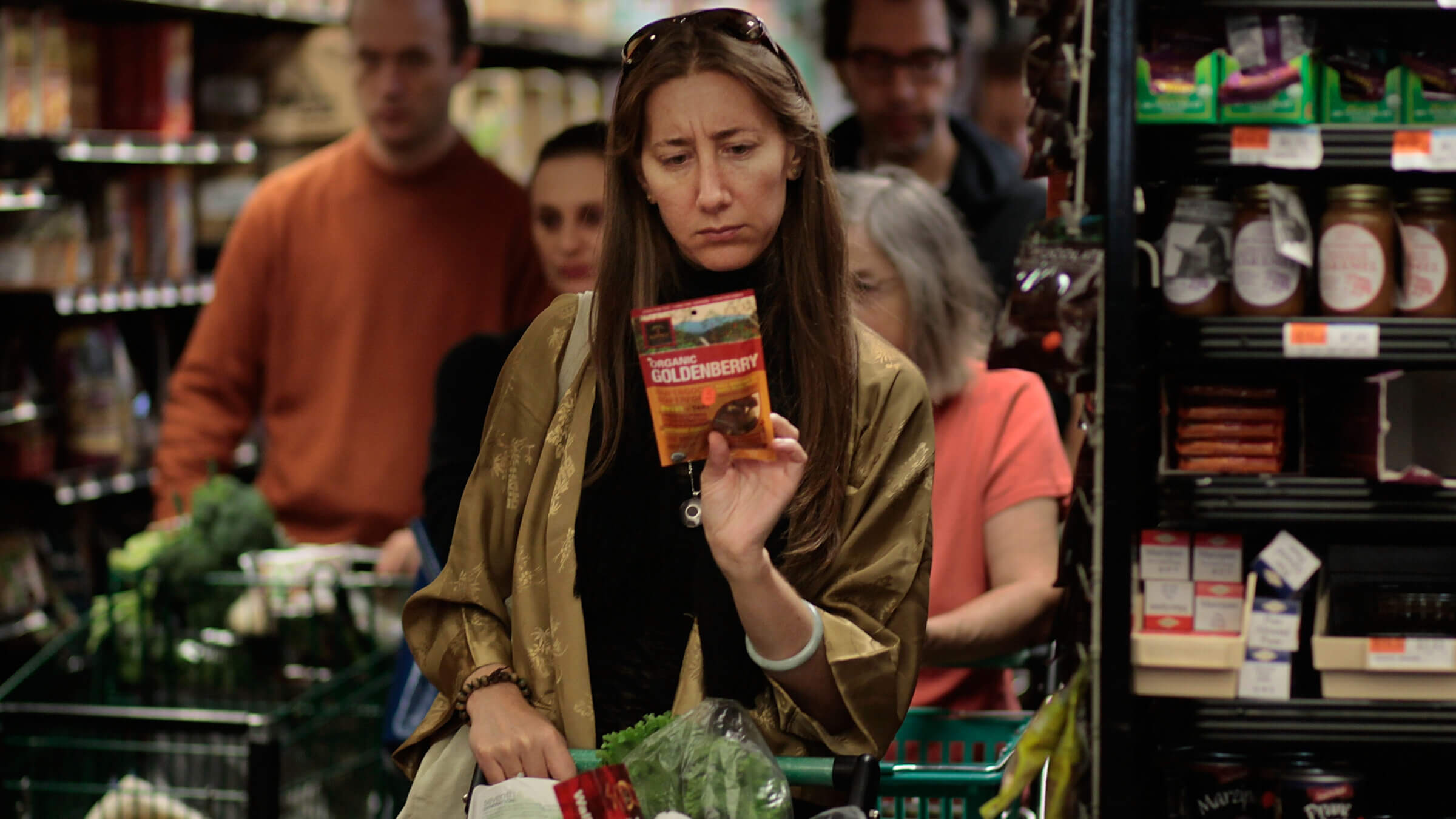
A woman carefully reading the label on a product at the Park Slope Food Coop. Photo by Getty Images

The Park Slope Coop says this is about human rights. Supporters compare it to past boycotts against apartheid South Africa and Pinochet-era Chile. But many Jewish and Israeli members inside the Coop say the atmosphere surrounding the campaign has become hostile, radicalized and frightening. Reports describe accusations of “Jewish supremacism,” intimidation claims, heavy security and members fearing retaliation for speaking openly.

When I spoke years ago with an Israeli in Brooklyn — then a member of the Coop and one of Israel’s and New York’s most respected jazz musicians (he lives in Brooklyn and owned a club there) — he described the Coop as a great place for all. His business, a nightclub, was later targeted with buckets of red paint because he is Israeli. New York has become increasingly hostile to Jews, and the Brooklyn Coop story is just another example of the hypocrisy.

This is the irony that liberals refuse to confront: the movement increasingly resembles the kind of purity politics it once warned against. Homes and businesses vandalized with red paint. Businesses singled out because they are Israeli. Public shaming campaigns and loyalty tests.

Some activists insist criticism of Israel is not antisemitism. Fair enough. Governments should be criticized but if so, then ALL governments.

But when the world’s only Jewish state is treated differently from every other nation on earth — when Israeli peppers are morally radioactive while products tied to far worse labor systems pass unnoticed through organic checkout lines, people must ask uncomfortable questions, especially when Jewish members say they no longer feel safe inside a liberal institution they helped build.

Interestingly, one reader pointed out, the Coop changed the rules of numbers required for voting the day before the boycott was sealed. He sent us this:

On May 26 the group decided to repeal the need for a supermajority of 75% to pass a vote, similar to quorum. The very next day the boycott was passed without a supermajority.
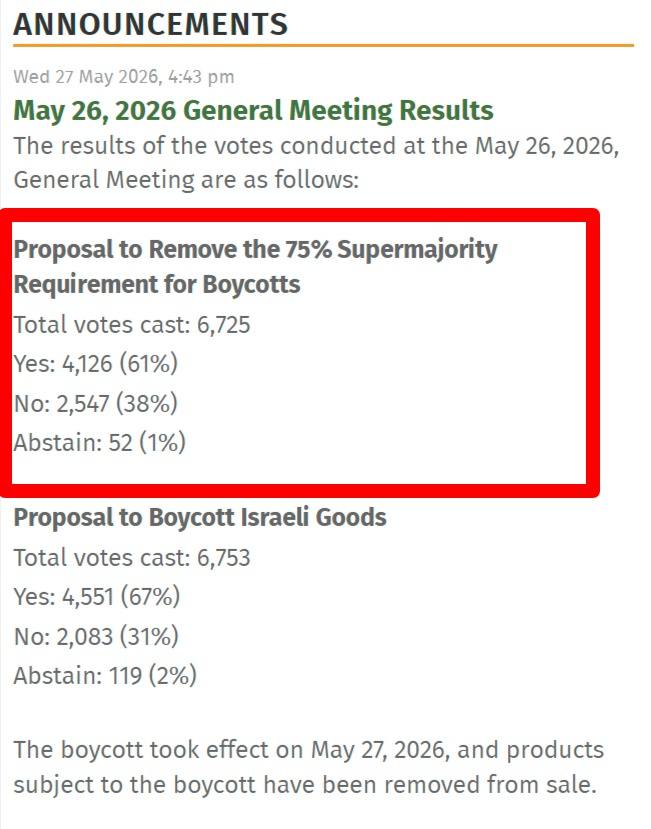
Rat finkery of changing the rules before the vote to win the vote


The tragedy is that this kind of activism rarely builds peace. It builds tribes instead of humanity. It rewards outrage over dialogue. Once an enlightenment group starts deciding which nationalities are acceptable to boycott publicly, history suggests the line rarely stops where activists think it will.

According to its mission statement, “We are committed to diversity and equality. We oppose discrimination in any form. We strive to make the Coop welcoming and accessible to all and to respect the opinions, needs and concerns of every member.”


Karin Kloosterman
Karin Kloostermanhttp://www.greenprophet.com
Karin Kloosterman is an award-winning journalist, innovation strategist, and founder of Green Prophet, one of the Middle East’s pioneering sustainability platforms. She has ranked in the Top 10 of Verizon innovation competitions, participated in NASA-linked challenges, and spoken worldwide on climate, food security, and future resilience. With an IoT technology patent, features in Canada’s National Post, and leadership inside teams building next-generation agricultural and planetary systems — including Mars-farming concepts — Karin operates at the intersection of storytelling, science, and systems change. She doesn’t report on the future – she helps design it. Reach out directly to [email protected]

Read More

TRENDING

HelloFresh’s pride prepping ad raises a bigger question: we are we still outsourcing dinner?

The backlash against HelloFresh's Pride Month marketing campaign has sparked a wider conversation about food, labor, sustainability, and whether consumers should reconnect with local farmers, butchers, and home gardens instead of relying on subscription meal kits.

A visit to Amirim, Israel’s first all-vegetarian village in the Galilee

Just 15 kilometers from Tzfat there is a moshav that was founded in the late 50s that was ideologically influenced by organic, vegetarian and vegan principles. My hostess at Ohn-Bar, the tzimmer where I stayed, explained that the people of Amirim were among the pioneers of Israel’s strong vegetarian movement.

Poop in the East River shows the city’s rat problem and what people like to eat

New York ecology and health can be monitored by a jug of water a week.

Plant trees in cities, for your heart

It seems like a no-brainer, but sometimes you need to give evidence to city councillors: A new multi-institutional study led by UC Davis Health suggests that not all green space is created equal. Living in urban neighborhoods with more visible trees is associated with a 4% lower incidence of cardiovascular disease, while areas dominated by grass or low shrubs may be linked to higher cardiovascular risk.

Stay at Michelberger in Berlin, your home base for the last cool city on earth

Berlin still feels like the last real city where you can just walk out the door and live without a schedule. Staying at Michelberger gave us a base in the middle of Friedrichshain’s raw energy – near RAW-Gelände, Skatehalle, Boxi and all the vegan food and alt shops you could want. From there, Berlin unfolds on foot, by tram, and without ever needing a tourist plan.

Yerukim Forms a New Green Economy Where the Money is Really Green

The Yerukim members who pick up the recyclables get to keep the monetary reward, the public earns "green" bills that can be used in shops, and business owners get to be associated with environmentalism.

Choosing Riyadh over Dubai? What Investors Should Know

Saudi Arabia is deploying capital at unmatched scale to catalyze tourism and advanced industry while rewiring its power-and-water backbone. The investable frontier is widening—especially in renewables, grid storage, water efficiency/desal retrofits, and hospitality operating platforms. Prudent investors will insist on phased delivery, enforceable KPIs (energy, water, biodiversity), and RHQ/zone compliance—while pricing political-economy and reputational risks alongside growth upside.

Sell your cooking oil for biodiesel money

Want to make money on old french fry oil? Sell it.

Qatar Alternative Energy Summit Pairs Investors And Innovators

Alternative energy investors and innovators can meet n' greet in Doha, Qatar March 16 and 17.

Here’s How To Implement The Four Pillars Of Employee Engagement

If you throw a party for your work team and they are vegans, don't make it a barbecue. Know the sustainability values of your team to boost moral and retain good people.

Locals From Rishon Fight IKEA

Big Box stores are a pretty new concept in Israel, and thank God that not every Israeli city wants them in their backyard. A word from someone who has see the beautiful farmland around her hometown Newmarket, Ontario stripped and converted into vulgar strip malls of big box shops: they have no place in a healthy and sustainable town or city.

The Jewish National Fund Meets An Inconvenient Truth

According to the JNF, it has transformed thousands of acres of barren land into green forests in Israel. They state that each person emits about 23 tons of carbon per year, estimating that each tree planted can absorb one ton of carbon in its lifetime. That's a whole lot of trees you'd need to be planting. Could so many fit in Israel?

How to quiet noise from construction in your office

Streets need to be resurfaced in New York but the humming and grinding noise is unsettling. Noise is environmental pollution. 

Popular Categories