
Swedish silk turns clothes into charging stations with your body heat

silk charge
Wear a dress from this silk and light up the room, literally

Imagine a sweater that powers electronics to monitor your health or charge your mobile phone while running. This development faces challenges because of the lack of materials that both conduct electricity stably and are well suited for textiles. Now a research group, led by Chalmers University of Technology in Sweden, presents an ordinary silk thread, coated with a conductive plastic material, that shows promising properties for turning textiles into electricity generators. Imagine a dress you are wearing that lights up the night – literally!

Textile materials with piezoelectric properties can be obtained in the form of yarns and filaments, woven fabric structures, knitted fabric
Textile materials with piezoelectric or thermoelectric properties can be obtained in the form of yarns and filaments, woven fabric structures, knitted fabrics.

Thermoelectric textiles convert temperature differences, for example between our bodies and the surrounding air, into an electrical potential. This technology can be of great benefit in our everyday lives and in society. Connected to a sensor, the textiles can power these devices without the need for batteries. These sensors can be used to monitor our movements or measure our heartbeat.
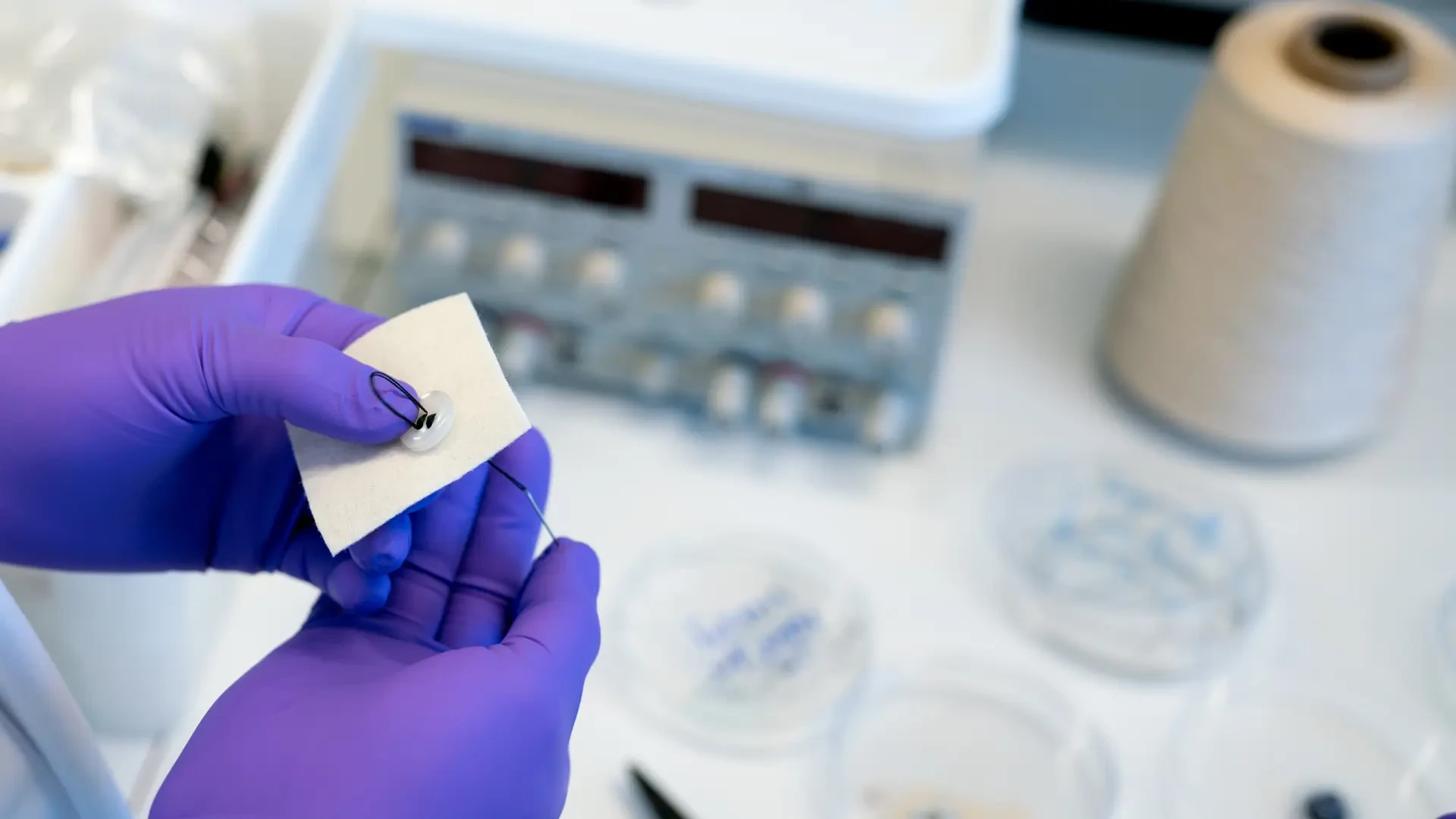

Since the textiles must be worn close to the body, the materials used in them must meet high demands on safety and flexibility. The silk thread that the researchers tested has a coating made of a conducting polymer. It is a plastic material with a chemical structure that makes the material electrically conductive and well adapted to textiles.

“The polymers that we use are bendable, lightweight and are easy to use in both liquid and solid form. They are also non-toxic,” says Mariavittoria Craighero, who is a doctoral student at the Department of Chemistry and Chemical Engineering at Chalmers University of Technology, and first author of a recently published study.

Enhanced stability and conductivity

The method used to make the electrically conductive thread is the same as used in previous studies within the same research project.  Previously, the thread contained metals to maintain its stability in contact with air. Since then, advances have been made to manufacture the thread with only organic (carbon-based) polymers. In the current study, the researchers have developed a new type of thread with enhanced electrical conductivity and stability.

Related: Thermoelectric ink changes on this stamp

“We found the missing piece of the puzzle to make an optimal thread – a type of polymer that had recently been discovered. It has outstanding performance stability in contact with air, while at the same time having a very good ability to conduct electricity. By using polymers, we don’t need any rare earth metals, which are common in electronics,” says Mariavittoria Craighero.

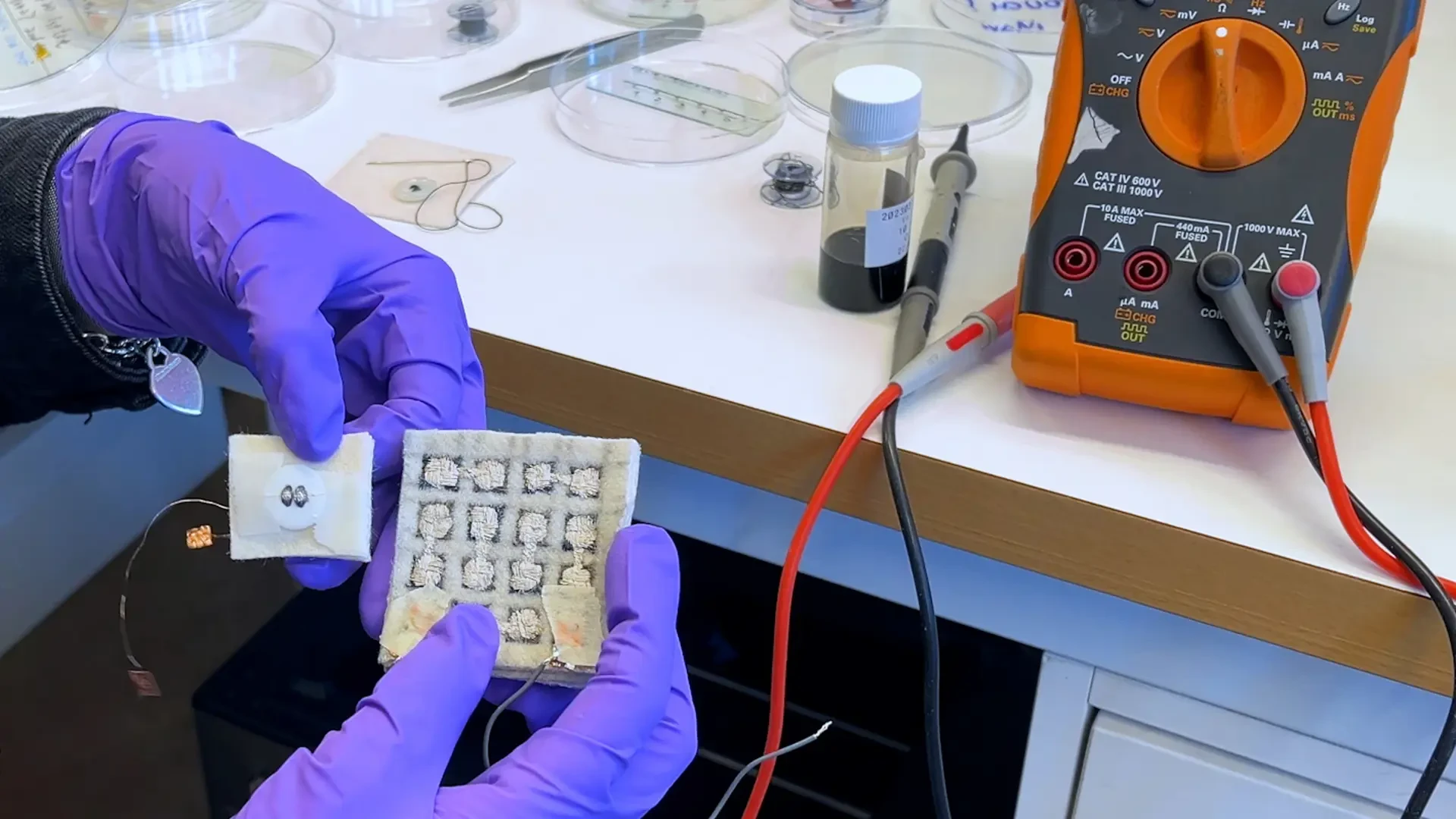
To show how the new thread can be used in practice, the researchers manufactured two thermoelectric generators – a button sewn with the thread, and a piece of textile with sewn-in threads. When they placed the thermoelectric textiles between a hot and a cold surface, they could observe how the voltage increased on the measuring instrument.

The effect depended on the temperature difference and the amount of conductive material in the textile.  As an example, the larger piece of fabric showed about 6 millivolts at a temperature difference of 30 degrees Celsius. In combination with a voltage converter, it could theoretically be used to charge portable electronics via a USB connector.  The researchers have also been able to show that the thread’s performance is maintained for at least a year. It is also machine washable.
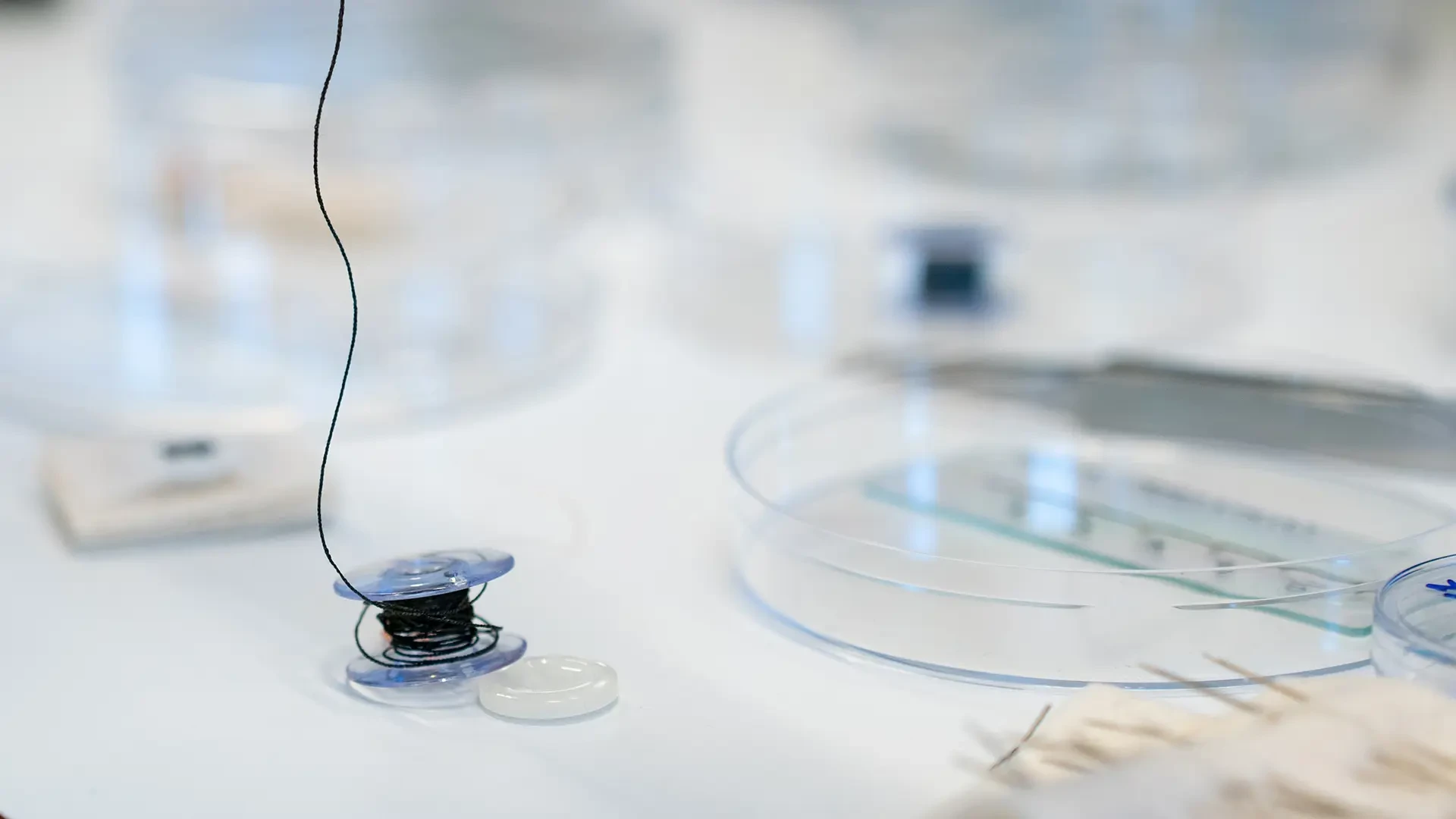
“After seven washes, the thread retained two-thirds of its conducting properties. This is a very good result, although it needs to be improved significantly before it becomes commercially interesting,” says Mariavittoria Craighero.

Can meet functions that these textiles require

The thermoelectric fabric and button cannot be produced efficiently outside the lab environment today. The material must be made and sewn in by hand, which is time-consuming. Just sewing it into the demonstrated fabric required four days of needlework. But the researchers see that the new thread has great potential and that it would be possible to develop an automated process and scale up.
silk changes charge

“We have now shown that it is possible to produce conductive organic materials that can meet the functions and properties that these textiles require. This is an important step forward. There are fantastic opportunities in thermoelectric textiles and this research can be of great benefit to society,” says Christian Müller, Professor at the Department of Chemistry and Chemical Engineering at Chalmers University of Technology and research leader of the study.


Read More

TRENDING

Data centers in Space? Sophia Space and Apex plan on busing them in

Can data centers really be built in space? Pasadena-based Sophia Space is partnering with Apex to test the idea by launching modular AI computing systems into low Earth orbit in 2027. Using radiation-hardened compute TILEs cooled by passive radiative systems and mounted on scalable satellite buses, the companies aim to prove that edge computing can operate reliably in space. While challenges remain, the project represents an important step toward distributed orbital computing networks that could support everything from climate monitoring and pollution tracking to autonomous spacecraft navigation in an increasingly crowded orbital environment.

Wave wind energy for Nvidia’s next AI energy boom?

As AI factories consume unprecedented amounts of electricity, NVIDIA is looking beyond chips and data centers to the ocean. The company recently spotlighted Israel's Eco Wave Power and its wave energy projects in Jaffa and Los Angeles, highlighting how AI, digital twins and renewable energy can work together to meet future power demands. The collaboration reflects a growing realization that the future of artificial intelligence may depend as much on clean energy infrastructure as it does on computing power.

Can a one trillion-Dollar SpaceX IPO change life on earth?

A SpaceX IPO could become one of the most consequential financial events of the century, creating thousands of millionaires and fueling investment across the New Space economy. From orbital robotics and African space programs to launch infrastructure and satellite networks, the ripple effects may extend far beyond Earth—while forcing investors to reconsider whether generative AI remains the most compelling technology bet of the decade.

Anthropic, Google and Stripe put nearly $1 Billion on carbon removal

A coalition led by Frontier, backed by Stripe, Google, Salesforce and newly joined AI company Anthropic, has committed an additional $915 million to remove carbon dioxide from the atmosphere. The pledge adds to a previous $1 billion commitment and brings Frontier's total buying power to nearly $2 billion.

Who Owns the Farm Robot? A State of Jefferson Startup Takes on Carbon Robotics

In California's self-proclaimed State of Jefferson, a small agricultural technology company is challenging the dominant laser-weeding business model. Laudando & Associates believes farmers should own and repair their AI-powered weeding tools rather than pay ongoing subscription fees. The approach has put the company on a collision course with industry leader Carbon Robotics, sparking a patent dispute that has pushed the Jefferson startup toward overseas markets while raising broader questions about ownership, right-to-repair, and the future of farm automation.

Yerukim Forms a New Green Economy Where the Money is Really Green

The Yerukim members who pick up the recyclables get to keep the monetary reward, the public earns "green" bills that can be used in shops, and business owners get to be associated with environmentalism.

Choosing Riyadh over Dubai? What Investors Should Know

Saudi Arabia is deploying capital at unmatched scale to catalyze tourism and advanced industry while rewiring its power-and-water backbone. The investable frontier is widening—especially in renewables, grid storage, water efficiency/desal retrofits, and hospitality operating platforms. Prudent investors will insist on phased delivery, enforceable KPIs (energy, water, biodiversity), and RHQ/zone compliance—while pricing political-economy and reputational risks alongside growth upside.

Sell your cooking oil for biodiesel money

Want to make money on old french fry oil? Sell it.

Qatar Alternative Energy Summit Pairs Investors And Innovators

Alternative energy investors and innovators can meet n' greet in Doha, Qatar March 16 and 17.

Here’s How To Implement The Four Pillars Of Employee Engagement

If you throw a party for your work team and they are vegans, don't make it a barbecue. Know the sustainability values of your team to boost moral and retain good people.

Locals From Rishon Fight IKEA

Big Box stores are a pretty new concept in Israel, and thank God that not every Israeli city wants them in their backyard. A word from someone who has see the beautiful farmland around her hometown Newmarket, Ontario stripped and converted into vulgar strip malls of big box shops: they have no place in a healthy and sustainable town or city.

The Jewish National Fund Meets An Inconvenient Truth

According to the JNF, it has transformed thousands of acres of barren land into green forests in Israel. They state that each person emits about 23 tons of carbon per year, estimating that each tree planted can absorb one ton of carbon in its lifetime. That's a whole lot of trees you'd need to be planting. Could so many fit in Israel?

How to quiet noise from construction in your office

Streets need to be resurfaced in New York but the humming and grinding noise is unsettling. Noise is environmental pollution. 

Popular Categories