

Travelling to any city, even your own city for a day, at some point you’ll need to ask, where can I go? Cities haven’t yet solved clean, sustainable ways for us to pee when out in public, so when you go to cities like Tel Aviv you will see “wild peeing” men urinating all over the place. Moms and dads hold their children’s bottoms, often in plain view, in the air beside a tree. And you know what happened to the Italian in Bread and Chocolate who desperately wanted to be Swiss but was found peeing in public?
Peeing in public is humiliating for the person who needs to go, and it’s not good for our cities and parks that shouldn’t become a public toilet.
If companies from Israel like Waze have solved traffic, some startup somewhere must be able to solve the problem of the clean, sustainable public toilet which remains hard to find and when we do, an unpleasant experience.
How can we make public toilets more sustainable and accessible? How can public washrooms in cities make us feel safe, clean and honored? Can we add urinals to trees? Use compost toilets? We have a traditional answer from NYC: just make it elevated and clean; and some interesting solutions from Holland. We asked and Green Prophet readers replied.
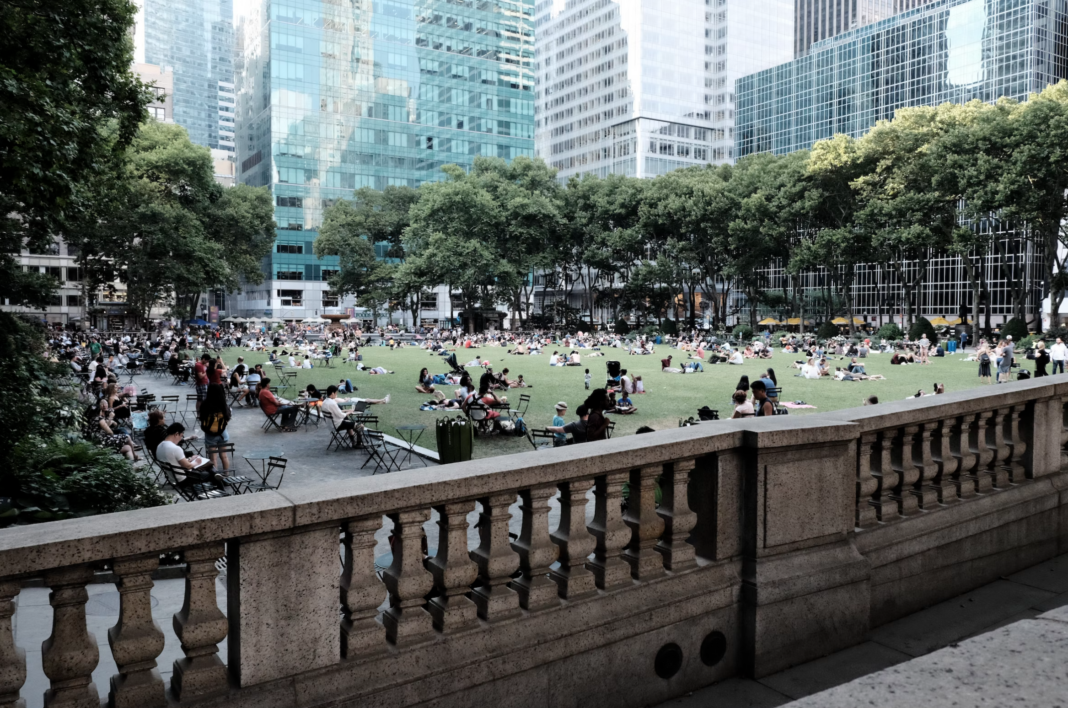
John Goodman from John Goodman PR, who represents the PR office of Bryant Park, NYC tells Green Prophet that “one of the finest examples of a public urinal/bathroom in the country is the public rest room at Bryant Park in NYC. Conceived by Dan Biederman, Executive Director of the park, the public restrooms in this city park mirror those found in a five-star hotel. They are safe and continually cleaned and maintained,” he points out.

Funded by private donors the Bryant Park toilets contain two stalls for men and three for women who enjoy fresh flowers, paintings of the park made by artists-in-residence, and waiting bathroom attendants, with classical music in the background.

“What an important and perplexing problem. It is one that I have wrestling with for decades,” says environmental artist Pablo Solomon. “Sadly, we are poisoning our water supplies with drugs, hormones, chemicals from our urine. Most water treatment plants just cannot filter out all of the complex compounds which our bodies remove through urination.
“Living on a ranch, we have a septic system. Since our house is on a hill, we have developed a vertical filtering system for the fluids. This consists of about 20 vertical feet of alternating sand, gravel and clays using gravity. While not perfect, this works better than most alternatives.
“A workable alternative,” he says, and which is not going to work in public spaces “is to urinate in a pan or bucket (yes like was done for thousands of years) and then dump the urine in a place that might be
relatively okay, in pasture or yard/landscape areas–not a garden where you grow food. To kill the urine smell in the bucket in an environmentally friendly way is to put baking soda and add then add vinegar.”
Trond Nyland, Founder and CEO of Mattress Review tells us, “you’re exploring an important and interesting topic, and since I have ample experience living and traveling internationally, I’ve seen green urinals firsthand.
Nyland says that GreenPee has installed a good number of streetside urinal hemp planters in Amsterdam, and it has significantly reduced unrestrained public urinating and saved tons of water for drinking. Instead of producing more waste, the concept centers on the hemp and urine mixing inside to produce fertilizer for city parks and others.
A sustainable urinal for women
He also recommends the woman version, Lapee which “offers a female urinal option that’s touch-free, ideal in the time of COVID-19. All open-air urinals have much better ventilation, decreasing the risk of transmission of coronavirus. Touchless options will be best in the times of COVID-19, so designers should keep this in mind.”

But isn’t the idea of green urinals like in Amsterdam, a little bit too much, “out there” for Americans? No says Karen Condor, a writer: “America is a melting pot. US culture has been shaped by many other cultures from around the world, including Latin America, Africa, and Asia. We adopt and adapt to things that seem outrageous at first then become normalized. Just think of tattoos or bento boxes just a few decades ago.
She’s familiar Amsterdam’s GreenPee, “the planter-like, hemp-filled, sustainable urinals as an attempt to
offset the city’s ‘wild peeing’ hotspots which will one day be a normal sight in American cities, too. Now that people know how to guard against coronavirus through sanitizing their homes and cars, they have evolved into mobile sanitizing. And it’s easier to sanitize a small area than to worry about an entire public restroom.”
Condor notes that this sustainable “alternative is also easier for a city to operate than full public
restrooms. This will help straining city budgets trying to meet population increase and tourist demand for more public restroom facilities. Cities would not have to allocate as much space or as much money for these “green” urinals. And given the growing awareness about the environment, cities pursuing green alternatives will see an increase in this type of idea being welcomed.”
My travelling friend who spent years in India had a novel idea, probably an ancient one, for going pee in public. She’d wear a long skirt and billow it out, and as she sat down could quietly pee in place with no one even noticing. But that’s still putting pee out in the public space. And we don’t want that.
What are future sustainable designers to do? Look to the squat toilet of the Middle East for ideas. You will find them in Sinai and Syria. And while they are growing less common in countries like Thailand, you can still find them there too. Still curious about peeing in other cultures, Abdul Al Lily explains how to use a squat toilet in Saudi Arabia.
Having to go pee is not going to go away. But having our nature spots, and cities full of public urine makes everything around us feel like a toilet. Unless you are in a toilet in Bryant Park, you really don’t want that.
Tips for peeing in the wild (not on city streets)
It’s important to pee far from water sources (about 200 feet away) and about the same distance from trails and campsites to avoid impacting the natural environment. If you’re on a sloping incline, pee facing downhill so it flows away from you and not back down onto your feet.