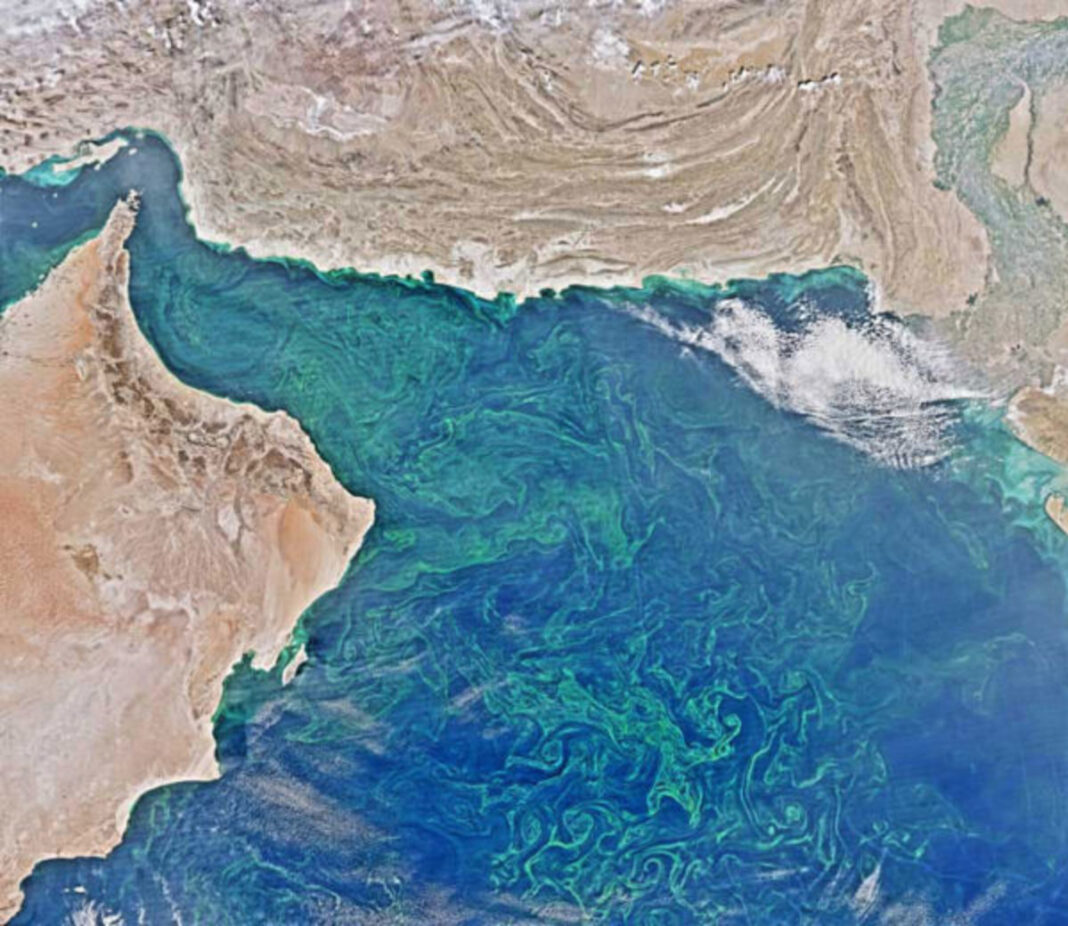
The Arabian Sea’s Deadzone is Bigger than Florida, and it keeps growing

arabian sea deadzone

New research from the University of East Anglia has confirmed a dramatic decrease in oxygen in the Gulf of Oman part of the Arabian Sea. But the environmental disaster is worse than expected.

The ‘dead zone’ was confirmed by underwater robots called Seagliders – which were able to collect data in areas of water previously inaccessible due to the piracy and geopolitical tensions.

The robots are about the same size as a small human diver, but can reach depths of 1000 yards and travel the ocean for months, covering thousands of miles.

dead zone arabian sea

Two gliders were deployed in the Gulf of Oman for eight months. They communicated by satellite to build an underwater picture of oxygen levels, and the ocean mechanics that transport oxygen from one area to another. Where they expected some oxygen, they found an area larger than Florida or the country of Scotland with almost no oxygen left.

The research was led by Dr Bastien Queste from UEA’s School of Environmental Sciences, in collaboration with Oman’s Sultan Qaboos University.

Dr Queste said: “Dead zones are areas devoid of oxygen. In the ocean, these are also known as ‘oxygen minimum zones’ and they are naturally occurring between 200 and 800 meters deep in some parts of the world.

Disaster waiting to happen

“They are a disaster waiting to happen – made worse by climate change, as warmer waters hold less oxygen, and by fertiliser and sewage running off the land into the seas.

“The Arabian Sea is the largest and thickest dead zone in the world. But until now, no-one really knew how bad the situation was because piracy and conflicts in the area have made it too dangerous to collect data.

“We barely have any data collected for almost half a century because of how difficult it is to send ships there,” he says.

Pirates and kidnapping make it nearly impossible for researchers to want to go out and venture there. Some do like this group EcoOcean who run an eco-ship.

“Our research shows that the situation is actually worse than feared – and that the area of dead zone is vast and growing. The ocean is suffocating.

“Of course all fish, marine plants and other animals need oxygen, so they can’t survive there. It’s a real environmental problem, with dire consequences for humans too who rely on the oceans for food and employment.

“Another problem is that when oxygen is absent, the chemical cycling of nitrogen – a key nutrient for plant growth – changes dramatically. Nitrous oxide, a greenhouse gas 300 times more potent than CO2 is produced,” he added.

Computer simulations of ocean oxygen show a decrease in oxygen over the next century and growing oxygen minimum zones. However these simulations have a difficult time representing small but very important features such as eddies which impact how oxygen is transported.

The team combined their Seaglider data with a very high-resolution computer simulation to determine how oxygen is spread around the north-western Arabian Sea throughout different seasons and the monsoons.

They found that the deadzone moves up and down between seasons, causing fish to be squeezed in a thin layer near the surface.

“Management of the fisheries and ecosystems of the western Indian Ocean over coming decades will depend on better understanding and forecasting of oxygen levels in key areas such as the Gulf of Oman,” added Dr Queste.

Bhok Thompson
Bhok Thompsonhttp://www.greenprophet.com
Bhok Thompson is an “eco-tinkerer” who thrives at the intersection of sustainability, business, and cutting-edge technology. With a background in mechanical engineering and a deep fascination with renewable energy, Bhok has dedicated his career to developing innovative solutions that bridge environmental consciousness with profitability. A frequent contributor to Green Prophet, Bhok writes about futuristic green tech, urban sustainability, and the latest trends in eco-friendly startups. His passion for engineering meets his love for business as he mentors young entrepreneurs looking to create scalable, impact-driven companies. Beyond his work, Bhok is an avid collector of vintage mechanical watches, believing they represent an era of precision and craftsmanship that modern technology often overlooks. Reach out: [email protected]

Read More

TRENDING

Hydrophilis Rebreather: After the Penis Jokes and Shark Bait Memes, Oliver Isler Says His Underwater Dream Is Serious

The Hydrophilis rebreather is a new scuba system that could make diving safer and more fun.

Seychelles resumes sooty tern egg collection despite population crash

Known as a biodiversity indicator species, local experts say it's too early to stop protecting these important birds in the Syechelles

Microplastics Are Becoming Superbug Highways — New Study Warns Beachgoers to Wear Gloves

Prof. Pennie Lindeque added that microplastics “act as carriers for antimicrobial-resistant bacteria, enhancing their survival and spread… each particle becomes a tiny vehicle capable of transporting pathogens from sewage works to beaches, swimming areas and shellfish-growing sites.”

Ocean Action Forum 2025: Can Saudi Arabia Redefine the Future of Marine Stewardship?

Saudi Arabia, a nation better known for its oil...

This fish can taste with its legs

This fish tastes with its legs: It’s “the weirdest, coolest fish I’d ever seen”, says developmental biologist David Kingsley.

Yerukim Forms a New Green Economy Where the Money is Really Green

The Yerukim members who pick up the recyclables get to keep the monetary reward, the public earns "green" bills that can be used in shops, and business owners get to be associated with environmentalism.

Choosing Riyadh over Dubai? What Investors Should Know

Saudi Arabia is deploying capital at unmatched scale to catalyze tourism and advanced industry while rewiring its power-and-water backbone. The investable frontier is widening—especially in renewables, grid storage, water efficiency/desal retrofits, and hospitality operating platforms. Prudent investors will insist on phased delivery, enforceable KPIs (energy, water, biodiversity), and RHQ/zone compliance—while pricing political-economy and reputational risks alongside growth upside.

Sell your cooking oil for biodiesel money

Want to make money on old french fry oil? Sell it.

Qatar Alternative Energy Summit Pairs Investors And Innovators

Alternative energy investors and innovators can meet n' greet in Doha, Qatar March 16 and 17.

Here’s How To Implement The Four Pillars Of Employee Engagement

If you throw a party for your work team and they are vegans, don't make it a barbecue. Know the sustainability values of your team to boost moral and retain good people.

Locals From Rishon Fight IKEA

Big Box stores are a pretty new concept in Israel, and thank God that not every Israeli city wants them in their backyard. A word from someone who has see the beautiful farmland around her hometown Newmarket, Ontario stripped and converted into vulgar strip malls of big box shops: they have no place in a healthy and sustainable town or city.

The Jewish National Fund Meets An Inconvenient Truth

According to the JNF, it has transformed thousands of acres of barren land into green forests in Israel. They state that each person emits about 23 tons of carbon per year, estimating that each tree planted can absorb one ton of carbon in its lifetime. That's a whole lot of trees you'd need to be planting. Could so many fit in Israel?

How to quiet noise from construction in your office

Streets need to be resurfaced in New York but the humming and grinding noise is unsettling. Noise is environmental pollution. 

Popular Categories