
Lebanon’s Bees are Freezing to Death

bees, honey, agriculture, colony collapse disorder, farming, Lebanon, winter, extreme weatherHuge bee die offs do not bode well for agriculture in Lebanon

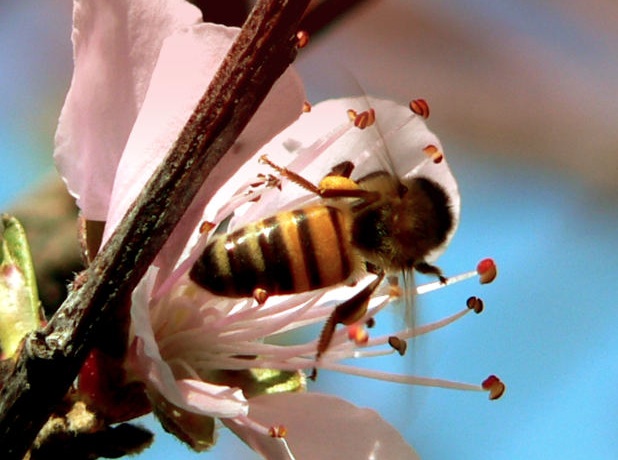
A staggering proportion of bees in an important agricultural hub have frozen to death in Lebanon. A recent influx of extreme weather that produced ice and frost combined with a series of diseases has wiped out up to 75% of the bees in Hasbaya and Arqoub, according to The Daily Star. As pollinators, bees are essential to the agricultural industry, which accounts for approximately 7% of Lebanon’s GDP and employs up to 15% of the country’s population.

“Severe weather conditions restricted bees’ movement without us being able to rescue them, which ultimately led to their death,”

Sheikh Tarek Abu Faour of the Beekeepers Association of south Lebanon told the paper.

Fed by the Hasbani river, the hills of Wadi El Taym – of which Hasbaya is the capital – “are covered with rows of silver-green olive trees, its most important source of income. Villagers also produce honey, grapes, figs, prickly pears, pine nuts and other fruit,” according to a Wikipedia entry.

The third most important industry in Lebanon, agriculture will be seriously affected by this sweeping loss which compounds the international impact of Colony Collapse Disorder that was reported by Lebanon Now in 2010.

Previously thought to occur only in Europe and North America with potential cases in Taiwan and Ireland, CCD is a phenomenon in which worker bees suddenly abandon their hives en masse, literally collapsing the colony.

Some scientists have pointed to climate change and even cellular phone use as the leading causes. Others attribute CCD to an influx in insect diseases.

“Dr. Rami Ollaik, professor in the American University of Beirut’s Faculty of Agricultural and Food Sciences, conducted his own study on CCD and found a 30 to 35 percent decrease in bee populations nationwide this year,” according to Lebanon Now.

In an August 2010 beekeeping project, 100 hives out of 450 suddenly disappeared, the paper reports.

The Beekeepers Association claims that beekeepers are receiving assistance from the Agricultural Ministry to cope with the diseases affecting up to 6,000 hives in Hasbaya alone.

Without bees there are few pollinators left. Without pollination plants can’t proliferate. And without food, humans are pretty much toast.

:: The Daily Star

image via Morguefile

More on Bees:
Green Prophet Visits Beehive Going Back to Ancient Roots
Balyolu: Turkey’s First Honey Tasting Tour
Organic Honey or Mass-Produced – Which do You Buy?
Tafline Laylin
Tafline Laylinhttp://www.greenprophet.com
As a tour leader who led “eco-friendly” camping trips throughout North America, Tafline soon realized that she was instead leaving behind a trail of gas fumes, plastic bottles and Pringles. In fact, wherever she traveled – whether it was Viet Nam or South Africa or England – it became clear how inefficiently the mandate to re-think our consumer culture is reaching the general public. Born in Iran, raised in South Africa and the United States, she currently splits her time between Africa and the Middle East. Tafline can be reached at tafline (at) greenprophet (dot) com.

Read More

TRENDING

Who Owns the Farm Robot? A State of Jefferson Startup Takes on Carbon Robotics

In California's self-proclaimed State of Jefferson, a small agricultural technology company is challenging the dominant laser-weeding business model. Laudando & Associates believes farmers should own and repair their AI-powered weeding tools rather than pay ongoing subscription fees. The approach has put the company on a collision course with industry leader Carbon Robotics, sparking a patent dispute that has pushed the Jefferson startup toward overseas markets while raising broader questions about ownership, right-to-repair, and the future of farm automation.

Regenerative Wool or Greenwashing? Zentera Responds to Critics

Zentera responds to questions about ZQ wool, animal welfare, regenerative farming, ethical fashion and the fallout from PETA's New Zealand investigation.

Tanner Winterhof on the Custom Harvesters Quietly Holding American Agriculture Together

In late January, in a Des Moines hotel ballroom that smelled faintly of diesel and convention coffee, Tanner Winterhof spent three days hosting the members and attendees of the  U.S. Custom Harvesters Inc. annual convention on his podcast as Farm4Profit’s official media partner for the show.

Monitoring farmers’ tillage patterns from space

Tillage is one of the clearest signals of how a farm treats its soil. Intensive plowing can degrade structure, release carbon, and increase erosion. Conservation practices—no-till, cover cropping, minimal disturbance—do the opposite. They build soil, retain water, and support biodiversity. But until now, measuring these practices at scale has been slow, expensive, and often self-reported.

Jujube, the sidr tree of medicine and magic

A magic holy sidr bath to deflect the evil eye? It needs 7 powdered sidr leaves stirred into a bucket of warm water. The hadith of the Prophet Muhammad allows to repeat healing prayers and verses from the Koran to increase the water’s potency. 5 grams, or 1 tablespoon of sidr powder equals 7 leaves.

Yerukim Forms a New Green Economy Where the Money is Really Green

The Yerukim members who pick up the recyclables get to keep the monetary reward, the public earns "green" bills that can be used in shops, and business owners get to be associated with environmentalism.

Choosing Riyadh over Dubai? What Investors Should Know

Saudi Arabia is deploying capital at unmatched scale to catalyze tourism and advanced industry while rewiring its power-and-water backbone. The investable frontier is widening—especially in renewables, grid storage, water efficiency/desal retrofits, and hospitality operating platforms. Prudent investors will insist on phased delivery, enforceable KPIs (energy, water, biodiversity), and RHQ/zone compliance—while pricing political-economy and reputational risks alongside growth upside.

Sell your cooking oil for biodiesel money

Want to make money on old french fry oil? Sell it.

Qatar Alternative Energy Summit Pairs Investors And Innovators

Alternative energy investors and innovators can meet n' greet in Doha, Qatar March 16 and 17.

Here’s How To Implement The Four Pillars Of Employee Engagement

If you throw a party for your work team and they are vegans, don't make it a barbecue. Know the sustainability values of your team to boost moral and retain good people.

Locals From Rishon Fight IKEA

Big Box stores are a pretty new concept in Israel, and thank God that not every Israeli city wants them in their backyard. A word from someone who has see the beautiful farmland around her hometown Newmarket, Ontario stripped and converted into vulgar strip malls of big box shops: they have no place in a healthy and sustainable town or city.

The Jewish National Fund Meets An Inconvenient Truth

According to the JNF, it has transformed thousands of acres of barren land into green forests in Israel. They state that each person emits about 23 tons of carbon per year, estimating that each tree planted can absorb one ton of carbon in its lifetime. That's a whole lot of trees you'd need to be planting. Could so many fit in Israel?

How to quiet noise from construction in your office

Streets need to be resurfaced in New York but the humming and grinding noise is unsettling. Noise is environmental pollution. 

Popular Categories