
Afghanistan’s irrigation network gets an eco upgrade

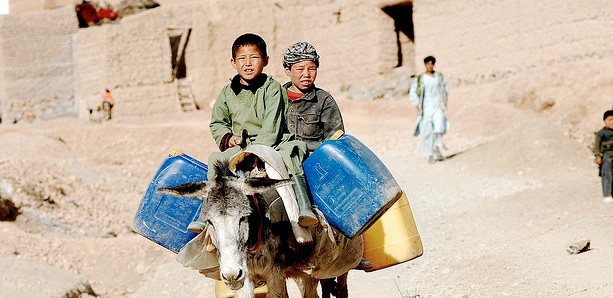
afghan boys carrying water on donkeyWorld Banks funds new irrigation project for Afghans.

The UN Food and Agriculture Organization is boosting its technical support for rehabilitation of Afghanistan‘s dilapidated traditional irrigation systems, in a bid to help farmers increase crop production. The initiative also aims to improve the knowledge and skills that farmers need to run and maintain irrigation systems.

The UN organization has signed a $27.7 million agreement with the Afghan Ministry of Energy and Water to provide technical assistance, including expertise and training for implementation of the Irrigation Restoration and Development Project (IRDP). This comes after decades of war in Afghanistan and migration away from rural areas have contributed to the degradation and neglect of the country’s irrigation system.

The lack of efficient irrigation facilities has left many farmers without sufficient water for agriculture, including the production of wheat, the country’s main staple food crop. But in recent years, the country’s Ministry of Energy and Water has placed a priority on water resources development within its National Development Strategy.

“The irrigation systems had suffered over the past three decades, not only because of a lack of investment, but also because people were moving away from the rural areas, leaving no one to maintain the systems or transfer indigenous skills to the younger generation. When there was a flood, for instance, there was no one to repair or clean up damaged canals or dams. So farmers in rural areas were not able to get enough water to cultivate their fields. As a result, they produced fewer crops,” said Pasquale Steduto, head of FAO’s Water Development and Management Unit.

The project is primarily funded by a grant from the World Bank with an additional contribution from the Government of Afghanistan. It builds on experience gained from FAO’s implementation of the Bank’s Emergency Irrigation Rehabilitation Project, which was completed in December 2011.

That emergency project strengthened the capacity of the Ministry’s Project Coordination Unit to plan and manage the rehabilitation of irrigation systems. The new six-year restoration and development project plans to follow up by designing and developing small storage dams, in addition to rehabilitating irrigation systems.

It will also complete development of hydro-meteorological networks and services to monitor weather conditions, water flow and water quality issues, and will include training in operation and maintenance of the networks.

Better irrigation, more crops

FAO will help the Ministry of Energy and Water by training personnel and assisting in the use of modern design and management methods. The initiative will also train farmers in improved water management practices, and operation and maintenance of irrigation systems.

The overall project objective is to increase agricultural productivity and production in the project areas, in line with the Afghanistan National Development Strategy.

The rehabilitation of irrigation schemes around the country are expected to cover a total irrigated area of about 300 000 ha, increase irrigated areas by about 15 percent, lead to an increase in the crop yield of around 20 percent, and benefit around 230 000 households.

“Wheat is the most important crop for Afghanistan because for 80-100 percent of the population, it is the number-one staple crop. And roughly 80 percent of the land which farmers cultivated is tilled for wheat. So any reduction in the production of wheat means a shortage of food. It directly affects the food security situation in Afghanistan,” said Steduto.

::FAO


Read More

LEAVE A REPLY

Please enter your comment!
Please enter your name here

TRENDING

Hormuz 2026 Conflict Poses an Energy and Food Security Dilemma in a Warming World

As tensions rise in one of the world’s most critical maritime chokepoints, the ripple effects go far beyond oil—touching food systems, climate pressures, and regional stability

Baby teeth read like tree rings paint a picture of toxins in early life

A new study from the Icahn School of Medicine at Mount Sinai in New York offers a striking insight into how the environments we are born into can quietly shape our brains years later. By analyzing naturally shed baby teeth, the ones tucked under pillows for the tooth fairy, researchers have reconstructed a detailed timeline of exposure to environmental metals during pregnancy and early infancy.

Poop in the East River shows the city’s rat problem and what people like to eat

New York ecology and health can be monitored by a jug of water a week.

Is your groundwater too young? New study finds risks for Parkinson’s and type of water you drink

People whose drinking water came from newer groundwater had a higher risk of developing Parkinson’s disease than those whose drinking water came from older groundwater, according to a preliminary study released March 2, 2026, that will be presented at the American Academy of Neurology’s 78th Annual Meeting taking place April 18–22, 2026, in Chicago and online.

The Saudi Startup Turning Desalination’s Toxic Waste Into Its Own Disinfectant

For millennia, the Middle East's water crisis seemed an immutable fact of geography — a region defined as much by what it lacked as by what lay beneath its sands. Today, a convergence of plummeting solar costs, advancing membrane technology, and hard-won engineering expertise is rewriting that story.

How to quiet noise from construction in your office

Streets need to be resurfaced in New York but the humming and grinding noise is unsettling. Noise is environmental pollution. 

EarthX and a blueprint for sustainable investing

Trammell S. Crow, a Dallas-based businessman and father of four, is focusing his efforts on impact investing, and media that focuses on saving the planet through EarthX.

Mining Afghanistan’s Mineral Discoveries Similar to Avatar

Now that American forces in Afghanistan are commemorating the longest period of any war that America has been involved in, including the 1965-73 Vietnam War, the recent discoveries of large and extremely valuable mineral and metal deposits may finally bring to light a reason to continue the presence of US fighting forces in this war torn and backward country.

From Pilot Plant to Global Stage: How Aduro Clean Technologies’ 2026 Expansion Signals a Turning Point for Chemical Recycling Investors Like Yazan Al Homsi

The company's Next Generation Process (NGP) Pilot Plant in London, Ontario, has officially moved into initial operating campaigns, generating the kind of structured, repeatable data that separates laboratory promise from commercial viability.

Nobul’s Regan McGee on Shareholder Value: “Complacency Is the Silent Killer” 

Why the governance framework designed to protect shareholders so...

Should You Invest in the Private Market?

startustartup Unlike public stock exchanges, which offer daily trading, strict...

How to build a 100-year-company

Kongō Gumi is a Japanese construction company, purportedly founded in 578 A.D., making it the world's oldest documented company. What can we learn about building sustainable businesses from them?

How AI Helps SaaS Companies Reduce Repetitive Customer Support Work

SaaS products are designed for large numbers of users with different levels of experience, and also in renewable energy.

Popular Categories