
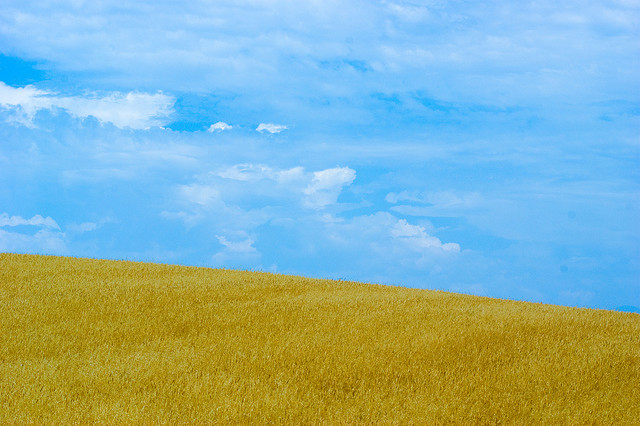

 Lacking sufficient water to grow enough wheat for its burgeoning population, Egypt (above pic of Suez Canal farm) looks to other Nile Basin countries for land and water.
During the heat of this year’s scorching summer, Russia’s wheat supply took a serious hit and the country scaled back its exports. One of their main wheat importers, Egypt lacks the water to provide what is a staple for its 80 million strong population. As the population inflates and water becomes even more scarce, Egypt hopes to make its wheat supply more self-sufficient.
After recently signing an agreement with Sudan to allow private Egyptian companies to grow various cereals there, the Egyptian authorities began eyeballing other Nile basin countries as potential sources of land and water for their agricultural pursuits. Meanwhile, fifty percent of the population living within the Nile basin live below the poverty line of $1 per day. Private Egyptian companies will grow food in the Al-Gezira Region south of Khartoum, while the Egyptian government’s role is limited to technical support, according to IRIN news.
The deal signed between Egypt and Sudan in September is part of what IRIN (the United Nations news source) calls “the land-grab phenomenon” that began to take shape in 2008 (and Green Prophet’s editor Karin wrote about it here – Africa Up For Sale?). This refers to various foreign countries that are cultivating crops in African countries to support their own populations.
Egypt’s population consumes approximately 14 million tons of wheat each year but is only capable of producing roughly 60% of that amount, according to the paper, but hopes to expand its self-sufficiency to 70% by 2017. In order to produce the requisite quantities to feed its population, Egypt will need 2.1 million hectares, compared to its current 1.26 million hectares.
“…in countries where governments depended on bread subsidies to prevent social unrest, declining wheat output and increasing prices could have serious ramifications,” FAO’s senior economist Abdolreza Abbassian told IRIN.
Meanwhile, experts caution against depending too much on African countries for water, especially since the Nile basin countries are already pushing back against Egypt’s historical hegemony of the Nile River.
“Any moves…might confirm the worst fears of decision-makers in Nile basin countries that Egypt is out to grab as much water as it can for itself. This is a real dilemma,” Abdel Salam Gomaa, a leading agricultural expert, told IRIN.
“These countries are so sensitive to any talk about their share of the water of the Nile, particularly when it comes to Egypt,” he added.
Given that several Nile Basin face their own food and water shortages because of poor management and environmental degradation, Egypt’s population should not take precedence over the local population.
:: IRIN News
More food news from the Middle East:
Interview: Buying Local in Dubai With Baker & Spice’s Yael Mejia
Americans and Israelis Headed for Widespread Obesity
Syngenta: Use GMOs To Boost Turkey’s Agricultural Sector
image of a Suez Canal farm via jgmorard

If Egypt had social planners with long term foresight spanning decades, it would be starting to plan moving most of the smaller towns and cities currently in the Nile Valley to the nearby desert wherever possible.
As it is now every bit of land that is gobbled up by urban sprawl is taken from the fertile land of the Nile Valley.
In the modern era there is no need for people to live on the shores of the River.
The climate is the same as the nearby desert.
They are there now due to historical reasons.
As the years have passed Egyptians have had less and less land to farm. This continuing trend is going to soon be coupled with loss of land in the Delta due to rising Sea levels.
Unfortunately Egypt doesn’t seem to be concerned about the rapidly increasing loss of arable land.
Dear sir/madam,
I would beg to differ with the subject of the above article,egypt has never and will never ‘Grab’ any land in any country,Egyptians are peace loving people,full of life,the population may be increasing by the day,but then again,Egypt is a blessed land with 2 seas,a river,rare tourisim,astronomical number of minerals,agriculture,,i can go on forever,but no t any enough space,so we really dont need any more land,we hv oceons of water under our deserts,or we can use appropriate tech to desalinate sea water,or we can just use pure sea water to farm,look at eretria ,or mexico,they practise seawater farming,ple be careful of such heading for your articles,as they can do a lot of damage between nations,thank you&god bless!