
 New studies looking at evolution sees nothing extra-ordinary about island communities.
The Middle East region, particularly around Egypt, Israel and Jordan out East to Iraq is known as the cradle of civilization. It is no wonder then that much evolutionary thinking and discoveries are made from this region. More whale bones (and a fossilized whale fetus!) were just found in Egypt, Tafline reports, and now, we have news on islands and evolution.
Long before TV’s campy Fantasy Island, the isolation of island communities has touched an exotic and magical core in us. Darwin’s fascination with the Galapagos island chain and the evolution of its plant and animal life is just one example. Think of the extensive lore surrounding island-bred creatures like Komodo dragons, dwarf elephants, and Hobbit-sized humans. Conventional wisdom has it that they — and a horde of monster-sized insects — are all products of island evolution.
But are they?
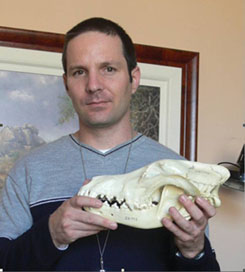 Dr. Shai Meiri (left) of Tel Aviv University’s Department of Zoology says “yes,” they are a product of evolution, but nothing more than one would expect to see by “chance,” citing research that shows there’s nothing extraordinary about evolutionary processes on islands. He and his colleagues have conducted a number of scientific studies comparing evolutionary patterns of island and mainland ecosystems, and the results refute the idea that islands operate under different, “magical” rules.
Man bites evolutionary dog
“My findings are a bit controversial for some evolutionary biologists,” says Dr. Meiri, the author of several papers and essays on island evolution. His research is based on statistical models he developed.
“There is a tendency to believe that big animals become very small on islands, and small animals become very big, due to limited resources or lack of competition. I’ve shown that this is just not true, at least not as a general rule. Evolution operates on islands no differently than anywhere else.”
In a recent study reported in Global Ecology and Biogeography, Dr. Meiri and his colleagues looked at a theoretical optimum body size towards which mammals are expected to grow, on both island communities and on the mainland.
“Contemporary evolutionary thinking maintains that smaller island mammals will rapidly grow larger towards the optimal size, while bigger animals will rapidly shrink due to the constraints of competition on the islands. The researchers found that island isolation per se does not really affect the evolutionary rate, the rates of diversification of species, or the rate at which body size shifts in populations of island and mainland animals.
Reality Island?
Employing their own statistical tools incorporating large data sets that compared body sizes on various islands and on mainland communities, Dr. Meiri and his colleagues found no such tendency for bizarrely-sized animals to develop on islands. “We concluded that the evolution of body sizes is as random with respect to ‘isolation’ as on the rest of the planet. This means that you can expect to find the same sort of patterns on islands and on the mainland.”
Dr. Meiri attributes our widely held misperceptions about “dragons and dwarfs” to the fact that people tend to notice the extremes more if they are found on islands.
The reason for science and mankind’s fascination with island communities could boil down to “better press,” says Dr. Meiri. If observers investigate human beings on 3,000 different South Pacific islands and all but one of the islands are populated by ordinary-sized people, they will tend to concentrate on the unique case. They forget about the other 2,999 islands in the South Pacific with normal-sized humans, and focus on the unusual.
“I think it’s purely a psychological bias,” Dr. Meiri concludes. “It’s just magical thinking. Nothing more.” Fantasies about island habitats and the animals that live there are best left for movies, TV shows, and fantasy novels, he adds.
::AFTAU
[image via balt-arts]