

 Israeli Bedouin go back to the green roots they’ve always had.
Sometimes, when an irresistible force meets an immovable object – like when the government decides to go through with a development plan in a certain area, despite the objections of local residents – you get a “big bang.”
But in Israel’s Negev desert, an organization with a unique project may just prevent that explosion. With Bustan, Raed Al-Mickawi and Alon Shepon seek to achieve social and environmental justice and sustainable community action through a compromise between the government’s urban modernity and the traditional farming society of the Bedouin.
Most of the time, the modern and traditional in Israel manage to peacefully co-exist. But in southern Israel, the Bedouin residents say government plans to build large residential neighborhoods with adjacent industrial zones and shopping districts on land they use for farming is something that needs resisting.
Modernity vs. traditional village life is certainly not an issue unique to Israel, and world history is full of stories of tension – and worse – that developed from such conflicts.
A precedent for the world
Bustan’s director Al-Mickawi is eager to set a new precedent: “If we can develop one village in a manner that will allow modernity and traditional village life to coexist, we will have built a model that can be duplicated around the Negev, and around the world,” he tells ISRAEL21c.
Bustan can and will accomplish that goal he asserts, starting with the building of an old/new, green community center to facilitate community organization.
The center is to be powered by solar energy – the height of modernity – while the structure itself will be made of mud, in the traditional Bedouin style.
The location for the pilot community center is the Bedouin village of Qasr al-Sir, which is legally recognized but as yet undeveloped. There is no electricity in the township (except in the local school), and only one street is paved (ditto).
The center is slated to be the HQ for community organization, a place where residents will be encouraged to talk to each other and to government representatives about their needs and both will be able to share their vision for the region. As Al-Mickawi sees it, communication is a large part of the problem – both with the government and within the community itself.
Government’s dream, residents’ nightmare
Most of the residents engage in some form of agricultural work, growing subsistence crops on lands in and around the village. The homes are mostly large tents or mud huts. While such conditions may sound shocking to some, folks in Qasr al-Sir are just living the way their ancestors have for hundreds, maybe thousands of years.
Anxious to bring modernity to the Negev and to turn it into a viable alternative to the crowded center of Israel, the government plan is to transform Qasr al-Sir into a gem of modernity, with homes, schools, parks and industry. It is to be a pilot model for other new communities in the region.
Since many of the residents won’t be qualified to work at the new factories or businesses, the government will offer training programs for the young, while the older members of the community, who stand to lose the money they earn from their agricultural work, are to be compensated by Israel’s National Insurance Institute.
Sounds like a dream – but according to Al-Mickawi, the residents see it as a nightmare. Their opposition and the government’s determination could lead to a “Negev standoff,” but Bustan hopes to intervene.
Mutual suspicion
“There is a generation gap in Bedouin society, between the youth who go to school and the village elders,” Al-Mickawi says. “In addition, on the government’s side there is suspicion of the motives of those who resist development, with many politicians believing that they really seek to resist the state, and set up a Bedouin autonomy in the Negev.”
“We’re trying to build a consensus among Bedouin and with the government, enabling both sides to come to a meeting of the minds and develop the village in a way that will be acceptable to both. Far from encouraging them to divorce themselves from the political process, our project will help a large population to integrate into a society it has often felt alienated from,” he declares.
Al-Mickawi has already spoken with several Knesset members, and in the coming weeks is to meet with several government ministers, in an effort to get them on board. So far, reaction to the plan – among Bedouin, politicians and the foreign donors and endowment funds who are backing the project – has been extremely positive.
Potential impact could be far-reaching
Bustan is well known in the Negev, particularly for its Children’s Power Project, which distributes solar-powered medical equipment to disabled children lacking access to the electricity necessary to power the equipment.
Al-Mickawi and Shepon see themselves as facilitators and hope that the future of Qasr al-Sir will be in the hands of its residents. However, as committed environmentalists, they both want to preserve the Negev’s ecological balance.
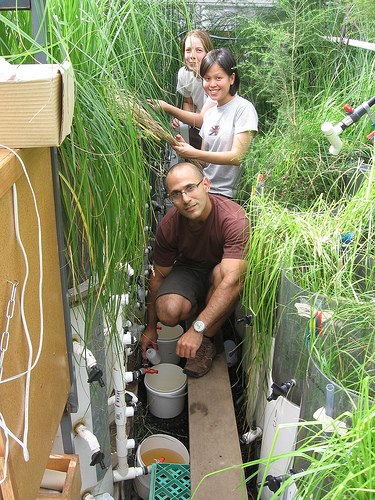
Shepon, for one, would be happy if the youth were to return in force to agriculture, using modern methods: “I’d like to see a self-sufficient agricultural unit which uses and reuses resources, married to traditional Bedouin techniques,” he says.
For example, suggests Shepon, instead of washing all their clothes by hand, as they do now, Bedouin housewives could have washing machines and use the resulting “gray water” for agricultural purposes, in much the same way as they use wash water today.
Al-Mickawi agrees: “I can see a situation where residents of a solid mud hut are watching a 50 inch TV hanging on their wall.”
“We’ve been in touch with other communities in the Negev, like kibbutzim, who have similar problems,” Al-Mickawi says. “We’re not necessarily interested in politics, but I see our success as having a large potential impact – on the Negev, and beyond.”
Like this story? Read more about Israel’s green Bedouin.
(This story was written by David Shamah and first appeared on ISRAEL21c – www.israel21c.org)


[…] Raed is the director of Bustan, an Israeli NGO working to promote self-determination and sustainability in the Bedouin communities of Israel’s Negev desert. […]
well well… good to see that BUSTAN is back in action after they seemed to have fallen off the edge for a while. best of luck and hope to see this project progress soon… an updated website would be great for those of us who are interested in where the NGO is headed!
.@greenprophet Bustan’s Mud Huts With Plasma Screens http://j.mp/32gGb6 http://www.jewpi.com