EcoBaladi Sprouts Organic Vegetables From the West Bank Valley of Thorns (Wadi Fuqin)

 abu-ibrahim organic eco-baladi farm west bank palestinian
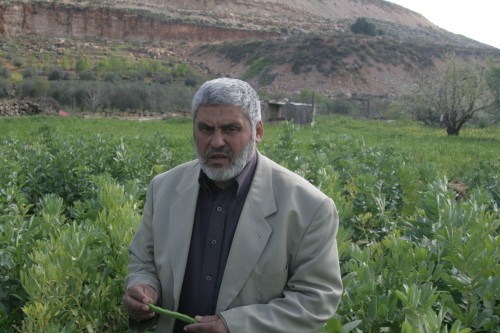
(Abu Ibrahim, 53, in a field of fava beans. Photo: Daniella Cheslow)

One of the most compelling parts of the West Bank is its Biblical landscape, shaped by the small villages and terraced farm plots that dot the rolling hillsides.

Yesterday, I saw that landscape up close on a visit to Wadi Fuqin (Valley of Thorns) a village of about 1,200 southwest of Jerusalem nestled in a valley under the brow of the apartment blocks of the neighboring Beitar Illit settlement. The 100 village farmers use old and new techniques to raise chemical-free vegetables for themselves, for Bethlehemites and for idealistic Jewish residents of neighboring Tzur Hadassah, Jerusalem and Tel Aviv through the EcoBaladi Web site.

Haaretz writer Ronit Vered recently waxed poetic about Wadi Fuqin here.

My host was Abu Ibrahim, 53, a school teacher who helps his 73-year-old father farm about 5 dunams (1.25 acres) on the valley floor. Abu Ibrahim has a wife and eight children. He speaks some English and bits and pieces of Hebrew. I got in touch with him through an Israeli woman who had ordered vegetables from him.


beitarfuqin abu-ibrahim organic eco-baladi farm west bank palestinian

Olive trees in Wadi Fuqin’s fields; Beitar Illit in the distance (all photos by Daniella Cheslow).

Getting to the valley requires either a private car, in which you can ride from Jerusalem out towards Gush Etziyon and Beitar Illit, or you can take a Palestinian bus from Jerusalem to either Bethlehem or Gilo Junction and from there, take a cab.

The village is small enough that on the ride in, my cab driver simply asked people where Abu Ibrahim lived. When we couldn’t find his house, the driver asked a village boy to jump in the car and help us out, and he happily obliged.

The homes in the built-up area of the village ascended a steep incline traversed by risky asphalt roads. The farmland, all in the flatter valley, was divided into tiny patches; green wheat grew on one and knee-high cabbages bloomed on a miniscule square.

The bright green tendrils of snow peas sprang up between the cabbages and the onions. Further afield were fava beans, and at the edge of another small square were the tall leaves of the beetroot. Olive and almond trees were mainly on the edges of the farmland.

I was interested in seeing the traditional ways of farming being used in the fields; while some plots were traversed by black drip irrigation pipes, others were dug to take advantage of the lay of the land. For example, there was a square, full water reservoir in the fields. At its base was a channel dug of earth. Water from the reservoir flows into the channel and onto the patch of cabbages.

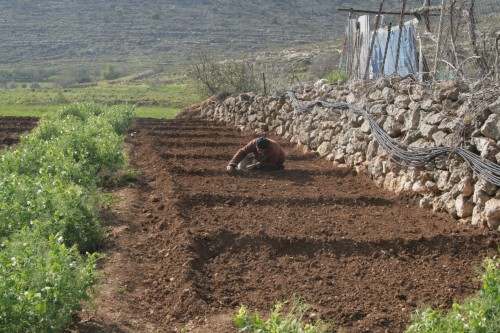
A little lower on the hill was a chain of square dirt plots separated by raised lines of earth; Abu Ibrahim said that as the top square fills with water, he breaks the barrier to let the water flow to the next one.

reservoir-channel1

The water reservoir; water flows out the hole at the bottom and down the earthen channel to the fields below.
onion terrace abu-ibrahim organic eco-baladi farm west bank palestinian

Abu Ibrahim’s father, 73,  planting onions in the beds that descend the hillside. Planting this way helps direct water from plot to plot, downhill.

Abu Ibrahim said that because the crops are first grown for local consumption, the farmers are careful not to use chemicals. He said this helps him command a premium in Bethlehem markets, and among Israelis. At the same time, there was a bottle of Spanish weed killer resting between the plots; he said that helped get rid of the weeds that grow so high that it is impossible to plow with his donkey.

abuibrahim abu-ibrahim organic eco-baladi farm west bank palestinian

Abu Ibrahim picking lemons from his backyard tree.

At his own home, Abu Ibrahim grows vegetables in a greenhouse and lemons on a few trees in the backyard. Under his and his family’s homes are a chicken coop; he said the chickens sleep indoors at night and peck around the backyard during the day. In another pen, goats and sheep bleated.

sheep abu-ibrahim organic eco-baladi farm west bank palestinian

One of Abu Ibrahim’s sheep.

Wadi Fuqin’s future is unsure. As I learned when I visited last year, the village is wedged between the Green Line on one side and Beitar Illit on the other. The villagers claim that sewage from Beitar Illit is contaminating the eleven springs that historically have provided for local water needs. The prospect of the security barrier being built is a constant presence; the Green Line runs right through the valley.

map abu-ibrahim organic eco-baladi farm west bank palestinian
Map of the area. Wadi Fuqin is southwest of Jerusalem, the brown smudge just north of the blue area of Beitar Illit. Map taken from Btselem.org.

If you are interested in ordering vegetables from Wadi Fuqin, check out www.EcoBaladi.com.

Daniella Cheslow
Daniella Cheslowhttp://www.greenprophet.com
Daniella Cheslow grew up in a car-dependent suburb in New Jersey, where she noticed strip malls and Wal-Marts slowly replacing farmland. Her introduction to nature came through hiking trips in Israel. As a counselor for a freshman backpacking program at Northwestern University, Daniella noticed that Americans outdoors seemed to need to arm themselves with performance clothing, specialized water bottles and sophisticated camping silverware. This made her think about how to interact with and enjoy nature simply. This year, Daniella is getting a Master’s in Geography from Ben Gurion University of the Negev. She also freelance writes, photographs and podcasts. In her free time, she takes day trips in the desert, drops off compost and cooks local foods like stuffed zucchini, kubbeh and majadara. Daniella gets her peak oil anxiety from James Howard Kunstler and her organic food dreams from Michael Pollan. Read more at her blog, TheTruthHerzl.com. Daniella can be reached at daniella (at) greenprophet (dot) com.

Read More

4 COMMENTS

TRENDING

A visit to Amirim, Israel’s first all-vegetarian village in the Galilee

Just 15 kilometers from Tzfat there is a moshav that was founded in the late 50s that was ideologically influenced by organic, vegetarian and vegan principles. My hostess at Ohn-Bar, the tzimmer where I stayed, explained that the people of Amirim were among the pioneers of Israel’s strong vegetarian movement.

Can Scientists Predict Coral Bleaching Before It Happens?

Now researchers at the Woods Hole Oceanographic Institution (WHOI) in the US say they have developed a way to predict coral bleaching five to six months before it occurs, potentially giving reef managers enough time to intervene and save vulnerable corals.

AC Water Uses: How to Reuse Air Conditioner Condensate Water for Plants, Cleaning and Water Conservation

That means the water dripping from your air conditioner may already be usable for gardening, cleaning, flushing toilets, topping up humidifiers, or cooling systems — instead of disappearing into the sewer. A new study. Is it safe?

Hormuz 2026 Conflict Poses an Energy and Food Security Dilemma in a Warming World

As tensions rise in one of the world’s most critical maritime chokepoints, the ripple effects go far beyond oil—touching food systems, climate pressures, and regional stability

Baby teeth read like tree rings paint a picture of toxins in early life

A new study from the Icahn School of Medicine at Mount Sinai in New York offers a striking insight into how the environments we are born into can quietly shape our brains years later. By analyzing naturally shed baby teeth, the ones tucked under pillows for the tooth fairy, researchers have reconstructed a detailed timeline of exposure to environmental metals during pregnancy and early infancy.

Locals From Rishon Fight IKEA

Big Box stores are a pretty new concept in Israel, and thank God that not every Israeli city wants them in their backyard. A word from someone who has see the beautiful farmland around her hometown Newmarket, Ontario stripped and converted into vulgar strip malls of big box shops: they have no place in a healthy and sustainable town or city.

The Jewish National Fund Meets An Inconvenient Truth

According to the JNF, it has transformed thousands of acres of barren land into green forests in Israel. They state that each person emits about 23 tons of carbon per year, estimating that each tree planted can absorb one ton of carbon in its lifetime. That's a whole lot of trees you'd need to be planting. Could so many fit in Israel?

How to quiet noise from construction in your office

Streets need to be resurfaced in New York but the humming and grinding noise is unsettling. Noise is environmental pollution. 

EarthX and a blueprint for sustainable investing

Trammell S. Crow, a Dallas-based businessman and father of four, is focusing his efforts on impact investing, and media that focuses on saving the planet through EarthX.

Mining Afghanistan’s Mineral Discoveries Similar to Avatar

Now that American forces in Afghanistan are commemorating the longest period of any war that America has been involved in, including the 1965-73 Vietnam War, the recent discoveries of large and extremely valuable mineral and metal deposits may finally bring to light a reason to continue the presence of US fighting forces in this war torn and backward country.

From Pilot Plant to Global Stage: How Aduro Clean Technologies’ 2026 Expansion Signals a Turning Point for Chemical Recycling Investors Like Yazan Al Homsi

The company's Next Generation Process (NGP) Pilot Plant in London, Ontario, has officially moved into initial operating campaigns, generating the kind of structured, repeatable data that separates laboratory promise from commercial viability.

Nobul’s Regan McGee on Shareholder Value: “Complacency Is the Silent Killer” 

Why the governance framework designed to protect shareholders so...

Should You Invest in the Private Market?

startustartup Unlike public stock exchanges, which offer daily trading, strict...

Popular Categories