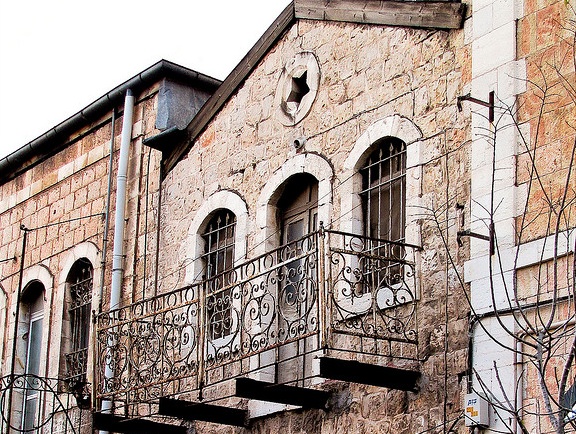

 We’ve heard about peak oil. Ilana asks about “peak Jerusalem stone” – and if it will ever be under threat.
My earliest memory of arriving in Jerusalem in 1993 is permeated with a sense of bewilderment. Coming from Queens, New York, everything was strange to me as I stared out the window of a car speeding from the airport – from the palm trees to the massive banner stretched across three buildings with an unintelligible slogan (in later months I’d discover it said, “The nation is with the Golan”).
But what stood out most to me was the beauty of the luminous stone buildings, so different from Queens architecture and seemingly so appropriate to all that the ancient holy city is and should be. Even now, after becoming jaded to the sight of Jerusalem stone, I feel a pang that is almost like pity when I visit other parts of the country and see that they – like Queens – have dull slabs for facades instead of the stone that makes Jerusalem unique.
But now that so much of our public discourse has turned to environmental concerns, it must be asked: Is quarrying Jerusalem stone sustainable or is it a resource that is finite in supply and will vanish due to our greed? Do we harm any ecosystems by mining for this stone? It feels almost heretical to ask these questions, since Jerusalem stone is such a vital source of Jerusalemite pride.
Investigating these questions led me to Ithamar Perath, retired geologist and lifelong Jerusalemite, whose special interest and field of research are the uses of building materials, particularly stone, in ancient Israel.
The answers, Perath makes clear, are rooted in thousands of years of quarrying for Jerusalem stone, a practice that has been taking place since the time of the earliest inhabitants of the city. The history and archeology of the city are closely tied with the quarrying of Jerusalem stone.
But first, to the business of the way we get our Jerusalem stone today. Quarrying generally is a mechanized process that takes place in the desert, and not just anyone can obtain permission to quarry the stone.
Rather, explains Perath, “You can’t get a quarry license if you don’t present a plan to mend the landscape – which means you have to do something with it, whether it’s to smooth the outlines of the quarry, make it into a playground, or build a swimming pool that can serve the community for recreation.”
Perath is dismissive of the idea of Jerusalem stone as an endangered resource, remarking, “Not in 10,000 years will we run out of Jerusalem stone.”
Though Jerusalemites think of it as unique, the stone is actually a very common substance, says Perath. “All the stone is limestone or dolomitic limestone, which are both marine deposits from about 90 million years ago when this whole area was sea bottom.”
As it turns out, we have the British Mandate to thank for the law that requires buildings in Jerusalem to be faced with Jerusalem stone. It instituted the law for aesthetic reasons, even though it would double building costs, and subsequently produced some very attractive buildings, the King David Hotel and the YMCA among them.
But while the British Mandate appreciated the aesthetic qualities of Jerusalem stone, using it as a building material was far from being their idea. The ancient Jerusalemites were accustomed to building their houses from the Jerusalem stone they had quarried within the city and used the hole that remained as a cistern to collect rainwater beneath the home. In this fashion, most quarrying in ancient Jerusalem took place underground and has therefore not left much of a mark on the landscape.
In fact, there are several ancient quarries around Jerusalem – the bus station in east Jerusalem is the site of an ancient quarry, as is Rehov Hamadregot Nahlaot. The Garden Tomb resembles Golgotha – loosely translated as “skull hill” and the site of the crucifixion – because it was in fact a quarry.
It was a sign of wealth in ancient Jerusalem that the city did not have to transport building materials from far away as most cities were forced to do. “A city is very lucky when it can quarry in its own yard,” Perath concludes.
“Jerusalem built itself from its own stones.”
Read more green news on Jerusalem:
Jerusalem’s Living Building Grows With the Seasons
An Unwelcome Colony of Parakeets Move Into Jerusalem
Jerusalem Exhibit Focuses on the Deep
Image via Flavio